










Tata Chemicals Industrial Essentials posts Rs 190 crore EBIT loss
Key highlights
- Tata Chemicals Industrial Essentials EBIT reversed from a Rs 147 crore H1FY26 profit to a Rs 190 crore H1FY27 loss.
- Tata Chemicals Industrial Essentials revenue rose Rs 365 crore year on year to Rs 4,502 crore in H1FY27.
- Tata Chemicals’ US unit EBITDA changed from Rs 264 crore in H1FY26 to a Rs 20 crore loss in H1FY27.
- Tata Chemicals Kenya soda ash volume fell to 109 thousand tonnes in H1FY27 from 120 thousand tonnes a year earlier.
powered by IRIS
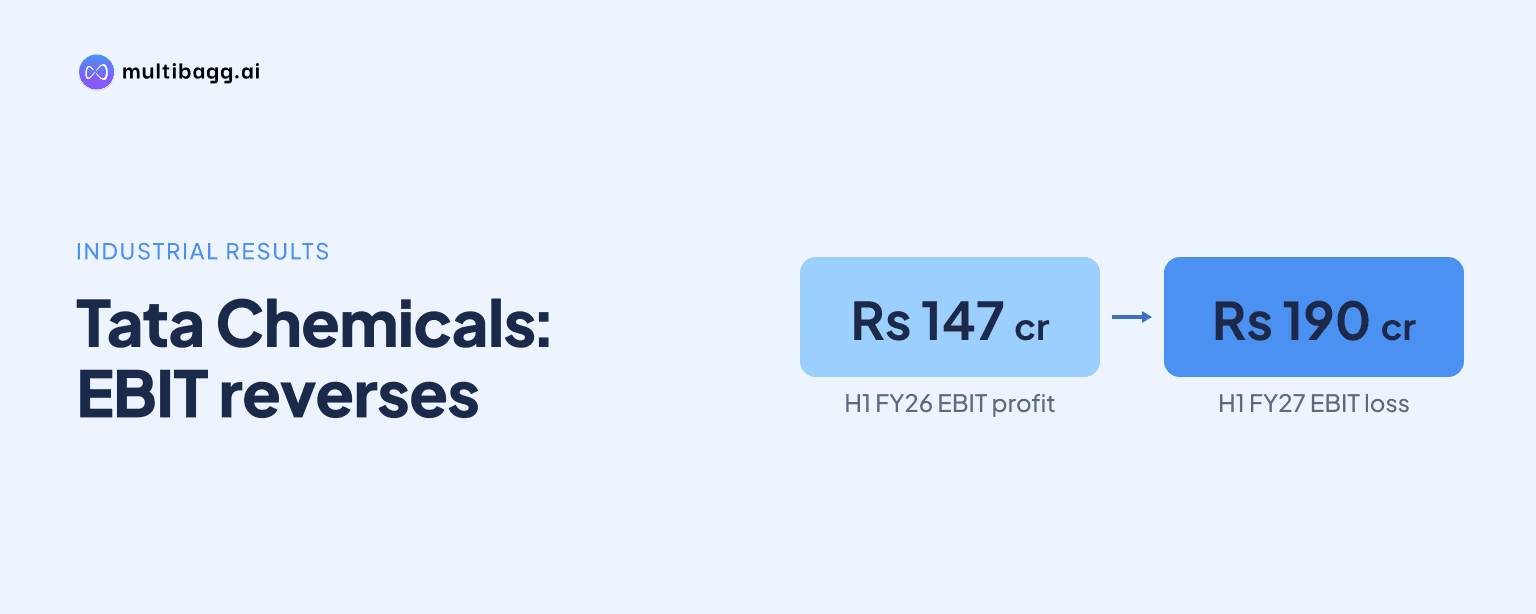
Tata Chemicals reported a Rs 190 crore Industrial Essentials earnings before interest and tax (EBIT) loss in H1FY27, reversing a Rs 147 crore profit in H1FY26, although segment revenue rose Rs 365 crore to Rs 4,502 crore. Higher US volumes did not offset lower US realisations, UK cost pressures and Kenya’s temporary suspension.
Know Tata Chemicals inside out
Results, valuation, peers and who's buying, in one view.
Why did Tata Chemicals Industrial Essentials move into a loss?
Tata Chemicals Industrial Essentials moved into a loss because higher sales did not offset pricing and cost pressures across overseas operations. EBIT fell Rs 337 crore year on year, from a Rs 147 crore profit in H1FY26 to a Rs 190 crore loss in H1FY27. The presentation defines segment EBIT as excluding finance costs and unallocated expenses or income.
The decline continued in the quarter ended 30 September 2026. Industrial Essentials revenue was Rs 2,262 crore in Q2FY27, above Rs 2,150 crore in Q2FY26 and Rs 2,240 crore in Q1FY27. However, Q2FY27 EBIT was a Rs 120 crore loss, compared with a Rs 16 crore profit a year earlier and a Rs 70 crore loss in the preceding quarter.
Industrial Essentials was Tata Chemicals’ largest reported segment by H1FY27 revenue, exceeding Living Essentials revenue of Rs 2,255 crore and Farm Essentials revenue of Rs 1,880 crore. It was also the only loss-making segment: Living Essentials EBIT increased to Rs 273 crore from Rs 259 crore, while Farm Essentials EBIT was unchanged at Rs 250 crore. Total segment EBIT consequently declined to Rs 333 crore from Rs 656 crore.
What happened to Tata Chemicals soda ash volumes?
Tata Chemicals’ soda ash sales volume increased by 84 thousand tonnes in H1FY27, but the growth came from the US while Kenya volumes fell. Total volume reached 1,735 thousand tonnes, compared with 1,651 thousand tonnes in H1FY26. US volume rose by 98 thousand tonnes to 1,239 thousand tonnes, while India volume declined by 3 thousand tonnes to 387 thousand tonnes.
Kenya partly offset the US increase as its H1FY27 soda ash volume fell to 109 thousand tonnes from 120 thousand tonnes a year earlier. Q2FY27 Kenya volume was 34 thousand tonnes, down from 58 thousand tonnes in Q2FY26 and 75 thousand tonnes in Q1FY27. Tata Chemicals said Kenya operations were temporarily suspended.
The Q2 comparison shows that larger US sales did not translate into higher group volume to the same extent. Total soda ash volume was 851 thousand tonnes in Q2FY27, only 2 thousand tonnes above Q2FY26, although US volume increased by 26 thousand tonnes to 625 thousand tonnes. Kenya volume fell by 24 thousand tonnes while India volume was unchanged at 192 thousand tonnes.
How did US, UK and Kenya operations affect Tata Chemicals earnings?
Tata Chemicals’ US unit recorded an EBITDA loss of Rs 20 crore in H1FY27, compared with EBITDA of Rs 264 crore in H1FY26, a Rs 284 crore reversal. EBITDA means earnings before interest, tax, depreciation and amortisation. US revenue still rose Rs 399 crore to Rs 2,889 crore, driven by higher volume.
Management attributed the US unit’s H1FY27 outcome to lower net realisations, higher input costs associated with geopolitical issues and the Middle East conflict, and higher fixed costs and depreciation mainly related to currency impact. In Q2FY27, the US unit reported revenue of Rs 1,492 crore, up from Rs 1,282 crore a year earlier, but EBITDA changed to a Rs 23 crore loss from Rs 77 crore profit.
The UK unit’s EBITDA declined to Rs 4 crore in H1FY27 from Rs 72 crore in H1FY26 despite revenue rising Rs 12 crore to Rs 786 crore. Management cited high input energy costs, logistics disruption from the prolonged Middle East conflict, and higher fixed costs and depreciation mainly due to currency impact. It also noted lower finance costs following debt repayment.
Kenya’s EBITDA changed from a Rs 35 crore profit in H1FY26 to a Rs 19 crore loss in H1FY27, while revenue declined Rs 47 crore to Rs 216 crore. Tata Chemicals directly linked the Kenyan impact to the temporary suspension. In Q2FY27, Kenya reported revenue of Rs 71 crore and an EBITDA loss of Rs 20 crore, against revenue of Rs 129 crore and EBITDA of Rs 18 crore in Q2FY26.
Got a follow-up? Ask IRIS
Which Tata Chemicals operations offset overseas pressures?
Tata Chemicals’ India unit partly offset overseas pressures, with H1FY27 EBITDA rising Rs 146 crore to Rs 656 crore on revenue growth of Rs 211 crore to Rs 2,584 crore. Management linked higher revenue to salt volumes and higher realisations across products, while noting higher input costs, lower other income and higher finance costs after overseas debt was refinanced through India.
Novabay-Singapore added Rs 117 crore of H1FY27 revenue following its acquisition effective 1 January 2026, but recorded an EBITDA loss of Rs 1 crore. Management said higher variable costs affected the operation because the Middle East crisis affected carbon dioxide availability and cost. The presentation provides no H1FY26 comparison because Novabay was acquired after that period.
Rallis reported H1FY27 EBITDA of Rs 311 crore, compared with Rs 306 crore in H1FY26, on revenue of Rs 1,880 crore against Rs 1,818 crore. Management said uneven rainfall and delayed sowing affected demand. The unit table represents Rallis at a 100% share, whereas Tata Chemicals’ consolidated figures adjust for Rallis India’s non-controlling interest.
What does Tata Chemicals’ wider financial picture show?
Tata Chemicals’ consolidated H1FY27 revenue increased Rs 836 crore to Rs 8,432 crore, while EBITDA decreased Rs 250 crore to Rs 936 crore. Profit before tax declined Rs 557 crore to Rs 104 crore and profit after tax fell Rs 525 crore to Rs 10 crore. The presentation cited higher India and US volumes and higher India realisations for revenue growth, while identifying lower US realisation, Kenya’s suspension and higher input and fixed costs as EBITDA pressures.
In Q2FY27, consolidated EBITDA was Rs 381 crore, down from Rs 537 crore in Q2FY26 and Rs 555 crore in Q1FY27. The consolidated EBITDA margin was 9%, compared with 14% a year earlier and 13% in the preceding quarter. Consolidated profit after tax was a Rs 50 crore loss in Q2FY27, compared with a Rs 219 crore profit in Q2FY26.
Standalone results moved differently from the consolidated outcome. Standalone H1FY27 revenue rose to Rs 2,584 crore from Rs 2,373 crore and EBITDA increased to Rs 656 crore from Rs 510 crore. Standalone profit before tax was unchanged at Rs 544 crore, while profit after tax declined to Rs 465 crore from Rs 485 crore.
Conclusion
Tata Chemicals’ H1FY27 Industrial Essentials result separated sales growth from profitability: segment revenue rose to Rs 4,502 crore, led by US soda ash volume, but EBIT reversed to a Rs 190 crore loss. The US EBITDA reversal of Rs 284 crore, the UK EBITDA decline of Rs 68 crore and Kenya’s Rs 19 crore EBITDA loss identify the overseas pressures disclosed in the presentation.
The next periods will show the effect of Tata Chemicals’ stated plan to improve operational performance, pursue debottlenecking and realise new capacities. Disclosed projects include a 40 thousand-tonne-per-annum bicarbonate plant in Singapore and an 85-tonnes-per-hour biomass boiler project at Mithapur that is progressing as planned, while US realisations, UK energy and logistics costs, and Kenya’s operating status remain unresolved factors.