










Tata Chemicals Limited H1 revenue up 11%, PAT falls to ₹10 crore
Key highlights
- Tata Chemicals’ H1FY27 consolidated revenue rose 11% to ₹8,432 crore from ₹7,596 crore.
- Tata Chemicals’ H1FY27 consolidated EBITDA fell 21% to ₹936 crore from ₹1,186 crore.
- Tata Chemicals’ H1FY27 consolidated PAT fell to ₹10 crore from ₹535 crore.
- Tata Chemicals sold 1,735 thousand tonnes of soda ash in H1FY27, up from 1,651 thousand tonnes.
powered by IRIS
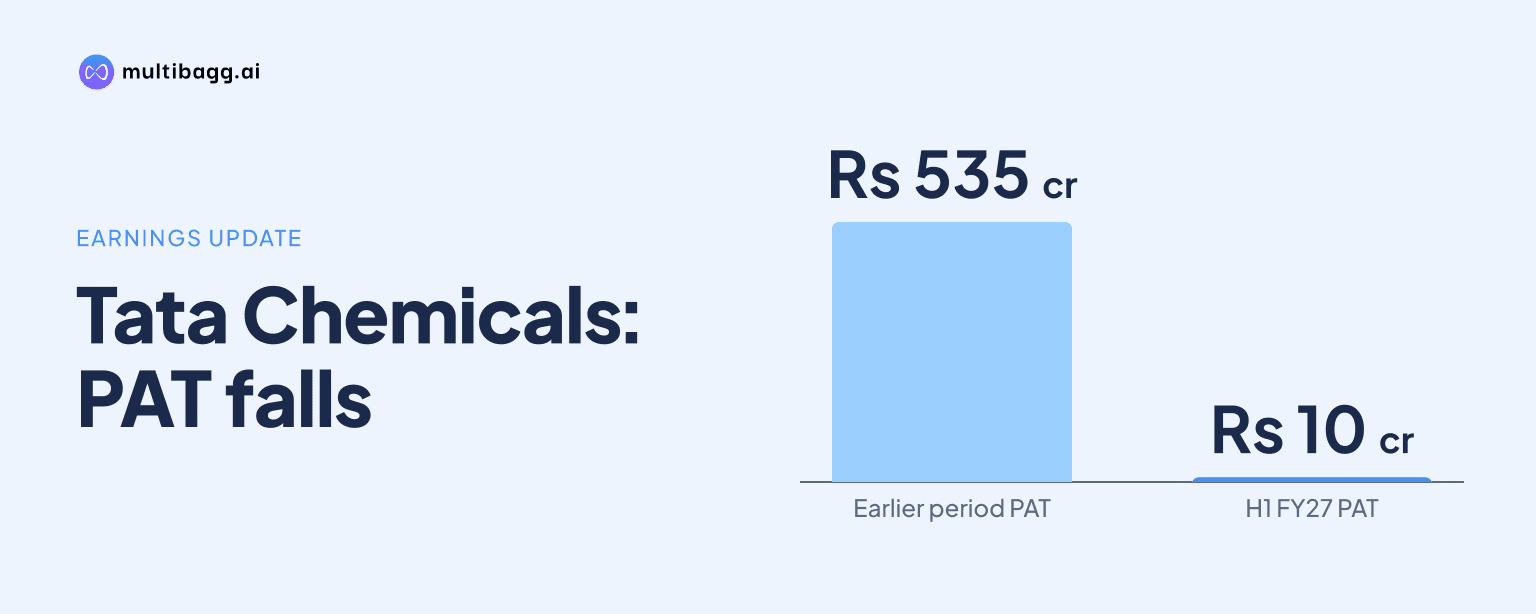
Tata Chemicals Limited reported H1FY27 consolidated profit after tax of ₹10 crore for the half year ended 30 September 2026, down from ₹535 crore in H1FY26, although revenue rose 11% to ₹8,432 crore. Tata Chemicals’ consolidated EBITDA fell 21% to ₹936 crore as lower realisations and higher input and fixed costs outweighed volume gains.
Know Tata Chemicals inside out
Results, valuation, peers and who's buying, in one view.
Why did Tata Chemicals’ H1FY27 profit fall?
Tata Chemicals’ H1FY27 profit fell because lower realisations and higher input and fixed costs reduced operating earnings despite higher sales volumes. Consolidated profit before tax declined to ₹104 crore from ₹661 crore in H1FY26, while profit after tax declined by ₹525 crore to ₹10 crore. The presentation defines profit before tax and profit after tax as continuing operations, before exceptional items, after share in joint ventures and associates, and before non-controlling interests.
EBITDA, or earnings before interest, tax, depreciation and amortisation, fell by ₹250 crore to ₹936 crore from ₹1,186 crore. Tata Chemicals’ half-year EBITDA bridge shows that volume and mix added ₹192 crore, but price reduced EBITDA by ₹237 crore and fixed costs reduced it by a further ₹205 crore. In this bridge, price includes cost, foreign exchange and other items.
The second quarter showed a sharper earnings decline. Q2FY27 consolidated revenue increased to ₹4,177 crore from ₹3,877 crore in Q2FY26, but EBITDA declined to ₹381 crore from ₹537 crore. Tata Chemicals reported a Q2FY27 loss after tax of ₹50 crore, compared with profit after tax of ₹219 crore a year earlier and ₹60 crore in Q1FY27.
Management attributed the lower Q2FY27 profit to lower realisation, higher input costs, fixed costs and depreciation, as well as lower other income and joint-venture income. It also cited the temporary suspension of Kenya operations. These factors explain why the H1FY27 revenue increase of ₹836 crore did not result in higher consolidated EBITDA or profit after tax.
How did Tata Chemicals’ revenue and EBITDA change?
Tata Chemicals increased H1FY27 consolidated revenue by ₹836 crore, or 11%, to ₹8,432 crore, while EBITDA fell by ₹250 crore, or 21%, to ₹936 crore. Management attributed the revenue increase to higher volumes in India and the United States and higher realisation in India. It attributed the EBITDA decline to lower realisation and higher input and fixed costs.
The revenue bridge identifies ₹334 crore from volume and mix and ₹502 crore from price as the components of the H1FY27 revenue increase. The EBITDA bridge presents a different outcome: volume and mix contributed ₹192 crore, whereas price and fixed costs together reduced EBITDA by ₹442 crore. The comparison shows that higher reported sales did not offset the operating effect of price-related and cost movements.
Sequentially, Q2FY27 revenue was ₹78 crore below Q1FY27 revenue of ₹4,255 crore, while EBITDA was ₹174 crore below Q1FY27 EBITDA of ₹555 crore. Against Q2FY26, the Q2FY27 revenue bridge recorded ₹28 crore from volume and mix and ₹272 crore from price. However, price reduced Q2FY27 EBITDA by ₹129 crore and fixed cost reduced it by ₹99 crore.
Got a follow-up? Ask IRIS
Which Tata Chemicals segments changed in H1FY27?
Tata Chemicals’ Industrial Essentials business was its largest H1FY27 revenue segment, at ₹4,502 crore versus ₹4,137 crore in H1FY26, and its segment earnings before interest and tax, or EBIT, rose to ₹190 crore from ₹147 crore. Living Essentials revenue increased to ₹2,255 crore from ₹1,922 crore and EBIT rose to ₹273 crore from ₹259 crore. Farm Essentials revenue increased to ₹1,880 crore from ₹1,818 crore, while EBIT was unchanged at ₹250 crore.
Sales volumes provide context for the revenue increase. Total soda ash volume rose to 1,735 thousand tonnes in H1FY27 from 1,651 thousand tonnes in H1FY26. United States soda ash volume increased to 1,239 thousand tonnes from 1,141 thousand tonnes, India volume was 387 thousand tonnes against 390 thousand tonnes, and Kenya volume fell to 109 thousand tonnes from 120 thousand tonnes.
Living Essentials volumes also rose during the half year. Total salt volume reached 970 thousand tonnes, compared with 851 thousand tonnes, as India salt volume increased to 827 thousand tonnes from 706 thousand tonnes. Sodium bicarbonate volume increased to 144 thousand tonnes from 118 thousand tonnes, including 23 thousand tonnes in Singapore, where the H1FY26 table records no volume.
These H1 segment results differed from the Q2FY27 Industrial Essentials outcome. Industrial Essentials revenue rose to ₹2,262 crore from ₹2,150 crore in Q2FY26, but EBIT moved to a ₹120 crore loss from a ₹16 crore profit. The quarterly loss was also wider than the ₹70 crore EBIT loss reported in Q1FY27.
What does Tata Chemicals’ Q2FY27 performance indicate?
Tata Chemicals’ Q2FY27 results indicate that consolidated pressure was concentrated in Industrial Essentials and international operations even as some businesses recorded higher revenue. Living Essentials Q2FY27 revenue increased to ₹1,191 crore from ₹1,072 crore in Q2FY26 and EBIT rose to ₹85 crore from ₹55 crore. Its EBIT was nevertheless below the ₹188 crore recorded in Q1FY27.
Farm Essentials followed a weaker quarterly pattern. Its Q2FY27 revenue was ₹858 crore, compared with ₹861 crore in Q2FY26 and ₹1,022 crore in Q1FY27. Farm Essentials EBIT was ₹94 crore, down from ₹128 crore a year earlier and ₹156 crore in the preceding quarter.
Management said the global soda ash cycle remains challenging in the near to medium term because of persistent oversupply, weak industrial end-markets and gradual recovery. It said United States exports to Southeast Asia face unremunerative pricing, while energy, freight and logistics remain exposed to geopolitical disruption. Tata Chemicals also linked Q2FY27 EBITDA of ₹381 crore to lower United States realisations, higher input and fixed costs, and the Kenya suspension.
Standalone results contrasted with the consolidated outcome. Standalone H1FY27 revenue increased to ₹2,584 crore from ₹2,373 crore and EBITDA rose to ₹656 crore from ₹510 crore. Standalone profit before tax was unchanged at ₹544 crore, while profit after tax declined to ₹465 crore from ₹485 crore.
Conclusion
Tata Chemicals’ H1FY27 figures show that volume-led revenue growth was not sufficient to protect consolidated earnings. Sales rose across Living Essentials, Industrial Essentials and Farm Essentials, while soda ash volume increased by 84 thousand tonnes. However, lower realisations and higher input and fixed costs reduced EBITDA, and the decline in profit before tax was substantially larger than the revenue gain.
The next developments to watch are the soda ash supply-demand cycle, United States export pricing into Southeast Asia, the status of Kenya operations, and energy, freight and logistics conditions. Tata Chemicals said its LIFE strategy would, over the long run, pivot the portfolio towards stable, non-cyclical and application-led businesses, but the presentation provides no timetable or financial target for that shift.