










Tata Motors completes Iveco settlement with 89.42% stake
Key highlights
- Tata Motors completed Iveco’s initial settlement on October 30, 2026, acquiring 238,157,212 shares for an 89.42% stake.
- The cash offer price was Rs 1,527.84 per Iveco common share, including dividend.
- Iveco revenue from operations declined from Rs 1,69,527 crore in CY23 to Rs 1,42,471 crore in CY25.
- Iveco’s board was reconstituted after settlement, with N. Chandrasekaran appointed chairperson and Olof Persson continuing as chief executive officer.
powered by IRIS
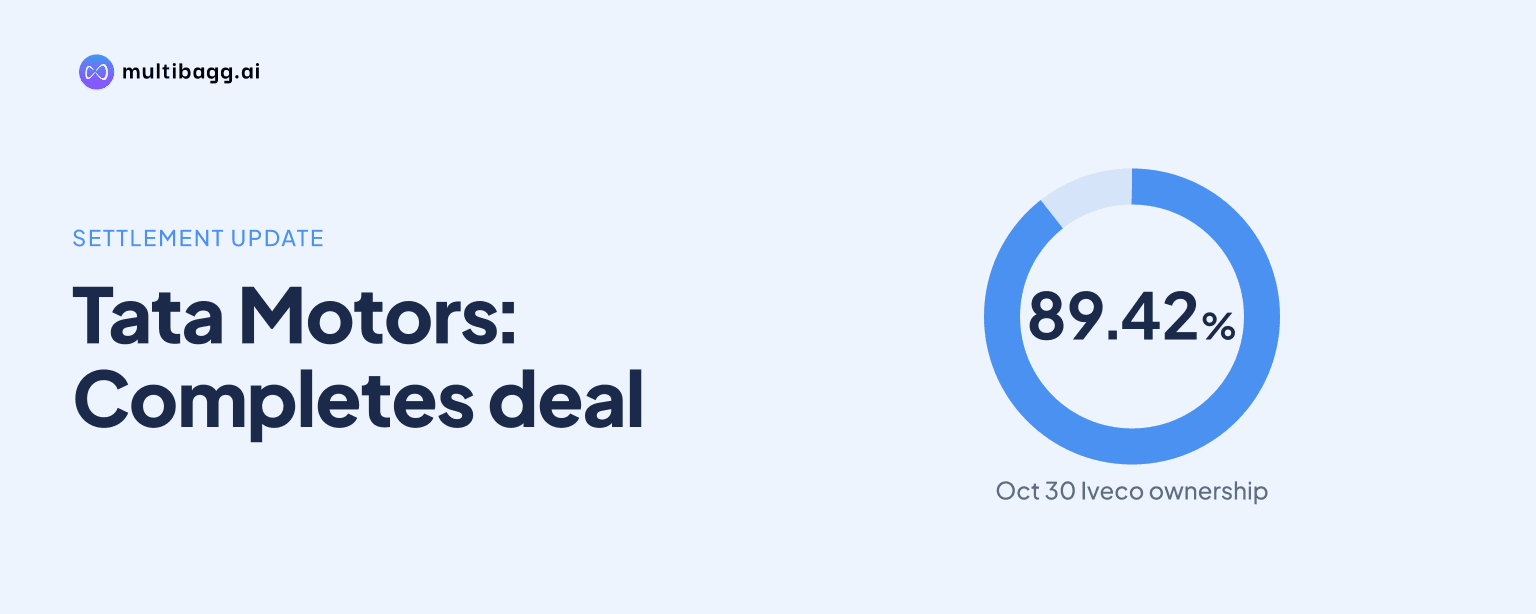
Tata Motors Limited completed the initial settlement of its tender offer for Iveco Group N.V. on October 30, 2026, making Iveco an indirect subsidiary. Through TML CV Holdings B.V., Tata Motors acquired 238,157,212 common shares, equal to about 89.42% of Iveco’s common share capital net of treasury shares, for cash consideration of Rs 1,527.84 per share.
Know Tata Motors inside out
Results, valuation, peers and who's buying, in one view.
How much of Iveco does Tata Motors own after settlement?
Tata Motors owns approximately 89.42% of Iveco’s common share capital, net of treasury shares, after the October 30, 2026 settlement. The holding consists of 238,157,212 common shares held by TML CV Holdings B.V., an indirect wholly owned subsidiary of Tata Motors.
The stake resulted from settlement of shares tendered during the acceptance period of a voluntary offer for all issued common shares. TML CV Holdings Pte. Ltd. promoted the offer through TML CV Holdings B.V., and the filing states that Iveco became part of Tata Motors once that settlement was completed.
Tata Motors offered cash consideration rather than a share swap. The stated offer price was Rs 1,527.84 per common share, including dividend, calculated using the filing’s stated reference exchange rate of Rs 106.1 per euro at the October 29, 2026 closing rate.
The acquisition was completed on October 30, 2026, according to the Regulation 30 disclosure. Tata Motors also said the transaction was not a related-party transaction and that its promoter group and group companies had no interest in Iveco before the acquisition.
Why did Tata Motors acquire Iveco?
Tata Motors said the acquisition combines businesses with complementary product portfolios and capabilities, with substantially no overlap in their industrial and geographic footprints. Management said the transaction is intended to create a more diversified entity with a significant global presence in commercial vehicles and mobility activities.
Iveco operates in the commercial-vehicles industry through five brands and related activities. These comprise IVECO, which sells heavy, medium and light-duty trucks; FPT, which supplies powertrain technologies to agriculture, construction, marine, power-generation and commercial-vehicle sectors; IVECO BUS and HEULIEZ; and IVECO CAPITAL, its financing arm.
The acquired business employs 33,000 people and operates 16 industrial sites and 22 research and development centres. The filing identifies Amsterdam in the Netherlands as Iveco’s headquarters and Turin, Italy, as its operational presence, while describing its heritage as Italian.
Iveco was incorporated on June 16, 2021, although the filing says the Iveco business was founded in 1975. Its disclosed activities span transportation vehicles, engines, powertrain systems and financial products and services for dealers and customers.
How has Iveco’s revenue changed over three years?
Iveco reported revenue from operations of about Rs 1,42,471 crore in CY25, down from about Rs 1,52,964 crore in CY24. Revenue had already declined from about Rs 1,69,527 crore in CY23, meaning the disclosed total fell in each of the two subsequent calendar years.
CY25 revenue was about Rs 10,493 crore below CY24, while CY24 revenue was about Rs 16,563 crore below CY23. The filing says the three-year revenue figures include revenue from the defence business, which is not part of the current transaction perimeter.
That qualification means the disclosed historical revenue series covers a wider business base than the tender-offer transaction. Iveco’s authorised share capital was about Rs 85 crore as of June 30, 2026, according to the acquisition disclosure.
Got a follow-up? Ask IRIS
What governance changes followed the Iveco settlement?
Iveco’s board was reconstituted on October 30, 2026, with N. Chandrasekaran appointed non-executive director, chairperson and senior non-executive director. Olof Persson is executive director and chief executive officer, while P. B. Balaji, Girish Wagh, Guenter Butschek and Charles Nichols serve as non-executive directors.
The new board committees took effect under amended corporate-governance documents. Charles Nichols chairs the three-member audit committee, Guenter Butschek chairs the three-member compensation committee, and Girish Wagh chairs the two-member environmental, social and governance committee.
All special voting shares that were outstanding immediately before settlement were repurchased for no consideration. The repurchase followed amended terms for the special voting shares and authorisation granted at Iveco’s extraordinary general meeting on October 16, 2026, leaving no special voting shares outstanding.
Iveco also brought forward the release of its third-quarter 2026 financial results to November 3, 2026, from November 5, 2026. The accelerated reporting date was announced alongside the board, committee and special-voting-share changes.
What happens to the remaining Iveco shares?
The offer for remaining Iveco common shares will reopen for five trading days from November 2 to November 6, 2026. Trading sessions during that period will run from 8:30 a.m. to 5:30 p.m. Central European Time, and settlement of shares tendered in the reopening is scheduled for November 13, 2026.
The reopening follows the payment date for common shares tendered during the original acceptance period. Tata Motors said the offeror would communicate further post-offer actions in due course, including, where applicable, a voluntary purchase procedure, Dutch legal squeeze-out, or post-offer demerger and liquidation.
Those routes were identified as potential procedures rather than confirmed outcomes on October 30, 2026. The settled 89.42% holding establishes Tata Motors’ indirect ownership position, while the five-day reopening offers remaining common shareholders the announced mechanism to tender.
Conclusion
Tata Motors has completed the settlement that made Iveco an indirect subsidiary through an 89.42% holding comprising 238,157,212 common shares. The cash offer of Rs 1,527.84 per share brings together commercial vehicles, powertrains, buses, coaches and financial services that management describes as complementary businesses with limited industrial and geographic overlap.
The next disclosed dates are Iveco’s third-quarter 2026 results on November 3, the end of the reopened tender period on November 6, and settlement on November 13, 2026 for shares tendered during that reopening. Tata Motors has not specified which post-offer procedure it will pursue, saying the offeror will disclose further information in due course.