










TCM Limited loan gives investor 20% compounded return priority
Key highlights
- TCM’s disclosed Loan Amount carries interest at 20% per annum, compounded annually.
- Each loan disbursement has a three-year tenure that the Company can extend to four years.
- Loan principal and accrued return receive priority before dividends can be declared from surplus funds.
- The First Party transfers shares at Rs 10 face value after full repayment of the loan and accrued return.
powered by IRIS
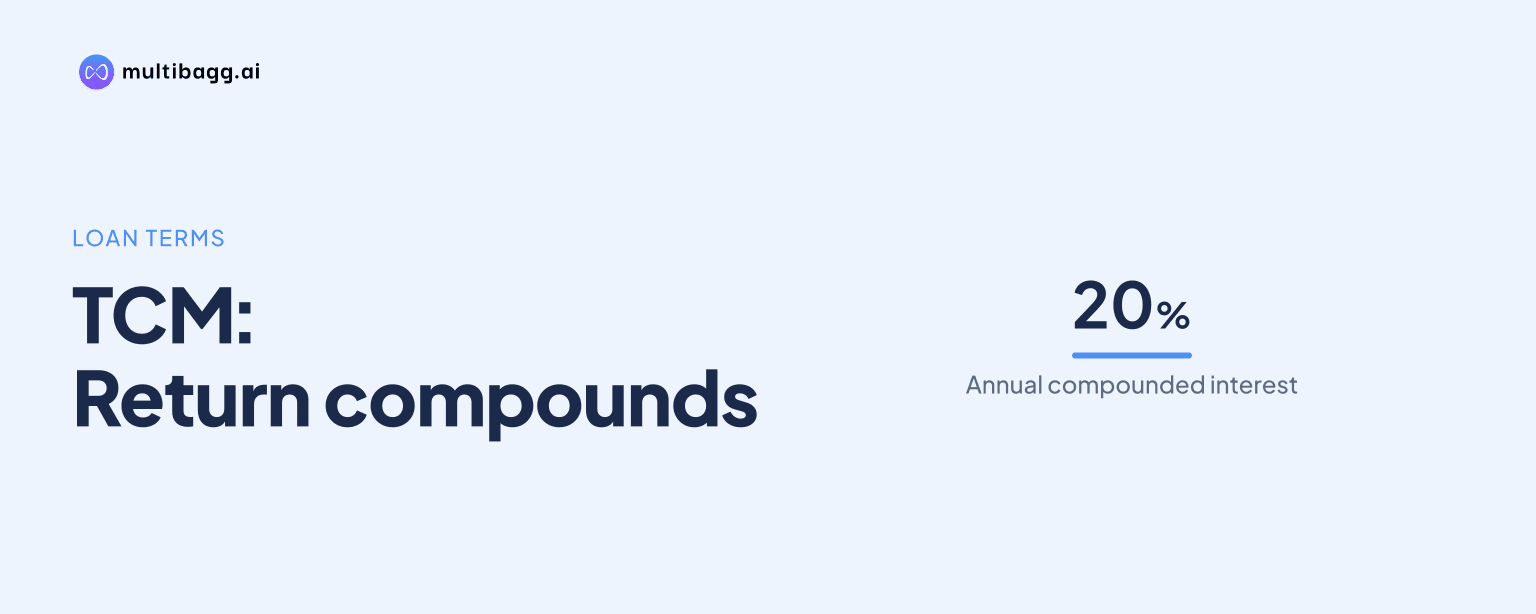
TCM’s disclosed Kalamassery project agreement gives the First Party a working-capital loan return of 20% a year, compounded annually, and requires the Company to prioritise repayment of principal and accrued return before dividends. Each disbursement has a three-year tenure, extendable by one year to a maximum of four years.
Know TCM inside out
Results, valuation, peers and who's buying, in one view.
What are TCM’s working-capital loan terms?
TCM’s agreement says the First Party will extend the Loan Amount to the Company as working capital for the project at 20% per annum, compounded annually. Interest is calculated on the amount remaining payable from time to time, rather than being stated as a fixed return on the original disbursed amount. The filing does not disclose the rupee value of the Loan Amount on pages 8 to 10.
Each disbursement has a tenure of three years from its own disbursement date. The Company may extend that tenure by one additional year, taking the stated maximum tenure to four years, or the parties may mutually agree another period subject to force majeure events. The tenure is therefore linked to each drawdown rather than being expressed as one common three-year project-finance period.
No shareholder is obliged to provide further funding, guarantees or security unless the shareholders mutually agree. For funding required above the Loan Amount, the Second Party and Third Party are to decide the arrangement, with construction-linked receivables, additional debt and further capital contribution listed as possible mechanisms. This separates the First Party’s 20% loan from later funding that may be required for project completion.
When can TCM distribute dividends?
TCM’s agreement permits dividends only after adequate provision for the Loan Amount, the accrued return and committed project costs. The board may recommend profit distributions in proportion to the shareholders’ respective holdings, but this remains subject to the Companies Act, the Loan Agreement and cash-flow requirements for completing the project.
The agreement gives priority to servicing and repayment of the Loan Amount together with the return accrued on it before a dividend declaration. Dividends may be declared only from surplus funds remaining after provision for project commitments, including debt servicing on any borrowings obtained from banks or financial institutions and the Company’s obligations under the Loan Agreement. No dividend amount, payment date or minimum surplus level is stated.
The 20% compounded return also has protection through the agreement’s Reserved Matters provisions. An amendment or waiver of the Loan Agreement, or an action affecting the First Party’s entitlement to the Loan Amount, its return or associated rights, requires the specified prior consent. A Reserved Matter decided without the required consent is stated to be void and ineffective between the shareholders.
Got a follow-up? Ask IRIS
How does the First Party exit TCM’s project company?
The First Party must transfer all its shares when the Company has fully repaid the Loan Amount and the entire accrued and payable return. The transfer is to occur simultaneously with, and is a condition of, full and final repayment. The shares move to the Second Party and Third Party, or their nominees, in proportions reflecting their respective shareholdings at that time.
The exit price is the face value of the shares, disclosed as Rs 10 per share. The agreement says the return earned under the Loan Agreement is the First Party’s entire economic consideration for participation in the Company and project. It excludes a premium or other payment linked to any increase in the value, net worth or enterprise value of the Company, project or property.
The same Rs 10 face-value transfer applies if the Company prepays the Loan Amount in full before the contractual term ends, or if the First Party and Company mutually agree an early repayment and exit. In either case, the share transfer must occur concurrently with the prepayment or early repayment. The four-year maximum stated tenure therefore does not prevent an earlier exit following full repayment.
Which TCM decisions require prior consent?
TCM’s agreement treats borrowings above Rs 25 lakh in aggregate at any time, excluding the Loan Amount, as a Reserved Matter. The consent framework also covers dividend declarations, amendments or termination of the Joint Development Agreement, and actions that adversely and disproportionately affect the First Party’s shareholding, economic interests or exit rights.
The agreement sets separate thresholds for capital expenditure outside the approved project budget and for settlements of claims. These thresholds apply alongside the restriction on borrowings above Rs 25 lakh and are distinct from the undisclosed Loan Amount.
Other Reserved Matters include changes in share capital, issue of convertible securities, merger, demerger, restructuring, disposal or encumbrance of the property outside the ordinary project course, and insolvency steps. The agreement also covers non-arm’s-length or non-ordinary-course related-party transactions, while the filing states that the parties are not related parties and the transaction is not a related-party transaction.
Conclusion
TCM’s disclosed structure gives the First Party a defined 20% annually compounded return through a working-capital loan, rather than through participation in any increase in project value. The contract places repayment of the Loan Amount and accrued return ahead of dividends, while the First Party’s shares transfer at Rs 10 face value once full repayment is made.
The next points to watch are the repayment timing of each three-year disbursement, whether the Company uses its one-year extension option, and any additional funding arranged beyond the undisclosed Loan Amount. The agreement also identifies final project completion as receipt of the occupancy or completion certificate for the last villa or phase, while share transfers are generally restricted for five years from the agreement date or until that completion point.