










TCM Limited confirms 44.59% stake in Kalamassery villa JV
Key highlights
- TCM signed the shareholder agreement on 17 November 2026 for a 2.5-acre Kalamassery villa project.
- TCM holds 4,455 shares, equal to 44.59% of Asset TCM Estates’ paid-up capital.
- Asset Homes holds 54.45% and is responsible for construction, approvals, branding and marketing.
- Borrowings above Rs 25 lakh and single capital expenditure above Rs 10 lakh are reserved matters.
powered by IRIS
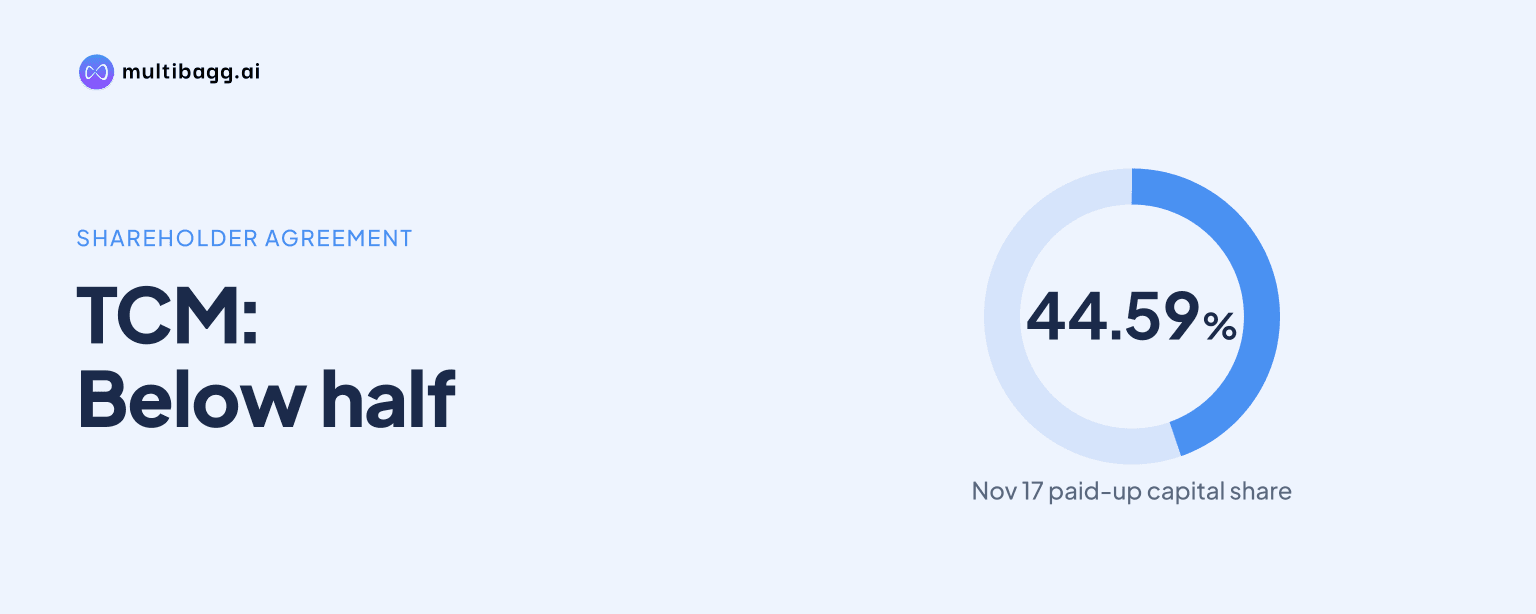
On 17 November 2026, TCM Limited executed a shareholder agreement for a 2.5-acre premium residential villa project at Kalamassery, Ernakulam, confirming its 44.59% holding in Asset TCM Estates Private Limited. Asset Homes holds 54.45%, while investor Suhas Nandan owns the remaining 1% of the joint-venture company.
Know TCM inside out
Results, valuation, peers and who's buying, in one view.
What stake does TCM hold in the Kalamassery villa venture?
TCM holds 4,455 equity shares, or 44.59% of the paid-up capital, in Asset TCM Estates, the joint-venture company for the Kalamassery project. The agreement was signed at Kochi on 17 November 2026, following TCM’s 18 September 2026 corporate announcement on the memorandum of understanding, or MOU, for the proposed development.
The joint venture has issued, subscribed and paid-up capital of Rs 1.01 lakh, divided into 10,100 equity shares with a face value of Rs 10 each. Asset Homes, the developer shareholder, owns 5,545 shares or 54.45%, and Suhas Nandan, the investor shareholder, owns 100 shares or 1%; the agreement states that this split reflects the parties’ entitlements agreed under the MOU.
The company’s authorised share capital is Rs 2 lakh, comprising 20,000 equity shares of Rs 10 each, compared with the Rs 1.01 lakh currently paid up. TCM is the minority shareholder at 44.59%, while Asset Homes holds the larger 54.45% stake and is designated to conduct day-to-day management.
How will the Kalamassery venture be managed?
Asset Homes will manage Asset TCM Estates’ day-to-day operations under a business plan and budget approved by the board. Its assigned responsibilities cover conceptualisation and design, statutory and regulatory approvals, construction, branding, marketing and handover of completed units to buyers or allottees for the Kalamassery villa project.
TCM’s role is to make the 2.5-acre property available to the joint venture under the JDA. This separates the landowner function from the developer function: TCM contributes the stated property, while Asset Homes is responsible for delivery and market-facing activities associated with the premium residential-villa project.
The board may have no more than five directors unless all shareholders agree otherwise. TCM can nominate up to two directors, Asset Homes can nominate up to two, and Suhas Nandan can nominate one; the chairman will be an Asset Homes nominee but will not have a second or casting vote.
Got a follow-up? Ask IRIS
What is the purpose of Asset TCM Estates?
Asset TCM Estates’ sole stated business is to plan, develop, construct, market and sell the project on the specified Kalamassery property, along with activities incidental or ancillary to that work. The company cannot undertake another business or activity without the prior written consent of all shareholders.
The agreement also provides that the joint venture may borrow funds as needed for the project, its operations and its business obligations. Suhas Nandan’s designated role is different from those of TCM and Asset Homes: as investor shareholder, he is to extend the loan amount as working capital under a separate loan agreement, although the filing does not disclose that loan amount.
The shareholder agreement records the parties’ rights and obligations, board composition, management arrangements and the terms under which the 1% investor shareholder will exit. Asset TCM Estates joined the agreement as a confirming and consenting party, recording its own obligations in relation to those arrangements.
Which decisions require TCM and Asset Homes approval?
TCM and Asset Homes must both give prior written consent for specified reserved matters, including a change in share capital, a merger, demerger, restructuring, voluntary winding-up and a change in the company’s objects or name. The same bilateral consent applies to amendment, waiver or termination of the JDA governing the 2.5-acre property.
The governance terms place limits around funding and spending decisions. Borrowings above Rs 25 lakh in aggregate at any time, excluding the investor loan amount, require the stipulated consent; capital expenditure above Rs 10 lakh in a single instance or Rs 25 lakh in a financial year also requires approval unless already included in the project budget.
A board meeting needs at least one director nominated by Asset Homes and one nominated by TCM for quorum, whether attendance is in person or through permitted video or audio-visual means. This requirement means both the developer and landowner must be represented in the minimum attendance required to conduct board business.
Certain safeguards also protect the investor’s specific interests. Alongside TCM and Asset Homes approval, Suhas Nandan’s written consent is required for actions affecting the loan agreement, his return on the loan amount, or his shareholding, economic interests or exit rights; litigation settlements above Rs 5 lakh are also listed among reserved matters.
Conclusion
The 17 November 2026 agreement converts the previously announced 18 September 2026 MOU into documented shareholder governance for a 2.5-acre Kalamassery villa development. TCM has a 44.59% landowner stake and up to two board nominees, while Asset Homes has 54.45%, up to two nominees and responsibility for project execution and daily management.
The next disclosed matters to watch are the project’s statutory and regulatory approvals, construction, marketing and sale of villas, all assigned to Asset Homes through the joint-venture structure. Investors can also monitor any funding proposal above the Rs 25 lakh aggregate borrowing threshold, capital expenditure beyond Rs 10 lakh per instance, or amendments to the JDA, because these are reserved matters requiring the stated approvals.