










TD Power Systems: Buy Calls Meet Demanding Valuation
Key highlights
- TD Power Systems reported Q1 FY27 consolidated revenue of Rs6,400.5 million, up 72.1% year on year.
- Management raised FY27 revenue guidance to Rs26,000 million from Rs24,000 million.
- Anand Rathi raised its target price to Rs1,751 from Rs1,324, implying 18.5% upside at its report price of Rs1,478.
- Anand Rathi noted valuation of 62.3 times FY27E EPS and 50.2 times FY28E EPS.
powered by IRIS
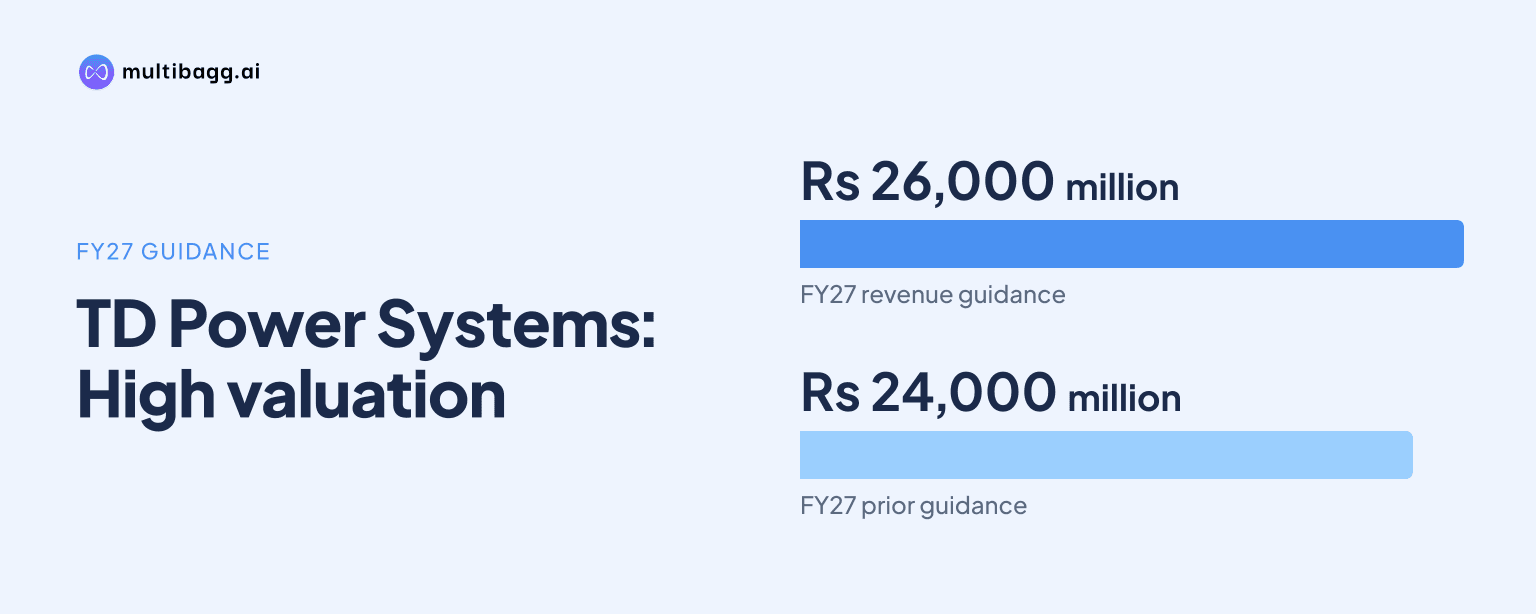
TD Power Systems Ltd reported consolidated Q1 FY27 revenue growth of 72.1% year on year to Rs6,400.5 million, supporting broker buy calls, but the stock's valuation of 62.3 times FY27E earnings and identified working-capital risks make position sizing and investment horizon important.
Should investors buy or hold TD Power Systems shares?
TD Power Systems has positive long-term analyst backing, while the case for immediate buying is tempered by a demanding valuation and sharp share-price volatility. Anand Rathi Research upgraded the company to BUY in its August 12, 2026 result update, and the two analysts cited in the discussion have Buy or Strong Buy ratings. Their consensus target is Rs887.75, although this target comes from a separate set of market data with a different referenced share price.
The latest broker update set a DCF-based target of Rs1,751, raised from Rs1,324. At the report's current market price of Rs1,478, that represented 18.5% potential upside. However, the same report noted that the stock traded at 62.3 times FY27E earnings per share and 50.2 times FY28E earnings per share. That leaves limited room for execution disappointments even when the operating outlook is constructive.
What drove TD Power Systems' Q1 FY27 growth?
TD Power Systems' Q1 FY27 revenue was driven by execution of 320 generators and price increases during the quarter. Consolidated revenue reached Rs6,400.5 million, up 72.1% year on year and 8.6% sequentially, exceeding Anand Rathi's Rs4,780 million estimate. The update said a global shortage of power-generation equipment and firm OEM schedules supported by customer advances were aiding demand.
Management cited demand across gas engines and turbines, steam turbines, hydro, geothermal, waste-to-energy, grid balancing and AI-data-centre-linked generation. It raised FY27 revenue guidance to Rs26,000 million from Rs24,000 million and indicated order inflows above Rs28,000 million, led by exports. These factors underpin the improved confidence in near-term execution, rather than a purely valuation-led investment argument.
Is TD Power Systems' valuation expensive versus the sector?
TD Power Systems is expensive on the valuation measures included in the discussion. One market snapshot placed the stock at a forward price-to-earnings ratio of 46 times after a 19% weekly decline to Rs577, compared with a 31-times Indian electrical-industry average. The latest Anand Rathi update used higher reference valuations of 62.3 times FY27E and 50.2 times FY28E earnings.
The figures come from different dates and price references, so they should not be combined into a single valuation estimate. They do, however, point in the same direction: investors are paying a premium for growth. Anand Rathi forecasts revenue and profit after tax CAGR of 28.8% and 38.7%, respectively, over FY26-FY28E, alongside FY28E return on equity of 28.3% and return on capital employed of 37.4%.
Got a follow-up? Ask IRIS
What risks should TD Power Systems investors monitor?
TD Power Systems investors should monitor commodity costs, execution, working capital and spending decisions for large generators. Anand Rathi specifically identified commodity-price volatility, execution delays, working-capital stretch and delays in large-generator capital expenditure as key risks. These risks matter more when the valuation assumes continued strong delivery.
Other figures in the social-media discussion also flag balance-sheet and cash-conversion issues, though they are not part of the August broker update. Trade receivables were said to have risen from Rs5,121 crore in Q2 FY26 to Rs7,853 crore in Q1 FY27, while current liabilities rose from Rs5,124 crore to Rs9,006 crore. Borrowings were also stated to have increased from zero in Q3 FY26 to Rs238 crore in Q1 FY27. Investors should verify these figures against company filings before using them in an investment decision.
Why is TD Power Systems volatile in the short term?
TD Power Systems is volatile because its market price has moved more sharply than most Indian stocks despite a favourable longer-term demand narrative. One market assessment described the shares as more volatile than 90% of Indian stocks, with typical weekly movement of 9.1%. It also placed the stock 20.30% below its 52-week high.
The discussion contains conflicting technical views. Some sources classify TD Power Systems as being in a short-term sell zone and a long-term buy zone, while an earlier chart-based view described a cup-and-handle breakout and a Rs618 target over one to two months. Such technical observations are time-sensitive and should not be treated as substitutes for monitoring earnings delivery, order inflows and cash conversion.
Conclusion
TD Power Systems has a growth-backed investment case following a 72.1% rise in Q1 FY27 revenue, higher FY27 revenue guidance and demand across multiple power-generation applications. Analyst sentiment is positive, but the valuation is demanding and the stock's reported volatility means the distinction between a long-term view and a short-term trading decision remains material.
The next watchpoints are progress toward FY27 revenue guidance of Rs26,000 million, order inflows expected above Rs28,000 million and evidence that execution converts into cash without a further working-capital stretch. Investors should also track the identified risks around commodity prices, delivery schedules and large-generator capital expenditure before relying on target-price upside alone.