










PI Industries Limited shares fall as Q2 profit drops 70%
Key highlights
- PI Industries traded at ₹1,745.50 on November 11, 2026, versus a 52-week range of ₹1,699.40 to ₹3,832.90.
- Q2 FY27 net income fell 70% year-on-year to ₹1.22 billion, while revenue declined 5.8% to ₹17.6 billion.
- Q2 FY27 EBITDA margin contracted to 13.88% from 29.02% a year earlier.
- Domestic agriculture and pharmaceuticals grew 19% and 20%, respectively, while agrochemical exports declined 18%.
powered by IRIS
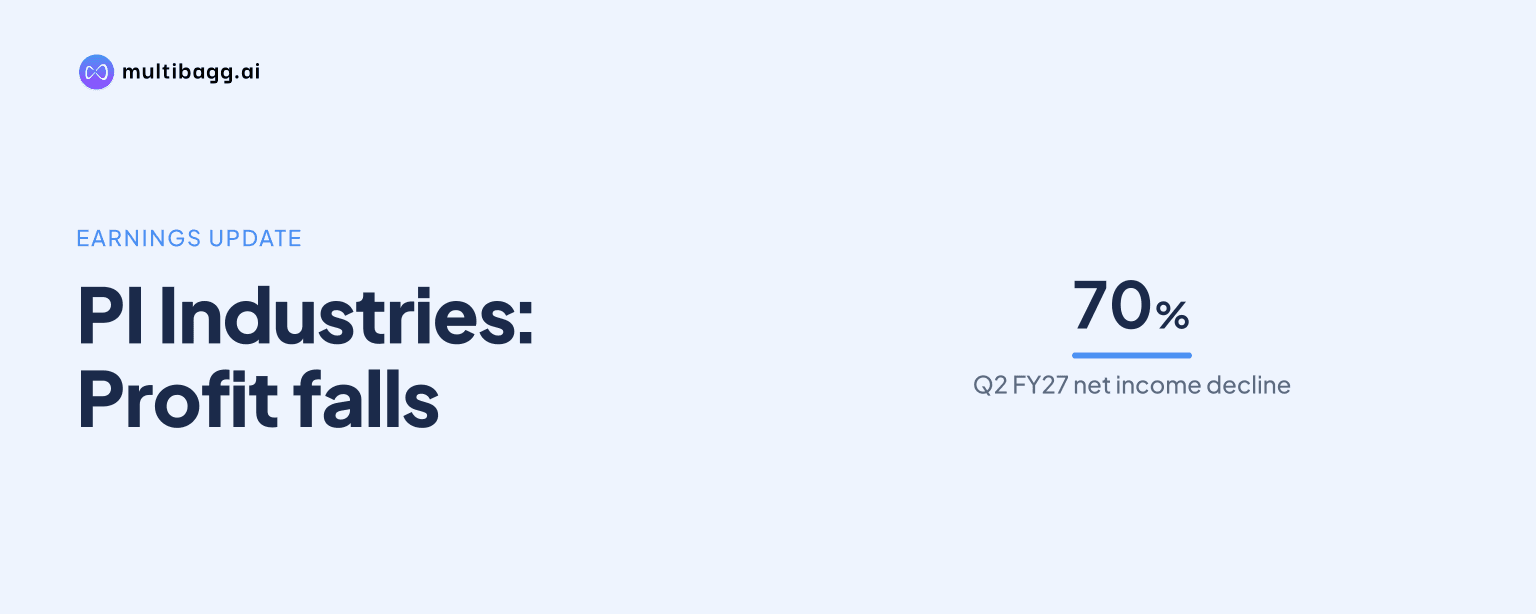
PI Industries Limited shares traded at ₹1,745.50 on November 11, 2026, after Q2 FY27 net income declined 70% year-on-year to ₹1.22 billion and revenue fell 5.8% to ₹17.6 billion. The result reflected weak agrochemical exports and a sharp contraction in operating profitability, despite growth in domestic agriculture and pharmaceuticals.
Why did PI Industries' Q2 FY27 profit fall 70%?
PI Industries' Q2 FY27 profit fell primarily because weaker agrochemical exports and higher expenses compressed margins. Consolidated net income was ₹1.22 billion, down 70.2% year-on-year, while earnings per share fell to ₹8.05 from ₹26.98 in the comparable quarter. Revenue declined 5.8% year-on-year to ₹17.6 billion.
The pressure was more pronounced at the operating level. Consolidated EBITDA margin contracted to 13.88% in Q2 FY27 from 29.02% in Q2 FY26, a fall of more than 15 percentage points. A separate result summary put profit margin at 6.9%, compared with 22% in the earlier period, and said revenue missed analyst estimates by 3.3% while EPS missed by 28%.
How far has PI Industries stock fallen?
PI Industries was trading at ₹1,745.50 on November 11, 2026, close to its 52-week low of ₹1,699.40 and far below its 52-week high of ₹3,832.90. The stock had declined 43.9% over six months and 41.68% over one year, based on the supplied market data.
The correction followed a period in which investors reassessed near-term earnings prospects in the agrochemical and custom synthesis businesses. Another market report said the stock touched a fresh 52-week low of ₹1,730 and cited declines of 42% over six months and 52% over one year. The differences in reported return figures reflect different data snapshots, but both sets of data point to a sustained downtrend.
Which PI Industries businesses are offsetting export weakness?
PI Industries' domestic agriculture and pharmaceuticals operations are providing some support, though they have not fully offset the decline in the custom synthesis and manufacturing business. Domestic agriculture revenue grew 19% and pharmaceuticals grew 20%, according to brokerage commentary, while agrochemical exports contracted 18% in the reported quarter.
The company operates across agro chemicals and pharma, selling crop-protection products, plant nutrients, specialty chemicals, custom synthesis and manufacturing services, and pharmaceutical products. Its longer-term development pipeline includes more than 90 molecules in active development, with over 60% in advanced stages. New products contributed 18% of export revenue in the latest year, while non-agrochemical areas accounted for roughly 40% or more of new enquiries.
Pharma CRDMO is a smaller but growing area within the group. Social-media research commentary said this business grew 40% in the latest full year and represented about 6% of total export revenue. The same material cited more than 250 patents filed to date, including 43 in the latest year, and more than 90 projects at different development stages.
Got a follow-up? Ask IRIS
What are analysts watching after the weak quarter?
Analysts are watching whether global agrochemical demand stabilises, whether margins recover and whether newer businesses can scale without extending the earnings drag. Nuvama cited a 9.1% year-on-year decline in consolidated revenue to ₹1,700 crore, a 780-basis-point fall in gross margin to 49.5%, and EBITDA margin of 13.7%, below its estimate.
Nuvama reduced its FY27 and FY28 earnings estimates by 35.9% and 28.2%, respectively, and shifted its valuation base to FY29. It retained a Hold rating and lowered its target price to ₹1,682 from ₹2,801. Motilal Oswal retained a Buy rating with a ₹2,060 target price, pointing to an order book of about $1.25 billion and potential growth from new CSM molecules, biologicals, domestic agriculture, pharma CRDMO and electronic specialty chemicals.
The supplied material also refers to an analyst target estimate of roughly ₹4,083, reduced from about ₹4,318, based on higher discount rates, a modest margin adjustment and a lower assumed future price-to-earnings multiple. That estimate differs substantially from the individual brokerage targets cited above, underlining that valuation views currently vary widely.
Conclusion
PI Industries faces a difficult near-term earnings backdrop, with lower exports, a 70% fall in Q2 FY27 net income and materially weaker margins driving the stock close to its 52-week low. Domestic agriculture and pharmaceuticals are growing, but their contribution has not yet compensated for the downturn in agrochemical exports and CSM.
Investors will next watch for a stabilisation in global agrochemical demand, progress in margin normalisation and the conversion of the reported $1.25 billion order book into revenue. The pace of scaling in biologicals, pharma CRDMO and electronic specialty chemicals, alongside working-capital trends and the performance of newer subsidiaries, remains central to the recovery case.