










Eternal Limited at ₹365: revenue rises, margin stays flat
Key highlights
- Eternal reported Q2 2027 revenue of ₹241,380 million, up from ₹135,900 million a year earlier.
- Eternal's Q2 2027 net income rose to ₹1,250 million from ₹650 million, while net margin stayed at 0.5%.
- Eternal traded at ₹364.40 on 8 November, compared with ₹284 at the start of the year.
- Analyst targets for Eternal ranged from ₹220 to ₹513, with an average of ₹382.41.
powered by IRIS
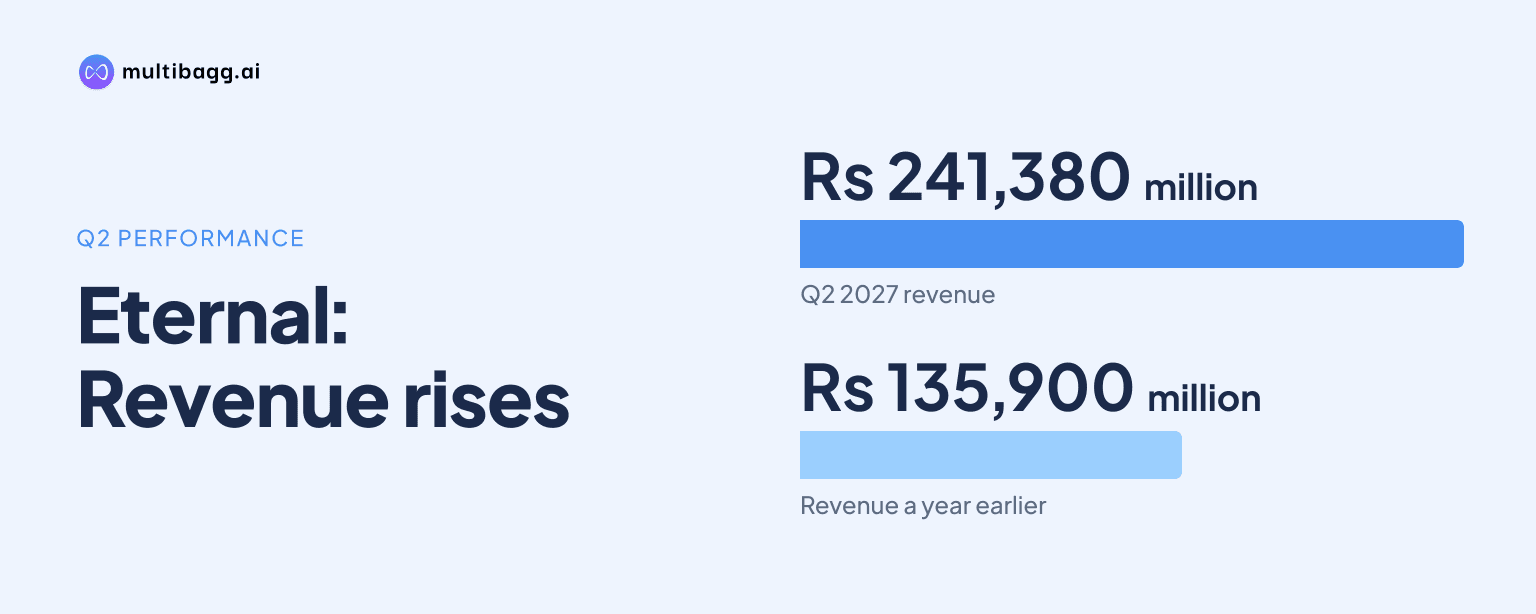
Eternal Limited traded near ₹364-₹365 after a 28.4% year-to-date return, supported by Q2 2027 revenue rising to ₹241,380 million from ₹135,900 million, but its net margin remained at 0.5%, leaving the expected profitability improvement unproven.
What did Eternal report in Q2 2027?
Eternal reported materially higher revenue and net income in Q2 2027 than it did a year earlier, although the net margin did not improve. Revenue rose to ₹241,380 million from ₹135,900 million, while net income increased to ₹1,250 million from ₹650 million.
The figures support the argument that Eternal is expanding scale. However, the reported margin outcome is equally important because both periods carried a net margin of 0.5%. Investors assessing the stock at around ₹365 therefore have evidence of stronger growth, but not yet of a step change in profitability.
Why is Eternal's flat margin central to the stock debate?
Eternal's flat 0.5% net margin is central because the optimistic valuation case depends on margin expansion alongside rapid revenue growth. The bullish narrative cited a fair value of ₹331 at the start of the year, based on assumptions including 41.0% annual revenue growth and profit margins reaching 8.3% within three years.
That framework has gained support from the growth in reported revenue and profit, but the current margin remains far below the assumed 8.3% level. Revenue and net income can rise together while profitability as a percentage of sales remains unchanged. For holders, the relevant follow-through is whether future results show the margin moving towards the level underlying the bullish case, rather than merely sustaining high growth in absolute terms.
What are the cautious arguments on Eternal at ₹365?
The cautious case for Eternal focuses on store economics, working-capital requirements and AI spending, alongside the risk that full inventory ownership and greenfield expansion could limit margins. A bearish narrative placed fair value at ₹207, 27% below the ₹284 share price at the start of the period.
That view did not assume no growth. It used assumed revenue growth of 28.3% and profit margins of 5.3%, but argued that operating demands could constrain the outcome. At ₹364.40, the share price was above that bearish fair-value estimate. This does not establish that the cautious case will prove correct, but it shows why a higher revenue base alone may not settle the debate around valuation.
Got a follow-up? Ask IRIS
What do analyst targets indicate for Eternal shares?
The available analyst data shows a wide target range for Eternal, with an average target of ₹382.41 against a quoted share price of ₹364.40. The low target was ₹220 and the high target was ₹513, illustrating substantial disagreement over the company's future value.
Refinitiv data covering 31 analysts showed 90.32% classified as Buy and 9.68% as Sell, with no Hold recommendations in the supplied consensus. Separately, Jefferies maintained a Buy rating and raised its target to ₹430, described as implying 34% upside. These figures indicate positive aggregate sentiment, but the spread between ₹220 and ₹513 also means investors should not treat the average target as a single settled view.
How has Eternal's share price moved this year?
Eternal's share price rose from ₹284 at the start of the year to about ₹364-₹365, producing the cited 28.4% return including dividends. On 8 November, the NSE closing price was ₹364.40, with the stock trading between ₹362.50 and ₹366.00 during that session.
On 9 November, supplied intraday quotes placed Eternal around ₹360.30 to ₹361.85, below the previous close. Its 52-week range was shown as ₹212.60 to ₹366.00 on the NSE, placing the recent price close to that range's upper end. The short-term movement adds context to the discussion, but the financial question remains whether the company can translate growth into a higher percentage margin.
Conclusion
Eternal's Q2 2027 update provides a clear growth signal: revenue increased to ₹241,380 million and net income reached ₹1,250 million. Yet the unchanged 0.5% net margin means the evidence is mixed for investors considering whether to hold or sell near ₹365, especially because both bullish and cautious valuation narratives rely on different assumptions about future profitability.
The next results should be watched for net-margin movement, store economics, working-capital demands and the effect of AI spending on expectations. Investors can also compare future company disclosures with the assumptions embedded in the bullish case of 8.3% margins within three years and the cautious case of 5.3% margins.