










Indian Oil Refiners Report ₹30,106 Crore Q2 Profit Surge
Key highlights
- IOC, BPCL and HPCL reported combined standalone Q2 net profit of ₹30,106 crore, up 68.3% year-on-year.
- BPCL's Q2 GRM rose to $32.53 per barrel from $10.78 per barrel a year earlier.
- HPCL's Q2 GRM increased to $32.15 per barrel from $8.80 per barrel a year earlier.
- IOC reported record standalone Q2 profit of ₹21,630 crore, including about ₹7,000 crore of inventory gains.
powered by IRIS
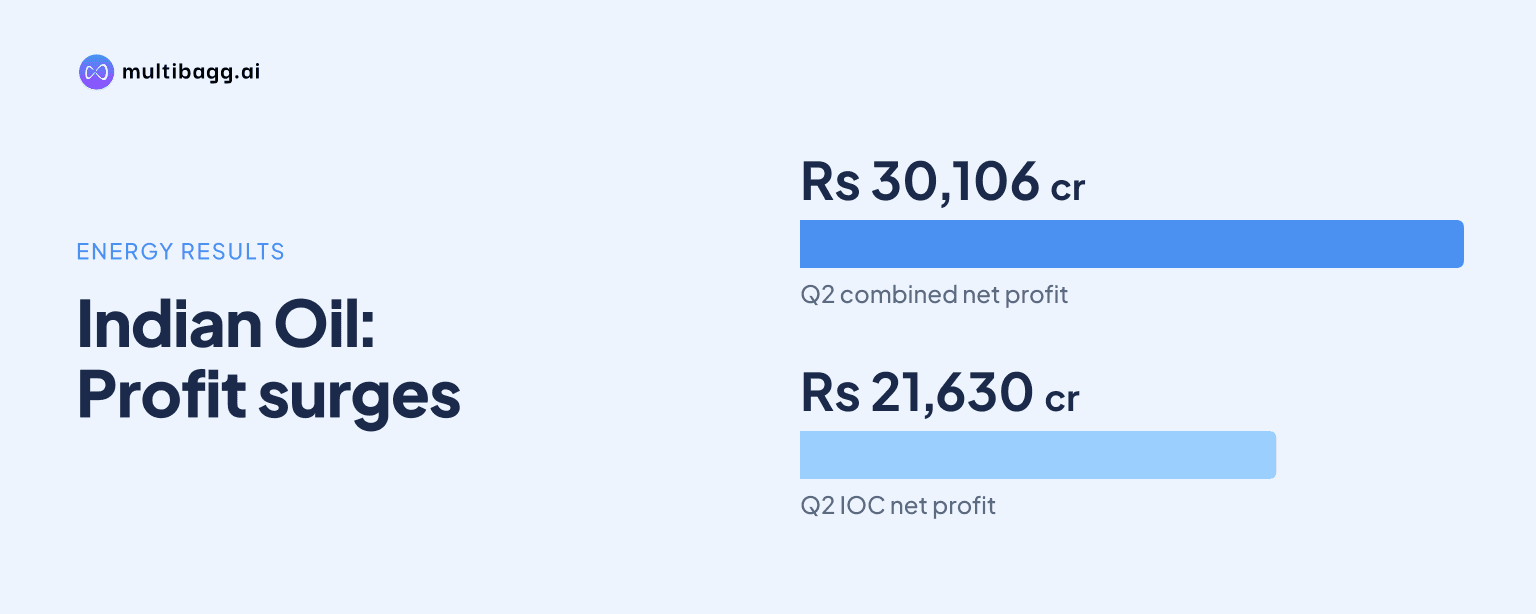
India's oil refining sector saw its three state-run fuel retailers report combined standalone net profit of ₹30,106 crore in the July-September quarter, supported by unusually strong refining margins and inventory gains. Bharat Petroleum Corporation Limited and Hindustan Petroleum Corporation Limited each reported gross refining margins above $32 per barrel, while Indian Oil Corporation Limited posted record standalone profit.
Why did Indian refiners' Q2 profits rise sharply?
Indian refiners' September-quarter profit recovery was driven primarily by higher returns from converting crude oil into petroleum products, along with inventory gains. The combined standalone profit of Indian Oil Corporation Limited (IOC), Bharat Petroleum Corporation Limited (BPCL) and Hindustan Petroleum Corporation Limited (HPCL) was ₹30,106 crore, a 68.3% increase from a year earlier and a reversal from a combined loss of about ₹18,150 crore in the preceding April-June quarter.
The quarterly total was also described as nearly 39% of the three companies' combined ₹77,281 crore profit for the full FY26. Their earnings benefited as global fuel supplies tightened amid refining-capacity disruptions in West Asia and Russia, low fuel inventories, and stronger prices for refined products. Diesel, gasoline and aviation turbine fuel contributed to the stronger refining environment.
Higher margins did not remove all pressures on the companies. Fuel retailers continued to face pressure on retail fuel sales and an unpaid LPG subsidy bill. The reported recovery was therefore not solely a result of marketing operations, with refining economics and inventory movements making the larger contribution.
How high were BPCL, HPCL and IOC refining margins?
BPCL, HPCL and IOC reported exceptionally high September-quarter gross refining margins, though levies reduced the reported benefit for some companies. BPCL's GRM was $32.53 a barrel, compared with $10.78 a barrel a year earlier, while HPCL's was $32.15 a barrel, compared with $8.80 a barrel.
IOC reported a GRM of $36.67 a barrel. After adjusting for the special additional excise duty, IOC's margin was around $18.52 a barrel and BPCL's was around $14 a barrel. These adjustments matter because the pre-duty GRM figures do not represent the full amount retained by refiners.
The strength was linked to robust diesel and aviation turbine fuel cracks. Still, higher crude freight costs and the loss of discounts on Russian crude weighed on margins compared with the June quarter, showing that elevated product margins do not flow entirely into refining profits.
Got a follow-up? Ask IRIS
Which Indian refiners contributed most to the profit jump?
IOC contributed the largest share of the state-run retailers' September-quarter earnings, reporting a record standalone net profit of ₹21,630 crore. That was nearly three times the ₹7,610 crore reported a year earlier, and followed a ₹2,661 crore loss in the June quarter.
IOC said favourable crude-price movements, better refining margins, and contributions from petrochemical and gas businesses supported its performance. A temporary decline in crude prices from mid-June to mid-August also created an inventory valuation gain of about ₹7,000 crore. This was a significant one-off support rather than recurring operating performance.
BPCL and HPCL also recorded a sharp rebound in refining profitability through their higher GRMs. Separately, Reliance Industries Limited (RIL) reported a 68% rise in oil-to-chemicals EBITDA to a record ₹25,203 crore. RIL's oil-to-chemicals revenue increased 44% to ₹231,601 crore, with high energy prices cited as a driver.
Are bumper refining margins likely to continue?
Indian refiners expect healthy margins in the coming months because refinery outages, depleted fuel inventories and constrained product supplies continue to support global fuel prices. These conditions can sustain stronger cracks for diesel, gasoline and aviation turbine fuel, which are central to refiners' returns.
However, the current level of profitability is exposed to several variables. Higher crude premiums, freight and insurance costs may reduce margins, while domestic fuel-pricing constraints can restrict the benefit available to fuel retailers. Fiscal measures can also take a share of strong refining gains, as shown by the impact of the special additional excise duty on reported margins.
The Q2 figures also contain items that should be separated from recurring earnings. IOC's approximately ₹7,000 crore inventory gain and the recognition of government compensation for past LPG losses helped lift the sector's quarterly outcome. Those supports may not recur at the same scale in later periods.
Conclusion
The September-quarter results show that India's oil refining sector benefited from a cyclical upswing in refining economics, not simply an improvement in fuel marketing. Combined standalone profit of ₹30,106 crore at IOC, BPCL and HPCL reflected high product margins, inventory gains and, in some cases, additional non-recurring support.
The next key indicator is whether disruptions in West Asia and Russia, low fuel inventories and tight product supply keep diesel, gasoline and aviation turbine fuel cracks elevated. Investors will also need to watch crude premiums, freight, insurance expenses, domestic fuel pricing and the effect of duties, all of which could limit how much of the headline GRM translates into earnings.