










Eternal Ltd valuation range reflects growth and margin debate
Key highlights
- Eternal reported 2QFY27 net revenue of ₹241 billion, up 19.4% quarter on quarter and 77.6% year on year.
- Blinkit added 308 stores, taking its store count to 2,751.
- Published brokerage targets for Eternal range from ₹225 to ₹513.
- Emkay raised its DCF-based target by 5% to ₹420 using a 13.36% WACC.
powered by IRIS
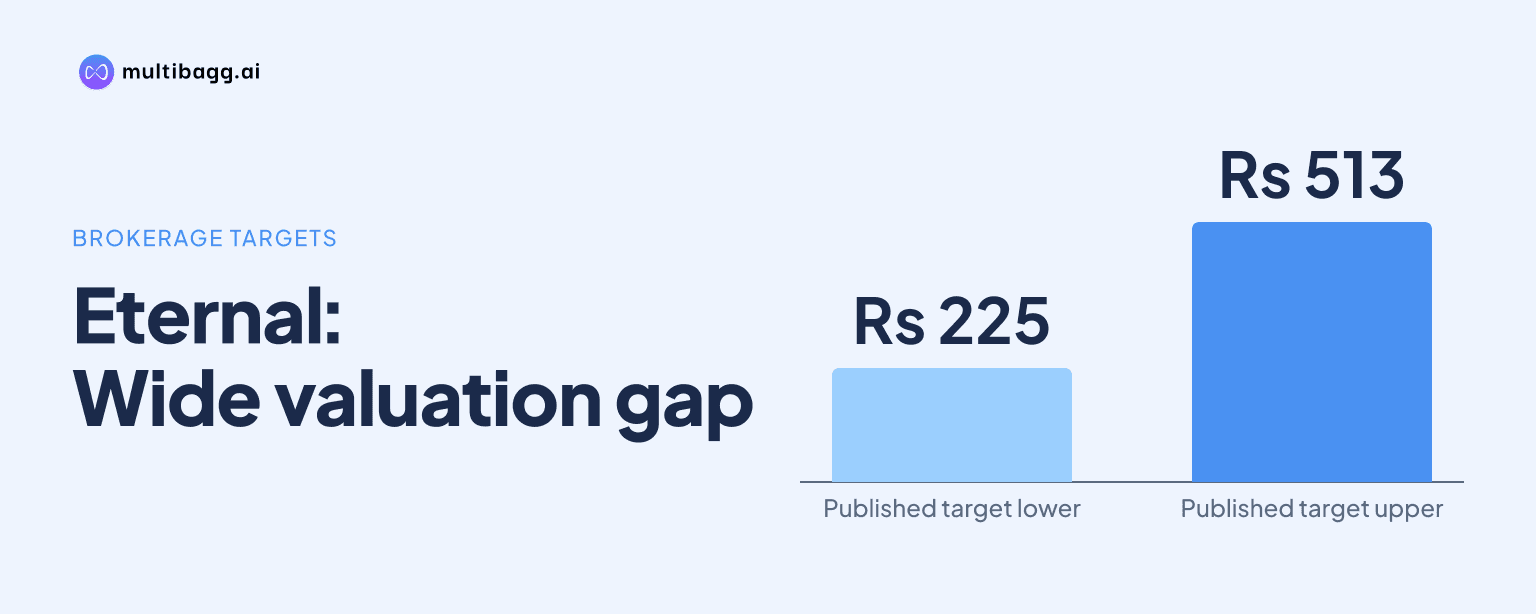
Eternal Ltd faces a valuation range shaped by competing growth and margin assumptions, with published brokerage targets spanning ₹225 to ₹513 after its September-quarter results. The gap reflects different views on Blinkit's store rollout, investment needs and the durability of Food Delivery profitability rather than a single agreed earnings path.
Why do Eternal targets range from ₹225 to ₹513?
Eternal's target range is wide because analysts differ materially on the value of quick commerce expansion and the profitability that can accompany it. The lowest cited Street target is ₹225 from Macquarie, while CLSA has the highest at ₹513. Ambit Capital has a Sell rating and a ₹245 target, whereas several brokerages retain Buy or Overweight views with targets around ₹400-₹430.
The target figures were published at different points and against different share-price reference dates, so they should not be treated as a single current upside calculation. One consensus update put the 12-month target at ₹381 against a Wednesday closing price of ₹312.35, while another analyst-consensus update raised its target to ₹382.41 from ₹370.19. The central point is the dispersion in assumptions, not a uniform market view.
What did Eternal report in the September quarter?
Eternal reported 2QFY27 net revenue of ₹241 billion, up 19.4% quarter on quarter and 77.6% year on year, according to Motilal Oswal's update. A separate set of figures in the discussion showed revenue of ₹241,380 million versus ₹135,900 million a year earlier, while net income rose to ₹1,250 million from ₹650 million.
Reported growth has strengthened the bullish case, but it has not settled the valuation debate. The supplied figures show a net margin of 0.5% in both comparison periods. That makes the future margin trajectory important: investors are weighing rapid revenue and network growth against the amount of profit that can be retained after expansion spending, delivery incentives and operating costs.
Food Delivery also remained a key support for positive research views. Emkay said adjusted EBITDA for Food Delivery increased 24.7% year on year to ₹6.27 billion, while Food Delivery NOV was ₹114.5 billion, broadly in line with Motilal Oswal's ₹114.7 billion estimate. Brokerages backing the stock describe Food Delivery as a cash-generating business supported by a duopoly structure and industry-leading margins.
Can Blinkit's store expansion remain economically sustainable?
Blinkit's expansion can support growth if store economics, customer frequency and retention remain resilient, but it also raises capital and working-capital risks. The business added 308 stores to reach 2,751, and management raised its March 2027 store target to more than 3,500 from 3,000. Its March 2028 target is 5,000 stores.
Bullish analysts see the network as a strategic advantage. Emkay cited Blinkit's sourcing, inventory management, category expansion, cash reserves and fulfilment network as reasons Eternal could capture a large share of India's quick commerce opportunity. Management expects year-on-year quick commerce NOV growth to accelerate from 3QFY27 as store additions increase, without near-term margin dilution, followed by long-term margin expansion.
The cautious view focuses on what could disrupt that outcome. Bearish commentary flags greenfield expansion into smaller cities, larger dark stores, higher per-store capital expenditure and full inventory ownership. These factors could pressure margins if throughput is volatile or if working-capital requirements rise. Selective delivery-fee cuts and aggressive discounting by competitors are additional variables for customer retention and order frequency.
Got a follow-up? Ask IRIS
How demanding is Eternal's current valuation?
Eternal's disclosed valuation multiples indicate that the market is pricing substantial future growth. One snapshot showed normalised price-to-earnings of 338.42 times, price-to-book of 10.30 times, price-to-sales of 4.26 times and price-to-cash-flow of 127.36 times. Another snapshot showed 307.21 times, 9.35 times, 3.87 times and 115.61 times respectively.
These readings were supplied alongside different share-price observations and should be viewed as snapshots rather than a single valuation date. Still, both sets underline that the investment case is highly sensitive to forecast changes. The consensus FY27 revenue forecast was raised to ₹1.02 trillion from ₹975.8 billion, while the EPS estimate was reduced to ₹1.06 from ₹1.65. Higher expected sales alone therefore do not guarantee a higher earnings forecast.
Emkay's ₹420 target uses a discounted cash flow approach with a 13.36% weighted average cost of capital. Its framework implies 35 times FY28E EV to EBITDA for Food Delivery and 1.89 times FY28E EV to NOV for quick commerce. The firm raised its FY27E, FY28E and FY29E revenue estimates by 1.7%, 3.3% and 7.8%, respectively, but cut FY27E and FY28E EBITDA estimates by about 10% because of faster network expansion.
What could change Eternal's stock outlook next?
Eternal's outlook could improve if quick commerce growth accelerates with stable unit economics and Food Delivery continues to produce cash flows. Management's guidance that quick commerce NOV growth should accelerate from 3QFY27 is therefore a key near-term operating marker. Stronger performance in smaller cities would also support the case that the network can scale beyond metros.
The principal risk is that the costs of expansion arrive faster than the benefits. Bearish valuation narratives assume growth can remain high while profit margins reach only 5.3%, compared with a bullish narrative that assumes 41.0% annual revenue growth and margins of 8.3% over three years. The cautious narrative assumes 28.3% revenue growth and places fair value at ₹207, while the bullish one puts fair value at ₹331.
Conclusion
Eternal's valuation is being driven less by a disagreement over recent revenue growth and more by competing expectations for quick commerce profitability. The September-quarter numbers, Food Delivery EBITDA growth and Blinkit's expanding store base support the positive case, while the modest disclosed net margin and large investment programme explain why some analysts retain sharply lower targets.
The next items to watch are management's expected 3QFY27 acceleration in quick commerce NOV growth, progress toward more than 3,500 stores by March 2027, and whether expansion occurs without near-term margin dilution. These operating measures will help determine whether higher revenue forecasts convert into the profitability assumed in the more optimistic valuation frameworks.