










TechD directs 80% of product revenue via distributors and partners
Key highlights
- TechD’s revenue model assigns 80% of product revenue to distributors and channel partners, with 20% through direct enterprise delivery.
- TechD says its product cross-selling plan can draw on an existing customer base of more than 900 customers.
- The 2025–2026 product phase names four TechD One products: Dark Vector, Human Trust, OT Shield and Provenance AI.
- TechD says 90% of Phase I products align with SEBI and RBI requirements.
powered by IRIS
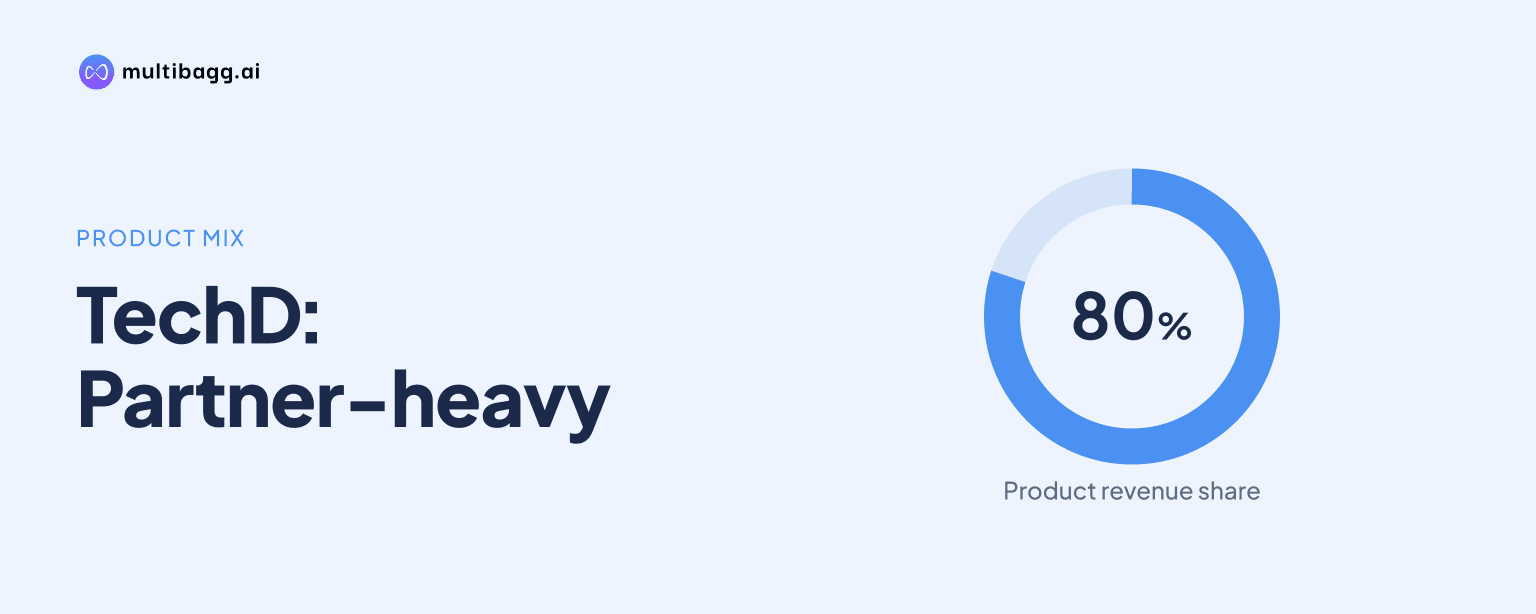
TechD Cybersecurity’s product revenue model assigns 80% of revenue to distributors and channel partners and 20% to direct enterprise delivery as it develops its artificial intelligence (AI)-native TechD One platform in 2025–2026. TechD intends to support this model by cross-selling products to its existing base of more than 900 customers.
Know TechD Cybersecurity inside out
Results, valuation, peers and who's buying, in one view.
How is TechD changing its business model?
TechD is moving from a services-led model to managed security services, proprietary products and then an integrated cybersecurity platform. During 2017–2022, its foundation was cybersecurity services spanning vulnerability assessment and penetration testing, or VAPT, digital forensics, incident response, governance, risk and compliance, or GRC, and training. The presentation says this work established a broad enterprise customer base.
From 2022–2025, TechD expanded into security operations centres, or SOCs, and managed security service provider, or MSSP, offerings. The stated aim was larger and longer-duration engagements, with a greater recurring component than project-led services. In the 2025–2026 phase, TechD says it launched TechD One to establish proprietary technology capabilities rather than relying solely on third-party original equipment manufacturers, or OEMs.
The planned next phase combines MSSP operations, proprietary products and cybersecurity services in one platform model. TechD identifies cross-selling, upselling, recurring revenue, technology ownership, operating leverage and a higher share of each customer’s cybersecurity spending as intended outcomes. These are strategic objectives disclosed in the presentation, rather than reported financial results from the product model.
What is included in TechD One?
TechD One is presented as an AI-native platform for security, compliance and privacy, with four products named in the 2025–2026 launch phase: Dark Vector, Human Trust, OT Shield and Provenance AI. Dark Vector covers external attack-surface management, dark-web threat intelligence and brand protection; TechD reports coverage of more than 200 dark-web sources, an average takedown time below 11 hours and 99.4% detection accuracy.
The wider TechD One product presentation lists seven capabilities, extending the four named launch products with SecOPS AI, PrivacyOPS AI and Identity Guard. Provenance AI is positioned around software supply-chain security, including software composition analysis, or SCA, software bills of materials, or SBOMs, and source-code analysis. Its product material says it performs dependency analysis 100 times deeper than traditional SCA and filters vulnerabilities by reachability, stating that 2% of common vulnerabilities and exposures, or CVEs, are actually reachable.
Human Trust AI is designed to identify phishing, voice phishing, or vishing, text-message phishing, or smishing, and insider-threat risks through behavioural analysis and automated training. TechD says AI-generated phishing has a six-times higher click rate than legacy-rule phishing, while its product material claims measurable behavioural transformation in less than 90 days. OT Shield AI is described as agentless for operational technology, or OT, environments and covers intelligence on more than 700 device manufacturers.
Got a follow-up? Ask IRIS
How will TechD sell its proprietary products?
TechD’s product revenue model assigns 80% of revenue to distributors and channel partners, with direct enterprise delivery accounting for 20%. The company says it is building distribution coverage across India and the Middle East and using strategic regional partners to extend reach beyond direct sales capacity.
The channel strategy is tied to TechD’s stated base of more than 900 customers. Management’s presentation identifies those existing relationships as an opportunity to sell additional products alongside cybersecurity services and MSSP engagements, with recurring business potential. This differs from a purely direct, project-by-project approach because distributors and partners are intended to carry most product revenue under the 80:20 split.
TechD also positions lower cost, faster deployment and delivery, and AI-native architecture as product strengths for channel sales. The presentation does not provide product revenue, distributor numbers, pricing, contract duration or a timetable for the India and Middle East network build. Accordingly, the disclosed 80% figure describes the revenue-model design, not achieved channel revenue.
What role does compliance play in TechD’s product plan?
TechD says 90% of its Phase I products align with requirements of the Securities and Exchange Board of India, or SEBI, and the Reserve Bank of India, or RBI. The company presents this alignment as a means of easing product adoption and cross-selling among existing customers that face regulated cybersecurity and compliance requirements.
The privacy and operations modules broaden the proposition beyond threat detection. PrivacyOPS AI is intended to discover and classify sensitive data, manage consent and data-subject requests, and support India’s Digital Personal Data Protection, or DPDP, framework as well as global privacy regulations. SecOPS AI combines security information and event management, or SIEM, security orchestration, automation and response, or SOAR, and SOC capabilities to automate detection, investigation and response.
Compliance is also part of the service portfolio that TechD is seeking to connect to products. Its offering includes ISO 27001, SOC 2, SEBI, RBI and International Financial Services Centres Authority, or IFSCA, compliance work, alongside VAPT, specialised security services and staff augmentation. The proposed integrated model therefore retains service delivery while adding products that can be offered to customers with overlapping security, privacy and regulatory needs.
Do TechD’s cybersecurity services remain part of the model?
TechD’s cybersecurity services remain part of the intended integrated platform rather than being replaced by products. The company continues to list VAPT across web, mobile, network, cloud and source-code environments; 24×7 managed monitoring; GRC; virtual chief information security officer services; red teaming; digital forensics; staff augmentation; and cybersecurity training.
Its standard service process has eight stages, starting with requirement analysis and scope definition in a statement of work, or SoW, and ending with knowledge transfer and support. Between those stages, TechD lists project planning, standards-based execution using ISO, National Institute of Standards and Technology, or NIST, and SANS methodologies, tool-driven delivery, quality assurance and reporting. This operating structure is the delivery layer that TechD plans to pair with proprietary products and MSSP contracts.
Conclusion
TechD’s disclosed transformation changes its commercial model as well as its product scope: services built the customer base from 2017–2022, MSSP expanded recurring engagement from 2022–2025, and the 2025–2026 product phase introduced TechD One. The central commercial mechanism is the model assigning 80% of product revenue to distributors and partners, supported by cross-selling to more than 900 customers and 90% Phase I alignment with SEBI and RBI requirements.
The next point to watch is execution of the integrated-platform plan, particularly distribution expansion in India and the Middle East and the connection of MSSP, services and TechD One products. The presentation does not disclose distributor recruitment, product revenue or adoption figures, so future updates would need to show whether the planned 80:20 channel-direct mix and recurring-revenue objectives are being achieved.