








TechEra says current plant supports Rs 100-120 crore revenue

Find your next multibaggerBe a Pro Investor
Research stocks and track your picks on the go. Download the app.
Key highlights
- TechEra said existing assets can support Rs 100 crore to Rs 120 crore of revenue from current products without fresh capex.
- Borrowings rose from around Rs 32 crore to around Rs 39 crore, and management cited a two-to-three-year profitability-led balance-sheet plan.
- TechEra reported around Rs 22 crore of H1 FY27 revenue and an aerospace-and-defence order book of around Rs 55 crore to Rs 57 crore.
- Around 150 to 160 flying-part components are in regular production, versus management’s discussion of 500 to 700 component types.
powered by IRIS
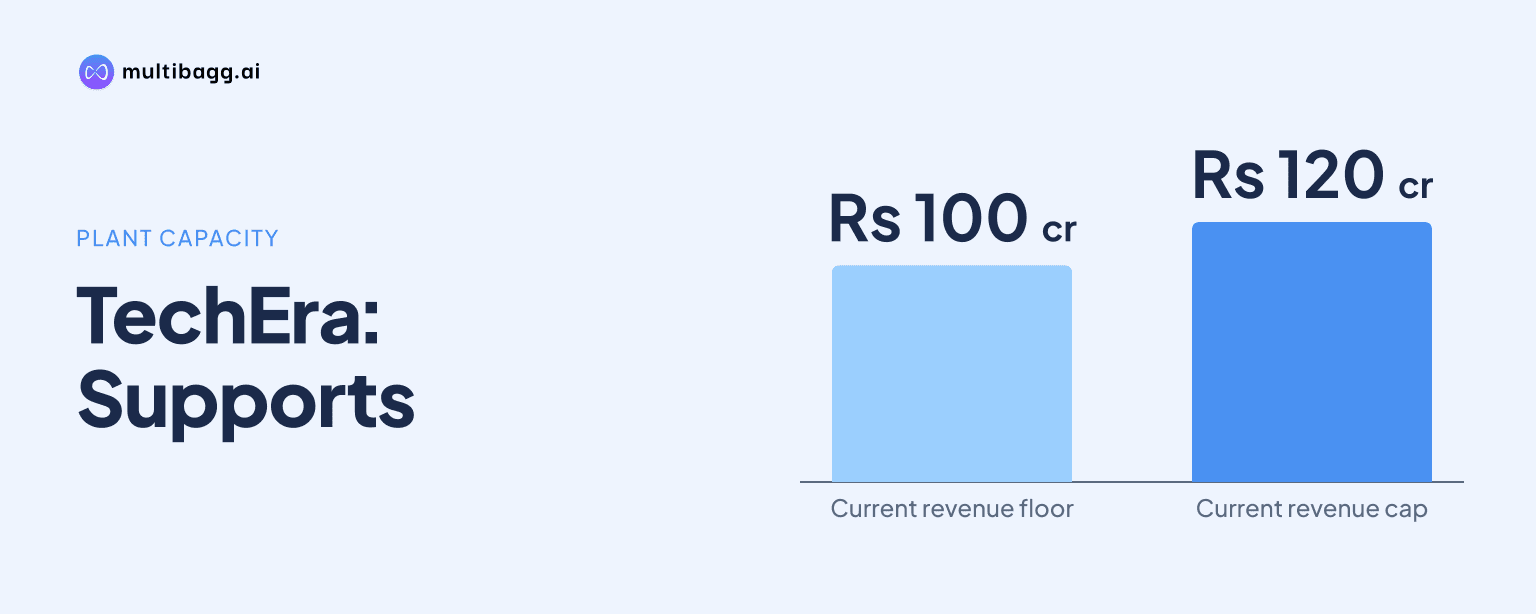
TechEra Engineering (India) Limited said on November 18, 2026 that its existing capacity can support Rs 100 crore to Rs 120 crore of revenue from its current products without further capital expenditure, even as borrowings rose from around Rs 32 crore to around Rs 39 crore. Management said specialised flying-parts opportunities could still require new machinery.
Know Techera Engineering India inside out
Results, valuation, peers and who's buying, in one view.
Can TechEra’s current plant support Rs 120 crore of revenue?
Yes. TechEra said its present capacity and capability can support Rs 100 crore to Rs 120 crore of revenue for the products it is making now, without additional investment. The statement was made in response to an investor’s reference to the company’s infrastructure capacity, and management confirmed that fresh capex was not needed to reach Rs 120 crore of revenue from the existing product portfolio.
The stated capacity range applies to the current product mix rather than every potential aerospace assignment. TechEra said that flying-parts manufacturing may require equipment upgrades every six months or so when it seeks a new capability, a larger client or a different kind of part. This distinguishes capacity available for existing work from machinery needed for a new technical category.
Management used aircraft-engine blades as an example. TechEra said it does not have machinery to make small or large engine blades, although it believes it could undertake such work with the relevant equipment. A machine for that application could cost Rs 5 crore to Rs 6 crore, according to management, while titanium machining and other critical components could also prompt project-specific investment.
Why did TechEra’s borrowings rise to around Rs 39 crore?
TechEra’s borrowings increased from around Rs 32 crore to around Rs 39 crore while it was adding flying-parts manufacturing capability. Management did not provide a breakdown linking individual borrowings to individual equipment purchases, but it described the investment requirement as integral to developing aerospace and defence production capability.
An investor on the November 18 call cited an outflow of around Rs 6.5 crore towards property, plant and equipment, or PPE. TechEra said this spending covered new machines, upgrades, fixturing equipment, machine foundations and related tooling. These additions were directed at flying-parts work, alongside the company’s tooling and fixtures and insourcing activities within aerospace and defence.
Management said profitability could address the balance sheet over the coming two to three years, but it did not commit to becoming debt-free quickly. Its explanation was that a manufacturer needs the same broad set of machines whether it makes one component or repeats production, citing a set of 10 machines as an illustration. The equipment must therefore be installed before a component has reached regular production volumes.
How advanced is TechEra’s flying-parts production capability?
TechEra said around 150 to 160 flying-part components are already in regular production, compared with management’s longer-term discussion of proving 500, 600 or 700 component types and moving them into regular production. Management said the number of proven flying-part components should increase every six months, although it did not disclose a numerical target for the next interval.
The difference between the current 150-to-160-component base and the larger potential production range informs management’s approach to capex and borrowings. TechEra said proving a single component takes four to seven months. That period can delay the point at which machinery and development expenditure translate into recurring manufacturing revenue.
TechEra also described the production opportunity around aircraft platforms. It said it manufactures more than 250 varieties of components in one area and has orders for manufacturing parts related to 15 aircraft. Management said that, once a component is registered as made by TechEra, it can receive the first right of refusal for later requirements, subject to capacity, cost and other conditions.
Got a follow-up? Ask IRIS
What do H1 FY27 revenue and inventory indicate?
TechEra reported revenue of around Rs 22 crore for H1 FY27, the half year ended September 30, 2026, while its order book stood at around Rs 55 crore to Rs 57 crore. The order book was entirely within aerospace and defence, covering tooling and fixtures, flying parts and insourcing, which means the reported H1 revenue represented less work than the value then available for execution.
Management said work in hand and the order book were not fully reflected in the H1 result. It expected inventory to convert in H2 FY27 and said results would turn positive before March 2027. This was management’s expectation, not a disclosed revenue target or earnings forecast.
The company attributed higher inventory to its project-based operating model. A project expected to take six or seven months can extend by a couple of months when part proving remains incomplete, management said. That timing can defer revenue recognition and working-capital conversion even after production work, tooling or component development has begun.
What could cause TechEra to spend more on capex?
A specialised order could require capex despite the stated Rs 100 crore to Rs 120 crore revenue capacity of the current asset base. TechEra identified engine blades, titanium machining and critical components as examples where it may need machinery that is not currently installed. Management said it did not want to rule out capex for the next three or four years for this reason.
TechEra’s direct work with the Indian Air Force could influence the mix of future projects. The company said it had received two Indian Air Force orders as of November 18, 2026. Management said the first, of minor value, took one and a half years to obtain, while the second arrived within four to five months.
Management explained that a successful development order can provide a five-year licence, allowing Indian Air Force bases to order the relevant product through the system. It said several quotations had been submitted after the second order. However, TechEra did not disclose order values, expected volumes, a capex budget or whether such work would require the specialised machinery it discussed.
Conclusion
TechEra’s position is that its current plant can support Rs 100 crore to Rs 120 crore of revenue from the existing product set, so routine capex is not required to reach that range. At the same time, borrowings rose to around Rs 39 crore during a capability-building phase that included around Rs 6.5 crore of PPE spending and a four-to-seven-month proving cycle for each component.
The next item to watch is management’s expectation that inventory will convert and results will turn positive before March 2027. Investors can also monitor whether the number of regularly produced flying-part components rises from the current 150 to 160 at the next six-month update, and whether Indian Air Force opportunities lead to specialised equipment spending.

