








TechEra lowers FY27 growth view to 15%-20% after H1 decline

Find your next multibaggerBe a Pro Investor
Research stocks and track your picks on the go. Download the app.
Key highlights
- TechEra said FY27 growth could be 15%-20%, while 30% remains possible but is not firm.
- TechEra reported H1 FY27 de-growth despite an order book management placed at roughly Rs 55 crore to Rs 60 crore.
- Employee cost increased 38% in H1 FY27 as TechEra recruited and trained personnel for new capabilities.
- TechEra said it has received two direct Indian Air Force orders after its first order took one-and-a-half years to secure.
powered by IRIS
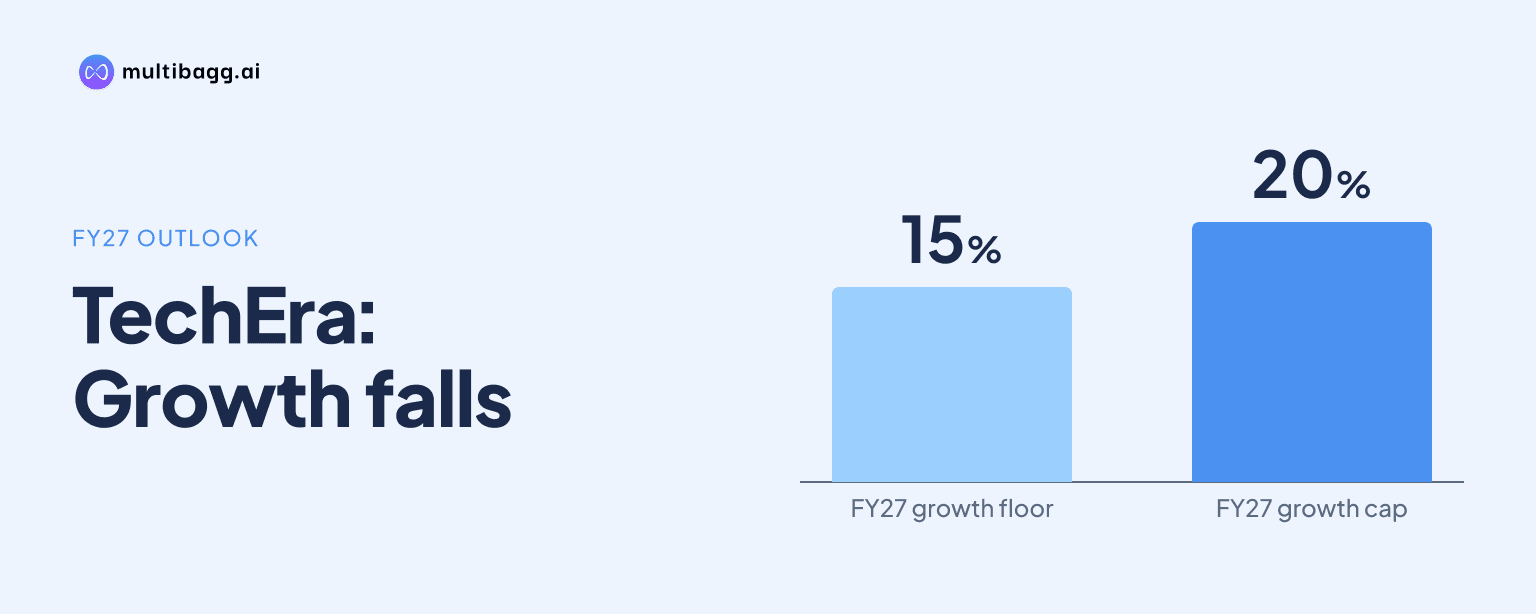
TechEra said FY27 revenue growth is now more likely to be 15%-20% after de-growth in H1 FY27, rather than its earlier 30%-40% expectation. Management attributed the weaker first half to execution-stage delays and investments in flying-parts and insourcing capabilities, while describing its order book as roughly Rs 55 crore to Rs 60 crore.
Know Techera Engineering India inside out
Results, valuation, peers and who's buying, in one view.
Why did TechEra lower its FY27 growth view?
TechEra lowered the practical FY27 growth view because management said retaining 30% growth after H1 FY27 de-growth would be a steep task. Meet Desai said 30% growth was not firm, although he did not rule it out. He said the company should remain positive for FY27, potentially delivering 15%-20% growth or, if execution improves materially, reaching 30%.
The revised range is more cautious than the 30%-40% expectation raised by an investor on the call. Management did not provide a full-year revenue target, an H2 FY27 revenue target or a schedule for converting orders into sales. The 15%-20% range is therefore the clearest current management indication, while 30% remains a possible rather than committed outcome.
Nimesh Desai linked the shortfall to aerospace-sector conversion cycles, particularly government procurement. He said TechEra did not expect the Indian Air Force to take about one-and-a-half to two years to assess domestic manufacturers’ capabilities. In his view, government processes did not move as quickly as the company anticipated, extending the expected growth timeline by another couple of years.
What caused TechEra’s H1 FY27 de-growth?
TechEra said its H1 FY27 de-growth reflected execution delays and capability building, not a shortage of orders or a deliberate pause in production. Meet Desai said the order book had never been higher and put it at nearly Rs 60 crore. He said the company had not held back execution because of weak order inflow.
Management identified data exchanges, customer inspections and part trials as immediate reasons for slower execution. It described these as standard aerospace-industry processes rather than project stoppages. TechEra expects H2 FY27 to be better than H1 FY27, but management did not quantify expected second-half revenue or identify how much of the roughly Rs 55 crore to Rs 60 crore order book will be executed in that period.
A separate drag came from building capabilities for private-sector flying-parts and insourcing work. Management said it had to manufacture products and add them to its portfolio before potential customers could assess the company’s capability. That work was undertaken in H1 FY27 rather than deferred, because waiting for confirmed orders could leave TechEra behind when opportunities materialise.
Employee cost rose 38% in the half year, a figure raised by an investor and addressed by management. Meet Desai said the increase funded manpower-led capabilities that need to be trained around six months before orders begin. Nimesh Desai said the cost base should stabilise in six months, after which the company expects to have one-and-a-half to two years of accumulated capability and experience in the workforce.
Got a follow-up? Ask IRIS
Does TechEra’s order book support a return to growth?
TechEra said its order book can support a return to positive growth, but it did not specify the timing of conversion. An investor cited an order book of Rs 45 crore at the end of H2 FY26. Management subsequently described the current book as nearly Rs 60 crore in one response and around Rs 55 crore in another, indicating a current range of roughly Rs 55 crore to Rs 60 crore.
The company’s bid pipeline does not provide a firm revenue forecast. Meet Desai said submitted proposals are always in three figures, but did not state their currency, conversion rate, expected award dates or value. He said customers themselves lack clarity over conversion cycles, so TechEra cannot reliably predict when submitted proposals will become confirmed orders.
Management said the order book had grown by at least 20%-30% each time it updated investors since April 1 of the previous year, generally at intervals of four to six months. Meet Desai said the same broad pattern should continue, with the book growing every three to four months from around Rs 55 crore. This is management’s expectation, not a disclosed year-end order-book target.
The Indian Air Force could add to order flow. TechEra said it has secured two direct orders from the Indian Air Force, after the first minor-value order took one-and-a-half years and the second arrived within four to five months. Management said it has submitted several additional quotations; a successful development order gives a five-year licence through which Indian Air Force bases can order the relevant product.
Which investments could shape TechEra’s later growth?
TechEra is building flying-parts, insourcing and aircraft-manufacturing-related capabilities ahead of orders. Management said it has recruited and trained personnel for a capability being developed with HAL, which it cited as a reason labour costs appear high. The stated approach is to have skilled people ready when contracts arrive rather than beginning recruitment after an award.
In flying parts, TechEra said it manufactures around 275 to 300 varieties for the domestic market, with quantities of around 3,000 to 4,000 parts. Management said 25%-30% of those parts cannot currently be made by any other domestic supplier, making TechEra the customer’s single source. It said this directory supports bids for FY28 opportunities and is intended to demonstrate capability to private commercial customers.
Ground support equipment remains a routine manufacturing activity and may account for most later execution. Meet Desai said TechEra has added a couple of customers in this domain and expects around 90% of later execution to come from ground support equipment rather than its other two areas. Management did not disclose separate H1 FY27 revenue for ground support equipment, tooling, automation or flying parts.
TechEra’s existing equipment can support Rs 100 crore to Rs 120 crore of revenue using its present products, according to Nimesh Desai. He said new capital expenditure would be opportunity-specific, such as a machine for aircraft-engine blades or critical titanium machining, which could cost Rs 5 crore to Rs 6 crore. Management said no further investment is needed to reach Rs 120 crore of revenue with the current product set.
Conclusion
TechEra’s FY27 growth outlook has become more measured after H1 FY27 de-growth, with management indicating 15%-20% growth as the more likely range and treating 30% as a possibility rather than a firm commitment. The company attributes the gap to inspection, trial and data-exchange cycles, alongside upfront investments in people and flying-parts capabilities. Its roughly Rs 55 crore to Rs 60 crore order book is above the Rs 45 crore cited for the end of H2 FY26, but conversion timing remains unresolved.
The next markers are H2 FY27 execution following customer inspections and trials, and whether the order book continues the 20%-30% growth pattern management cited in updates every four to six months. Investors can also watch for further Indian Air Force orders under the five-year licence arrangement, the stated six-month stabilisation of employee costs, and progress on FY28 flying-parts bids.

