










Tejas Cargo depreciation change limits period comparison
Key highlights
- Tejas Cargo adopted straight-line depreciation for commercial vehicles from April 1, 2026.
- Tejas Cargo set disclosed fleet useful lives ranging from 7 years to 12 years.
- Tejas Cargo reported Rs 25.529 crore of depreciation and amortisation for the half year ended September 30, 2026.
- Tejas Cargo purchased Rs 52.6303 crore of motor vehicles during the September 2026 half year.
powered by IRIS
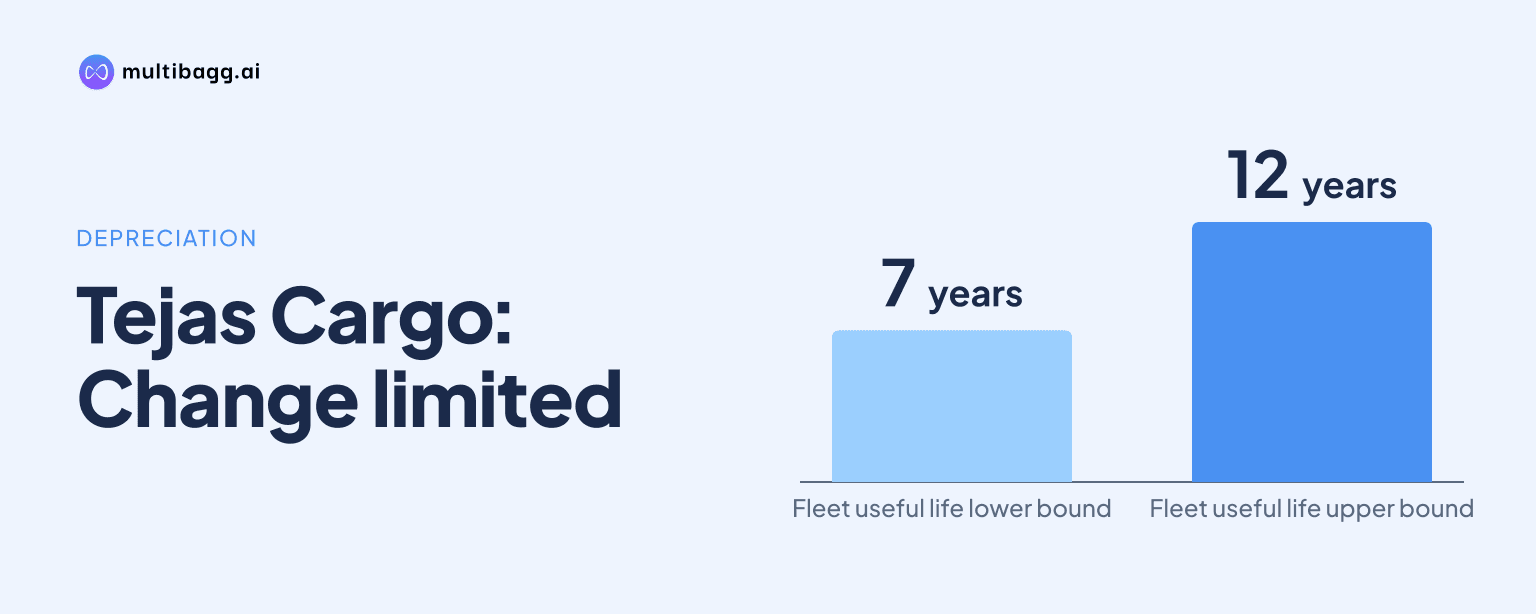
Tejas Cargo India Limited’s switch from the written-down-value method to straight-line depreciation for commercial vehicles from April 1, 2026 makes its Rs 25.529 crore depreciation and amortisation charge for the half year ended September 30, 2026 non-comparable with earlier periods, because the revised estimates were applied prospectively.
Know Tejas Cargo India inside out
Results, valuation, peers and who's buying, in one view.
Why did Tejas Cargo change its fleet depreciation method?
Tejas Cargo changed to straight-line depreciation because management said that method better reflects the pattern in which the fleet’s economic benefits are expected to be consumed. Until March 31, 2026, Tejas Cargo depreciated commercial vehicles using the written-down-value method over the useful lives specified in Part C of Schedule II to the Companies Act, 2013.
Tejas Cargo said its revised assumptions followed an independent technical evaluation and management’s assessment of operating experience, preventive maintenance, overhaul practices, average annual running and manufacturers’ guidance. The assessment also considered national-permit age limits of up to 15 years under the Central Motor Vehicles Rules, 1989, depending on vehicle type.
The company also cited values realised from vehicles sold after they had operated beyond earlier estimated useful lives. Improved road infrastructure, more efficient engines and higher fuel efficiency were further factors cited by Tejas Cargo when it set useful lives and residual values that differ from Schedule II benchmarks.
What useful lives and residual values has Tejas Cargo adopted?
Tejas Cargo has set a seven-year useful life and Rs 3 lakh residual value for 32-foot single-axle containers. For 32-foot multi-axle containers, the disclosed useful life is eight years and the residual value is Rs 3.50 lakh.
Tractors and trailers have the longest stated residual-value amount, at Rs 5 lakh, and a useful life of 12 years. Electric vehicles also have a 12-year useful life, while their residual value is set at 5% of original cost rather than at a fixed rupee amount.
The 12-year estimate for tractors, trailers and electric vehicles is the longest among the four disclosed categories, compared with seven years for single-axle containers. Tejas Cargo said all other asset classes remain depreciated as before over the useful lives set out in Part C of Schedule II.
How did Tejas Cargo report depreciation and profit in September 2026?
Tejas Cargo reported depreciation and amortisation expense of Rs 25.529 crore for the half year ended September 30, 2026, compared with Rs 23.8273 crore for the half year ended September 30, 2025. Profit after tax was Rs 13.81 crore in the latest half year, against Rs 12.6028 crore a year earlier.
The reported year-on-year increase in depreciation and amortisation was Rs 1.7017 crore, while profit after tax rose Rs 1.2072 crore. Tejas Cargo did not disclose a separate rupee impact of the revised depreciation method, useful lives or residual values, so these movements cannot be attributed solely to the accounting-estimate change.
Revenue from operations increased to Rs 342.5441 crore from Rs 301.611 crore, while profit before tax rose to Rs 18.4571 crore from Rs 16.842 crore. Finance costs also increased to Rs 10.3456 crore from Rs 7.1121 crore, another reported cost movement affecting the comparison of earnings across the two half years.
Got a follow-up? Ask IRIS
Why are Tejas Cargo’s earlier results not comparable?
Tejas Cargo accounted for the changes prospectively as changes in accounting estimates under Accounting Standard 10, Property, Plant and Equipment, read with Accounting Standard 5, Net Profit or Loss for the Period, Prior Period Items and Changes in Accounting Policies. The carrying amount of the relevant vehicles at April 1, 2026, after deducting residual values, is being depreciated over their remaining revised useful lives.
This treatment means Tejas Cargo has not restated results calculated under the earlier written-down-value approach. The company expressly said that the half-year results are not comparable with previous periods to the extent of the depreciation revision, and that future-period depreciation will also be affected.
The half year ended March 31, 2026, which preceded the April 1 implementation date, reported depreciation and amortisation of Rs 48.0796 crore and profit after tax of Rs 8.3274 crore. For the year ended March 31, 2026, depreciation and amortisation was Rs 71.9069 crore, compared with Rs 61.0074 crore in the year ended March 31, 2025; both annual periods predate the change.
What do the September 2026 statements show about fleet investment and funding?
Tejas Cargo reported property, plant and equipment of Rs 217.0997 crore at September 30, 2026, up from Rs 190.2293 crore at March 31, 2026. Its consolidated cash-flow statement recorded Rs 52.6303 crore of motor-vehicle purchases during the half year, alongside the revised commercial-vehicle depreciation approach.
Long-term borrowings rose to Rs 113.1734 crore at September 30, 2026 from Rs 96.0205 crore at March 31, 2026. Short-term borrowings increased to Rs 143.7813 crore from Rs 124.2026 crore, while cash and cash equivalents increased to Rs 20.058 crore from Rs 18.9349 crore.
Tejas Cargo said no business segment other than logistics contributed more than 10% of revenue, profit or assets, so segment reporting under Accounting Standard 17 was not applicable. The consolidated results include its wholly owned subsidiary and were reviewed by the Audit Committee and approved by the Board of Directors on November 14, 2026.
Conclusion
Tejas Cargo’s April 1, 2026 revision changes both the depreciation method and key estimates for commercial vehicles, setting useful lives from seven to 12 years and specified residual values. The company reported Rs 25.529 crore of depreciation and amortisation for the September 2026 half year, but has stated that comparisons with earlier results are limited by the prospective treatment.
The next reported periods will extend the use of the revised estimates beyond the first six months after implementation. Investors can watch whether Tejas Cargo provides a quantified effect of the change, as well as fleet investment after Rs 52.6303 crore of motor-vehicle purchases in the half year ended September 30, 2026.