










Tejas Cargo September-half profit rises to Rs 13.81 crore
Key highlights
- Tejas Cargo reported September 2026 half-year revenue from operations of Rs 342.54 crore, versus Rs 301.61 crore a year earlier.
- Tejas Cargo’s consolidated profit for the period increased to Rs 13.81 crore from Rs 12.60 crore in the September 2025 half year.
- Total expenses rose to Rs 328.53 crore from Rs 289.16 crore, while finance costs increased to Rs 10.35 crore from Rs 7.11 crore.
- Tejas Cargo changed commercial-vehicle depreciation to the straight-line method effective 1 April 2026.
powered by IRIS
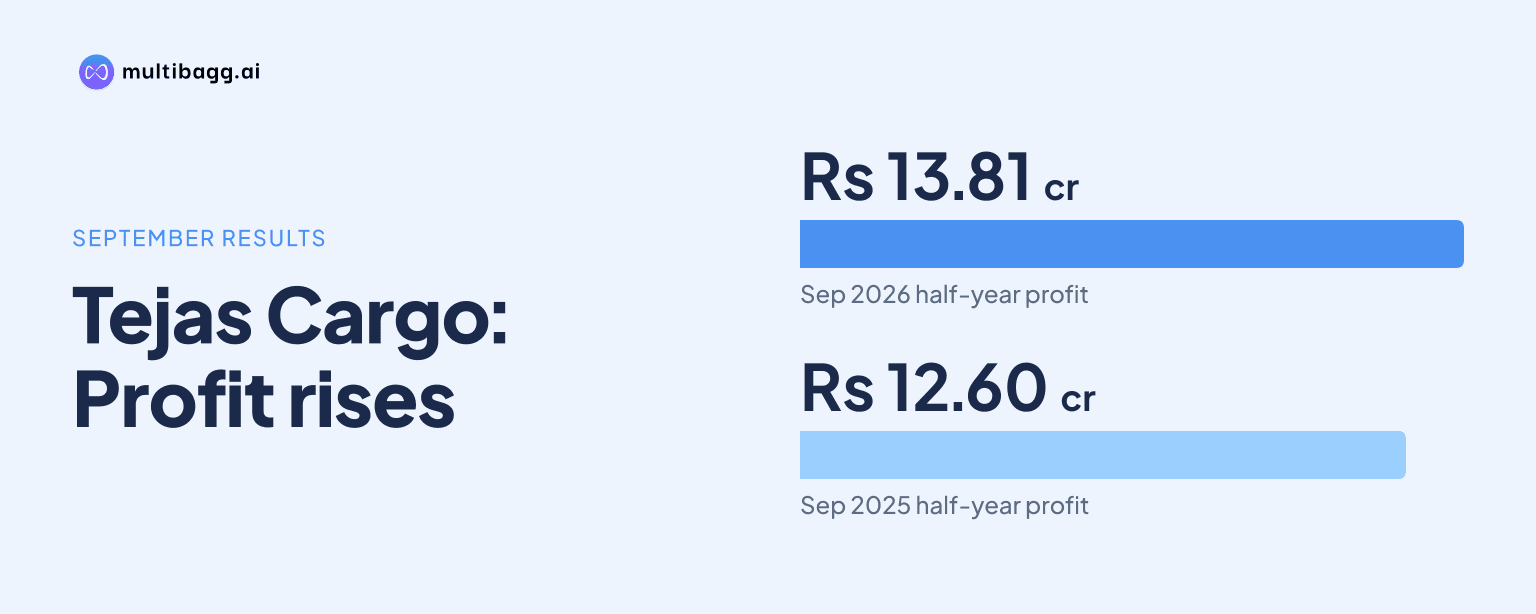
Tejas Cargo India Limited reported consolidated profit of Rs 13.81 crore for the half year ended 30 September 2026, up from Rs 12.60 crore a year earlier, as revenue from operations rose to Rs 342.54 crore from Rs 301.61 crore. The unaudited consolidated results include its wholly owned subsidiary, Tejas Carriers Solutions Private Limited.
Know Tejas Cargo India inside out
Results, valuation, peers and who's buying, in one view.
What did Tejas Cargo report for the September 2026 half year?
Tejas Cargo reported revenue from operations of Rs 342.54 crore for the half year ended 30 September 2026, an increase of Rs 40.93 crore from Rs 301.61 crore in the half year ended 30 September 2025. Other income was Rs 4.45 crore, compared with Rs 4.39 crore a year earlier, taking total income to Rs 346.99 crore.
Profit before tax rose to Rs 18.46 crore from Rs 16.84 crore in the year-earlier half year. Reported profit for the period increased by Rs 1.21 crore to Rs 13.81 crore from Rs 12.60 crore, contrary to a reading that higher revenue was accompanied by a year-on-year fall in consolidated profit.
The September 2026 half-year figures also exceeded those of the immediately preceding half year ended 31 March 2026. Revenue from operations was Rs 327.11 crore and profit for the period was Rs 8.33 crore in the March 2026 half year, versus Rs 342.54 crore and Rs 13.81 crore, respectively, in the latest period. Basic and diluted earnings per share were Rs 5.78, compared with Rs 5.27 a year earlier and Rs 3.49 in the preceding half year.
How did costs change in Tejas Cargo’s September-half results?
Tejas Cargo reported total expenses of Rs 328.53 crore for the half year ended 30 September 2026, compared with Rs 289.16 crore in the corresponding 2025 period. Expenses therefore increased by Rs 39.37 crore, while revenue from operations increased by Rs 40.93 crore and profit before tax rose by Rs 1.62 crore.
Employee benefits expense increased to Rs 11.54 crore from Rs 9.30 crore in the September 2025 half year. Finance costs rose to Rs 10.35 crore from Rs 7.11 crore, while depreciation and amortisation expense increased to Rs 25.53 crore from Rs 23.83 crore. Other expenses declined to Rs 4.13 crore from Rs 4.48 crore over the same year-on-year comparison.
Compared with the half year ended 31 March 2026, depreciation and amortisation expense declined from Rs 48.08 crore to Rs 25.53 crore, while other expenses fell from Rs 6.86 crore to Rs 4.13 crore. However, Tejas Cargo disclosed an accounting-estimate change effective from 1 April 2026, meaning depreciation for the September 2026 half year is not directly comparable with earlier periods.
Why is Tejas Cargo’s depreciation not directly comparable?
Tejas Cargo changed the depreciation method for commercial vehicles from written-down value, or WDV, to the straight-line method, or SLM, from 1 April 2026. The company also revised useful lives and residual values after an independent technical evaluation and management assessment, and its auditor said the resulting depreciation charge is not directly comparable with the corresponding previous period.
The revised useful life is seven years for 32-foot single-axle containers, eight years for 32-foot multi-axle containers, and 12 years for tractors and trailers. Residual values were set at Rs 3 lakh for single-axle containers, Rs 3.50 lakh for multi-axle containers and Rs 5 lakh for tractors and trailers. Electric vehicles have a 12-year useful life and a residual value of 5% of original cost.
Tejas Cargo said its assessment considered fleet operating experience, preventive maintenance, average annual running, manufacturers’ guidance and values realised on vehicle sales. It also cited improved road infrastructure, engine efficiency and national-permit vehicle age limits of up to 15 years depending on vehicle type. The change was accounted for prospectively under Accounting Standard 10 and Accounting Standard 5, so the vehicles’ carrying value at 1 April 2026, less residual value, is being depreciated over their remaining useful lives.
Got a follow-up? Ask IRIS
What do Tejas Cargo’s balance sheet and cash flows show?
Tejas Cargo reported total assets of Rs 499.29 crore at 30 September 2026, compared with Rs 447.43 crore at 31 March 2026. Property, plant and equipment increased to Rs 217.10 crore from Rs 190.23 crore, while capital work in progress declined to Rs 16.00 crore from Rs 19.23 crore during the same six-month period.
Long-term borrowings rose to Rs 113.17 crore at 30 September 2026 from Rs 96.02 crore at 31 March 2026. Short-term borrowings increased to Rs 143.78 crore from Rs 124.20 crore, bringing the two reported borrowing categories to Rs 256.95 crore at the September balance-sheet date. Cash and cash equivalents rose to Rs 20.06 crore from Rs 18.93 crore.
Net cash from operating activities was Rs 22.79 crore in the September 2026 half year, while net cash used in investing activities was Rs 48.06 crore. Tejas Cargo spent Rs 52.63 crore on motor vehicles during the period. Net cash from financing activities was Rs 26.39 crore, including increases of Rs 19.58 crore in short-term borrowings and Rs 17.15 crore in long-term borrowings, offset in part by Rs 10.35 crore of finance costs.
Trade receivables declined to Rs 114.57 crore at 30 September 2026 from Rs 118.26 crore at 31 March 2026. Other current assets increased to Rs 76.54 crore from Rs 49.49 crore, and the cash-flow statement recorded a Rs 27.05 crore outflow from changes in other current assets during the half year.
What business information does Tejas Cargo disclose?
Tejas Cargo said Accounting Standard 17 segment reporting was not applicable because, although it operates multiple business segments, no segment other than logistics contributed more than 10% of revenue, profit or assets. The September 2026 filing therefore does not provide a separate numerical revenue or profit breakdown for non-logistics activities.
The consolidated results include Tejas Carriers Solutions Private Limited, Tejas Cargo’s wholly owned subsidiary. The principal auditor did not directly review the subsidiary’s interim results for the half year ended 30 September 2026; its conclusion on those amounts and disclosures was based on another auditor’s review report provided to management.
Tejas Cargo’s equity shares are listed on NSE Emerge, the National Stock Exchange of India platform. The company prepared the results under the Accounting Standards specified under the Companies Act, 2013, rather than Indian Accounting Standards, because it cited the applicable exemption from mandatory adoption of Indian Accounting Standards. The board and audit committee reviewed and approved the results on 14 November 2026.
Conclusion
Tejas Cargo’s September 2026 half-year filing shows that revenue and reported consolidated profit both increased year on year, with revenue rising to Rs 342.54 crore and profit reaching Rs 13.81 crore. Higher employee benefits, finance costs and depreciation were recorded alongside the revenue increase, while total expenses rose to Rs 328.53 crore from Rs 289.16 crore.
The next reported periods will provide a longer view of the depreciation estimate change introduced on 1 April 2026, which the company and its auditor say limits comparison with earlier depreciation charges. Investors can also track further vehicle investment after the Rs 52.63 crore spent on motor vehicles in the September half year, together with movements in borrowings and other current assets.