










Tenneco Clean Air India Reports 34.2% Q2 Revenue Growth
Key highlights
- Tenneco Clean Air India reported Q2 FY27 revenue of ₹1,718 crore, up 34.2% year on year.
- Q2 FY27 EBITDA rose 20.7% to ₹262 crore and profit after tax increased 15.0% to ₹173 crore.
- The company announced approximately ₹45 crore of capital expenditure for a West India Clean Air plant.
- Tenneco Clean Air India's order book is approximately ₹16,500 crore, including ₹875 crore from export programmes.
powered by IRIS
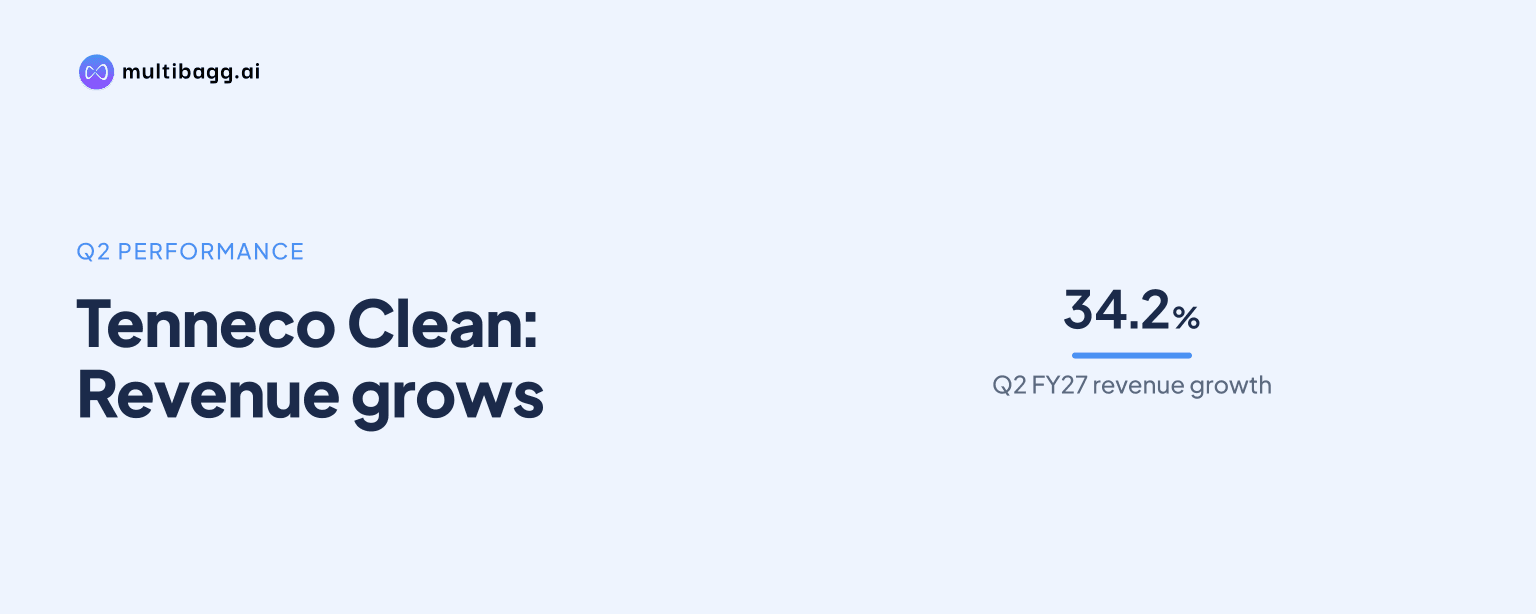
Tenneco Clean Air India Limited reported Q2 FY27 revenue of ₹1,718 crore, a 34.2% year-on-year increase, while planning a ₹45 crore Clean Air manufacturing plant in West India. The performance highlights continued demand across its emissions-control and suspension businesses, although its EBITDA margin on value-added revenue declined by 165 basis points.
Know Tenneco Clean Air India inside out
Results, valuation, peers and who's buying, in one view.
What did Tenneco Clean Air India report in Q2 FY27?
Tenneco Clean Air India reported higher revenue, EBITDA and profit for Q2 FY27. Revenue rose 34.2% year on year to ₹1,718 crore, while EBITDA increased 20.7% to ₹262 crore. Profit after tax grew 15.0% to ₹173 crore.
The growth in EBITDA was slower than the rise in revenue, reflected in the margin movement. EBITDA margin on value-added revenue was 17.2%, down 165 basis points from the comparable period. The earnings summary does not provide a detailed segment-wise explanation for the margin decline, but it places the result alongside the company’s expansion plans in Clean Air manufacturing.
The reported figures matter because the company supplies components tied to two major automotive requirements: exhaust aftertreatment systems that reduce vehicle emissions and suspension products such as shock absorbers and struts. Its Advanced Ride Technologies business is described as India’s largest supplier of shock absorbers and struts for passenger vehicles.
Why is Tenneco Clean Air India adding a West India plant?
Tenneco Clean Air India is planning the West India Clean Air plant to keep manufacturing capacity ahead of growing customer commitments. The company disclosed capital expenditure of about ₹45 crore for the facility, which complements an earlier announced plant in North India.
The planned plant comes as the company’s total order book has reached approximately ₹16,500 crore. Management said this book covers more than 100% of its FY30 revenue plan. About 35% of the orders are for Clean Air and Powertrain Solutions, while Advanced Ride Technologies accounts for about 65%. Export programmes contribute ₹875 crore to the order book.
A separate disclosure in May 2026 involved Tenneco Automotive India Private Limited, a material subsidiary of the listed company. Its board approved a new factory in Western India for front struts and rear shock absorbers, with capacity of about 2.1 million units annually to be added in phases during FY27 and FY28.
The supplied material contains differing investment references for that suspension project. One disclosure describes an investment of ₹690 million, which normalises to ₹69 crore, while another reference describes ₹690 crore. The investment amount for that specific project therefore cannot be treated as consistent from the provided information.
How tight is Tenneco Clean Air India's suspension capacity?
Tenneco Clean Air India's suspension operations were operating at 90% utilisation in FY26, indicating limited headroom at existing facilities. The company stated that plants making struts and shock absorbers had an installed annual base of 21 million units.
Another company disclosure cited current annual production capacity of 19.69 million units. These figures may reflect different reporting dates, product definitions or facilities, but the supplied information does not explain the difference. Both disclosures point to a large existing manufacturing base and capacity pressure in the suspension business.
The Western India suspension factory is intended to address that pressure. The material says the facility is expected to add about 2.1 million units of annual capacity for front struts and rear shock absorbers, with additions phased across FY27 and FY28. It also refers to a ₹70 crore Advanced Ride Technologies plant in the western region and indicates that the new plant is expected to be operational in FY28.
Tenneco has also introduced India’s first electronic suspension and identified the DCx DaVinci suspension system as a strategic product development. These product initiatives sit alongside the physical capacity addition, though the company has not provided revenue guidance specifically linked to either programme.
Got a follow-up? Ask IRIS
What are the key financial and expansion figures?
The key figures show strong Q2 growth, a sizeable order book and multiple capacity projects across Clean Air and Advanced Ride Technologies. The company’s disclosed FY27 capital expenditure range is ₹350 crore to ₹450 crore, including ₹140 crore for two announced plants according to the supplied material.
The order book mix also shows that Advanced Ride Technologies remains the larger contributor to committed business, at roughly 65% of the total, compared with about 35% for Clean Air and Powertrain Solutions. For investors, this makes execution in the suspension business particularly relevant even as the new Q2 announcement concerns a Clean Air facility.
The company listed on the BSE at a 25% premium on 19 November, according to the supplied company-news information. No current share price, market capitalisation or trading movement was provided, so the direct stock-market reaction to the Q2 result or plant announcement cannot be assessed from the available data.
How do regulations and customer demand shape the expansion?
Tenneco Clean Air India's expansion is linked to demand from original equipment manufacturers and to tightening vehicle-efficiency and emissions requirements. The supplied material refers to CAFE III, with a 33% carbon dioxide target beginning in April 2027, as well as tighter BS-VII and TREM-V norms.
These regulatory changes are relevant to the company’s Clean Air and Powertrain Solutions products because exhaust aftertreatment systems are designed to reduce pollutants from engine gases. The article material does not quantify the revenue opportunity from the rules, but the ₹16,500 crore order book gives a measurable indication of current customer commitments.
The company is also balancing expansion with profitability. The 165-basis-point decline in Q2 EBITDA margin on value-added revenue means that revenue growth did not fully translate into margin expansion during the quarter. The available disclosures do not assign a specific cause, so it would be premature to attribute the movement to pricing, input costs, start-up expenses or product mix.
Conclusion
Tenneco Clean Air India's Q2 FY27 results showed 34.2% revenue growth to ₹1,718 crore, alongside gains in EBITDA and profit. The ₹45 crore West India Clean Air plant and the substantial ₹16,500 crore order book show that capacity planning is central to the company’s response to committed demand across emissions-control and suspension products.
The next points to watch are execution of the West India and North India projects, phased addition of suspension capacity during FY27 and FY28, and margin performance after the 165-basis-point decline in Q2. Investors will also need clarity on the differing investment figures cited for the Western India suspension project and on the pace at which new facilities begin contributing revenue.