










Thyrocare Specialty Testing Starts With Maternal Screening
Key highlights
- Thyrocare launched its specialty diagnostics segment in May 2026, starting with reproductive genomics and maternal screening.
- Thyrocare serves 1 lakh patients daily across 4,500 pin codes and reports a 99% on-time phlebotomist arrival rate.
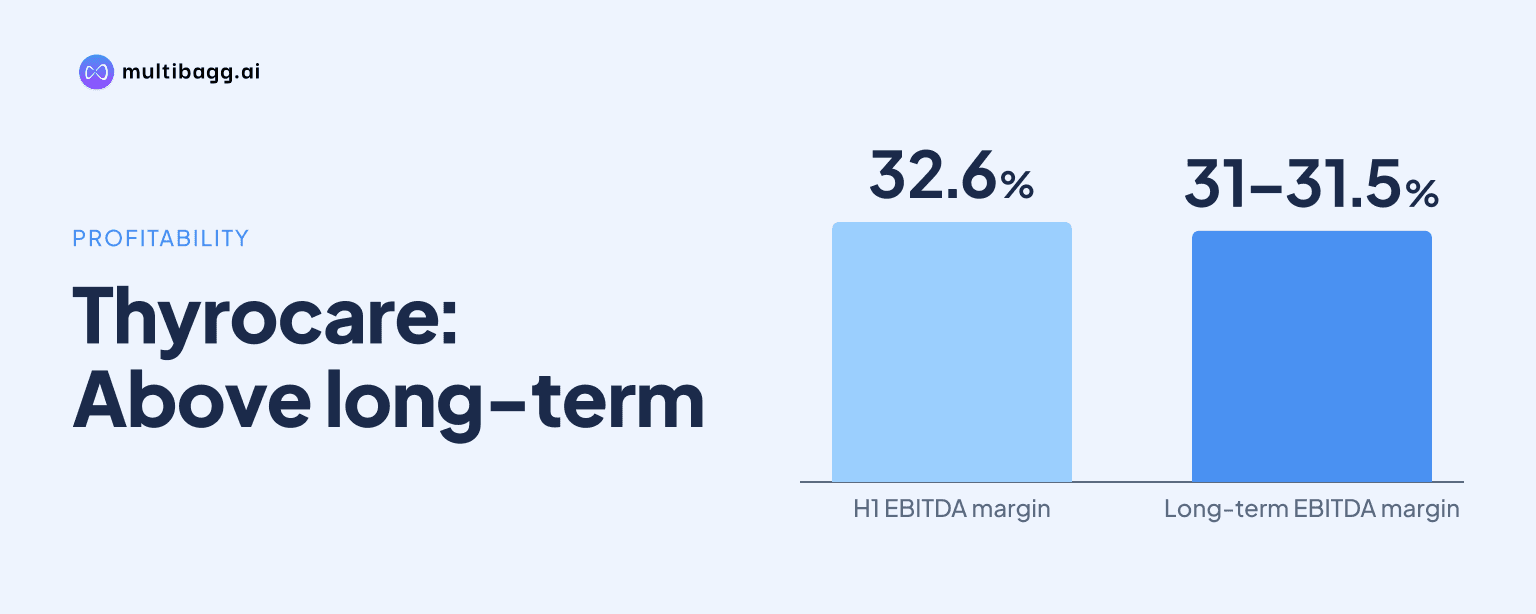
- The company reported a 32.6% EBITDA margin in H1 and maintains a long-term margin anchor of 31% to 31.5%.
- Test volume increased 27% while patient growth was 13%, resulting in a 12% increase in tests per patient.
powered by IRIS
Thyrocare Technologies Limited has begun specialty diagnostic testing after launching the segment in May, with reproductive genomics and maternal screening as its initial menu. Management said it funded related capital expenditure last financial year and assembled an industry-experienced team to market the tests to doctors, nursing homes and practitioners serving relevant clinical needs.
Know Thyrocare Technologies inside out
Results, valuation, peers and who's buying, in one view.
What specialty tests has Thyrocare started offering?
Thyrocare has started specialty testing centred on reproductive genomics, with maternal screening forming the main initial set of tests. Rajdeep Panwar said on the October 29, 2026 earnings call that the company is building its offering around this area and expects the menu to extend into more detailed diagnosis related to maternal screening. This shows that the segment has moved from a stated strategic intention to testing and marketing activity.
The specialty segment was launched in May, and Thyrocare had already invested the required capital expenditure in the previous financial year, according to Panwar. Management did not disclose the amount of that capital expenditure, the number of tests in the initial menu, pricing, test volumes or segment revenue. It also did not specify a timetable for adding the more detailed diagnostic tests it described.
The initial focus differs from Thyrocare's broader routine-pathology model because the company is targeting a clinically specific diagnostic pathway. Management described reproductive genomics as the starting point, rather than claiming a broad launch across all genetic-testing categories. This narrower starting menu is consistent with the company having put in place a team with scientific knowledge of the tests and the clinical settings in which they are used.
How will Thyrocare sell reproductive genomics tests?
Thyrocare will sell the initial specialty menu through a dedicated, industry-sourced team that engages doctors, nursing homes and other clinical practitioners. Panwar said the team has scientific know-how about the tests and experience in meeting the relevant clients. That model is distinct from a consumer-only approach because the stated customer-contact points include medical professionals and care providers.
The company did not give a headcount for this specialty team, its geographic coverage, the number of institutions contacted or the number of referrals generated since May. However, management linked rising employee costs to investment in field-force personnel and new technologies. Rahul Guha said investments in genomics, field-force teams and product launches are being funded from operating leverage in the underlying business.
Thyrocare's existing scale provides context for why management is investing in specialised capabilities. The company said it serves 1 lakh patients daily across 4,500 pin codes and measures a 99% on-time phlebotomist arrival rate. That operating network relates to the established diagnostic business, while the specialty strategy adds a more focused physician and nursing-home engagement channel for reproductive genomics and maternal screening.
Got a follow-up? Ask IRIS
What does specialty testing mean for Thyrocare's margins?
Thyrocare has not provided a separate margin target for specialty diagnostics, but management said it intends to fund growth investments within operating leverage and anchor long-term EBITDA margin at about 31% to 31.5%. EBITDA means earnings before interest, tax, depreciation and amortisation. Guha said the company delivered a 32.6% EBITDA margin in the first half while continuing to invest in growth initiatives.
Management specifically included genomics and field-force investment among the uses of operating leverage, alongside marketing for the pregnancy-kit launch. The pregnancy-kit launch had incurred roughly Rs 1.5 crore of expense in Q2, with another Rs 3 crore expected in Q3, but these figures were not identified as specialty-diagnostics spending. Therefore, the call supports an overall investment framework, not a quantified profitability forecast for reproductive genomics.
The wider diagnostics model is also seeking to raise revenue per patient through bundled tests. Management said test volume rose 27% while patients rose 13%, producing a 12% increase in tests per patient. Guha said collection, transport and laboratory processing costs are largely incurred at the patient level, so additional tests within a patient interaction can carry gross-margin contribution after those fixed patient-level steps.
How does specialty testing fit Thyrocare's wider growth plan?
Thyrocare views specialty and differentiated testing as potential additions to its portfolio, including through acquisitions. Guha said the company is open to acquisitions for geographical expansion in Gujarat, Rajasthan, the Northeast and parts of South India, as well as specialty, genomics and other differentiated testing. He did not identify an acquisition target, deal size or expected completion date.
The company continues to rely principally on network expansion for near-term growth in its established business. Management said average revenue per active franchisee has remained near Rs 1.2 lakh per quarter for roughly 12 quarters, because mature franchisees grow while newly added franchisees begin from lower revenue levels. Guha said he would place more emphasis on franchise additions than higher average revenue per franchisee as the driver of growth for some time.
That comparison shows the different roles of the two initiatives. Franchise expansion is a disclosed volume and network-growth mechanism within the existing model, while specialty testing is a newer segment launched in May with an initial reproductive-genomics menu. Management has disclosed testing, marketing, capital expenditure and staffing for specialty, but not yet a standalone revenue contribution or volume measure that would allow direct comparison with the franchise business.
Conclusion
Thyrocare has made specialty diagnostics operational rather than merely aspirational: it launched the segment in May, began testing and marketing, and started with reproductive genomics focused largely on maternal screening. Its dedicated clinical-sales model and prior-year capital expenditure indicate that the business is being built as a specialised service alongside a diagnostics network serving 1 lakh patients a day.
The next points to watch are the addition of detailed maternal diagnostic tests, any quantified specialty revenue or volume disclosure, and management's ability to keep investments within its stated long-term EBITDA margin anchor of about 31% to 31.5%. Management also said it remains open to specialty and genomics acquisitions, though no target, transaction or timetable has been disclosed.