










Tirupati Forge targets Q4 FY27 M107 commercial output
Key highlights
- Tirupati Forge manufactured its first 200 units of 155mm M107 empty shells in Q2 FY27.
- Tirupati Forge expects M107 commercial production to commence in Q4 FY27 after proof testing.
- Tirupati Forge expects 155mm ERFB shell commercial production by H1 FY28.
- Tirupati Forge reported Q2 FY27 total income of Rs 58.15 crore, up 51% quarter on quarter.
powered by IRIS
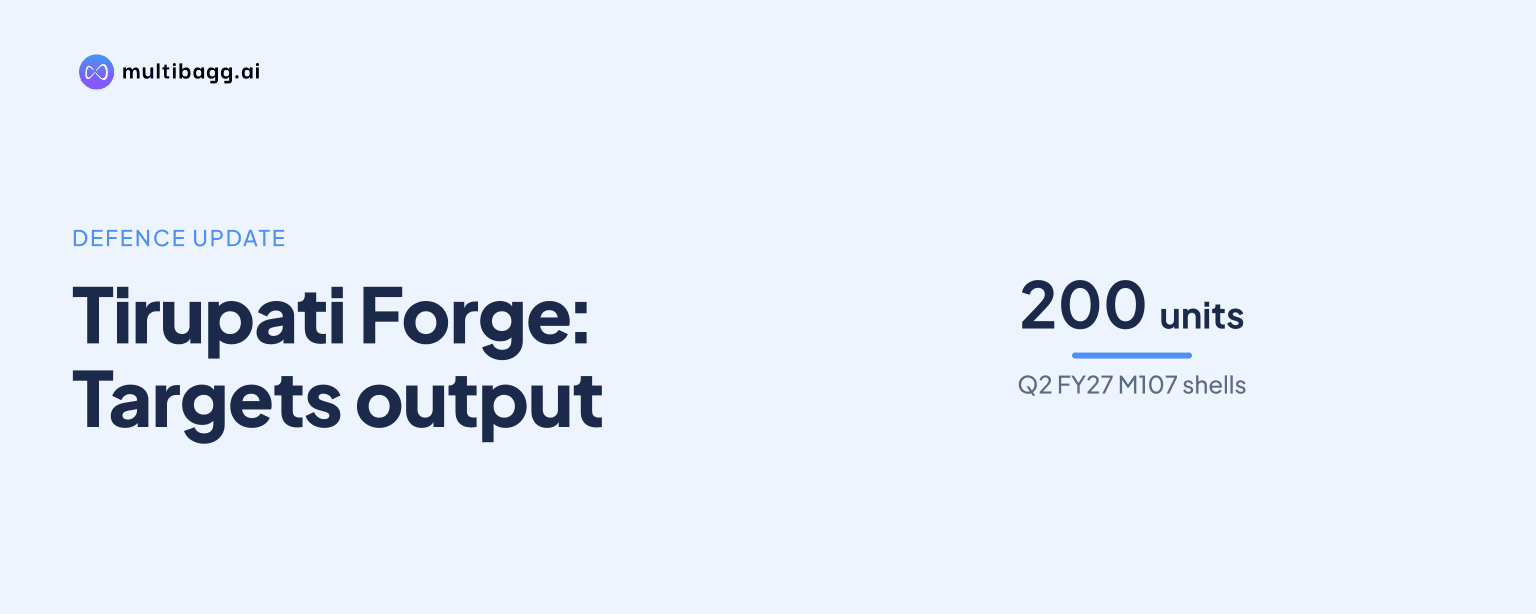
Tirupati Forge Limited completed its first batch of 200 155mm M107 empty shells in Q2 FY27 and expects commercial production to commence in Q4 FY27, subject to proof testing after final inspection. The company has also received a DPIIT manufacturing licence and completed forging and machining of a separate 155mm ERFB shell body.
Know Tirupati Forge inside out
Results, valuation, peers and who's buying, in one view.
What has Tirupati Forge completed on the M107 programme?
Tirupati Forge has manufactured 200 units in its initial batch of 155mm M107 empty shells during Q2 FY27. The company describes the batch as a milestone towards product validation and commercial readiness, rather than as recurring commercial production or a disclosed customer delivery.
The 200 units are empty shells, not completed ammunition, and the presentation does not identify a buyer, contract value or order quantity. Tirupati Forge said the Defence team visited its facility for final inspection for proof testing; its chairman’s update states that final inspection was completed and proof-testing results were awaited.
The manufacturing step places the M107 programme ahead of its disclosed commercial-production target but leaves validation unfinished. Tirupati Forge has not stated the proof-testing date, the testing agency, a specific M107 production capacity or the quantity it intends to produce once commercial output begins.
When will Tirupati Forge begin M107 commercial production?
Tirupati Forge expects commercial production of its 155mm M107 empty shells to commence in Q4 FY27. This is a company expectation rather than a confirmed launch, because proof-testing results for the initial 200-shell batch were still pending in the chairman’s Q2 FY27 update.
The M107 timetable is earlier than the company’s plan for its other disclosed shell product, the 155mm ERFB shell. Tirupati Forge expects ERFB commercial production by H1 FY28, after completing forging and machining of the ERFB shell body, while M107 has reached initial-batch manufacturing and the inspection-and-testing stage.
The presentation gives no revenue forecast from either programme, despite stating that Tirupati Forge sees encouraging defence order-book visibility. It also does not disclose M107 pricing, customer names, capacity allocated to defence manufacturing or the status of any binding commercial agreement.
How does the ERFB programme differ from the M107 project?
Tirupati Forge’s ERFB programme is at a different manufacturing stage and has a later commercial target than M107. The company has completed forging and machining of the 155mm ERFB shell body, whereas the M107 project has produced 200 empty shells and is awaiting proof-testing results before its expected Q4 FY27 commercial start.
Tirupati Forge calls ERFB a highly specialised defence product and says only a limited number of manufacturers globally have the needed technical expertise and manufacturing capability. The company says it is among a select group with these capabilities, but it does not quantify that group or identify other manufacturers in the presentation.
Management reported strong commercial interest in ERFB from multiple prospective customers in international markets. However, Tirupati Forge did not disclose customer identities, expected volumes, product prices or signed orders, so the presentation establishes commercial interest rather than reported ERFB sales.
Got a follow-up? Ask IRIS
What manufacturing base supports Tirupati Forge’s defence plans?
Tirupati Forge operates a manufacturing unit spread across 5 acres, with in-house testing and research and development laboratories and installed forging capacity of 15,000 tonnes per annum. The company also reports ring-rolling capacity of 15,000 tonnes per annum, although it does not allocate either capacity figure between defence and its existing industrial products.
Its disclosed processes include forging, machining, heat treatment, ring rolling, paint-shop operations and hydraulic extrusion. The heat-treatment facility has capacity of 1,000 kilograms per hour, while the company operates a 630-ton Lasco hydraulic extrusion press and says it is among only three firms in India with an installed 630-ton Lasco press line.
The machining facility covers computer numerical control machines ranging from 15mm to 800mm outer diameter, with fully automatic vertical machining centre machines for up to 1,000mm outer diameter. These manufacturing capabilities provide context for the completed forging and machining of the ERFB shell body, but Tirupati Forge has not specified the equipment used for M107 or ERFB production.
Tirupati Forge says it has more than 15 years of experience manufacturing forged and machined components. One company slide attributes 55% of revenue to overseas markets, including the United States, Canada, Malaysia, Europe and African countries, while another reports global revenue share of 69% and domestic revenue share of 31%; the presentation does not explain the difference between the two overseas measures.
What do Tirupati Forge’s Q2 FY27 financial figures show?
Tirupati Forge reported total income of Rs 58.15 crore in Q2 FY27, compared with Rs 38.43 crore in Q1 FY27, a quarter-on-quarter increase of 51%. The company attributed the increase to robust demand from the North American market, rather than to disclosed defence-programme revenue.
Profit after tax rose 238% quarter on quarter to Rs 4.12 crore in Q2 FY27 from Rs 1.22 crore in Q1 FY27. EBITA, or earnings before interest, taxes and amortisation, increased 74% to Rs 8.188 crore from Rs 4.703 crore over the same two quarters.
The financial comparison covers the established business during Q2 FY27, when the M107 batch was manufactured and ERFB shell-body work was completed. Tirupati Forge’s product portfolio is led by flanges at 66.67% of sales, while oil and gas represents 66.66% of sales by customer industry, indicating that defence was not presented as a separately quantified revenue segment.
Conclusion
Tirupati Forge has moved the M107 project from initial development into manufactured-batch validation by completing 200 155mm empty shells, conducting final inspection and awaiting proof-testing results. Its separate ERFB work broadens the disclosed defence pipeline, but neither product has reported commercial revenue, contract values or production-volume commitments in the presentation.
The next disclosed operational markers are the M107 proof-testing outcome and whether the Q4 FY27 commercial-production expectation is met. Management also expects ERFB commercial production by H1 FY28 and reports interest from prospective international customers, while customer contracts, defence capacity allocation and revenue contribution remain unresolved in the company’s update.