










Trident Limited Q2 Profit Rises; ₹4,650 Crore Plan Approved
Key highlights
- Trident Limited's Q2 net profit increased year-on-year on both standalone and consolidated bases.
- Revenue from operations was ₹1,650 crore, up 3% quarter-on-quarter.
- Q2 EBITDA was ₹248 crore, up 56% quarter-on-quarter.
- Trident Limited received in-principle approval for a ₹4,650 crore expansion across four segments.
powered by IRIS
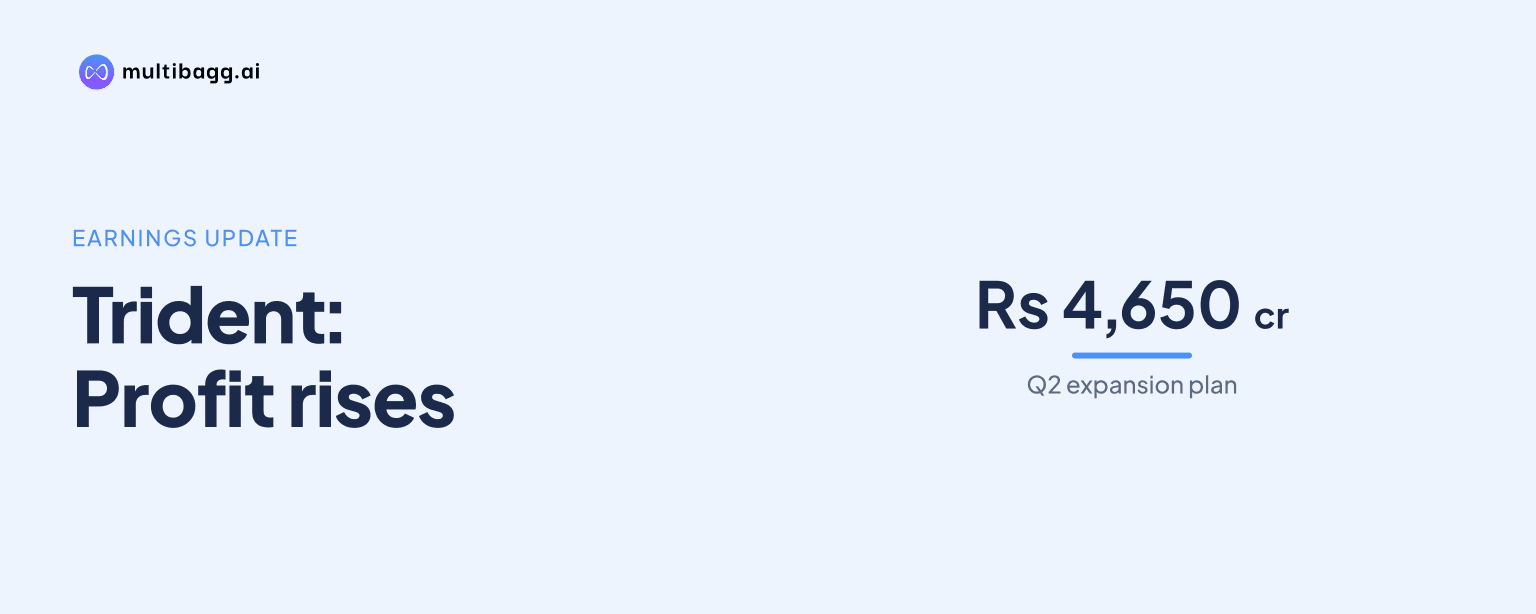
Trident Limited reported higher year-on-year profit in the second quarter while receiving in-principle approval for a ₹4,650 crore expansion across yarn, sheeting, paper and renewable power. The plan is significant because it combines capacity additions in Trident Limited's core manufacturing businesses with investment in renewable energy, while the quarterly numbers showed differing trends in profit and standalone revenue.
Know Trident inside out
Results, valuation, peers and who's buying, in one view.
What did Trident Limited report in Q2?
Trident Limited reported year-on-year growth in net profit on both standalone and consolidated bases during Q2, although standalone revenue declined from a year earlier. The result indicates that profit improved despite lower standalone revenue, but the supplied interim report summary does not disclose the absolute standalone or consolidated net-profit figures.
Revenue from operations was reported at ₹1,650 crore, up 3% quarter-on-quarter. EBITDA was ₹248 crore, representing a 56% quarter-on-quarter increase. These figures point to an improvement in operating earnings compared with the preceding quarter, while the year-on-year decline in standalone revenue remains an important part of the quarterly picture.
The distinction between standalone and consolidated reporting matters for investors. Standalone accounts reflect the parent company's business, while consolidated accounts include its subsidiaries and other entities within the group. Trident Limited's profit growth on both measures provides a broader view of the reported earnings performance, even as standalone revenue moved lower year-on-year.
What is included in Trident Limited's ₹4,650 crore expansion plan?
Trident Limited has received in-principle approval for a ₹4,650 crore multi-segment expansion covering yarn, sheeting, paper and renewable power. The proposal links the company's textile and paper operations with renewable-power capacity, consistent with its presence across yarn, home textiles, paper, chemicals and energy.
The approval is described as in principle, which means the proposal has advanced at the board or company planning level but the supplied information does not set out a project timeline, individual capacity additions, funding structure, implementation phases or commissioning dates. Those details will be relevant to assessing the investment's eventual operating and financial effect.
Yarn and sheeting are part of Trident Limited's textile portfolio, while paper is another major manufacturing segment for the company. Renewable power is also part of its operations. A plan covering all four areas suggests that the company is considering expansion across several existing business lines rather than focusing on a single product category.
How does the new proposal fit Trident Limited's earlier investment plans?
Trident Limited's ₹4,650 crore proposal follows other expansion and capital-expenditure initiatives disclosed in the supplied material. The group had earlier earmarked ₹1,000 crore for FY25-26 for sustainability, modernisation and asset-enhancement initiatives, while also discussing greenfield expansion planning in India.
The company had separately announced a ₹2,000 crore expansion plan in Punjab. That plan included ₹1,500 crore for terry towel capacity and paper-facility upgrades in Barnala, and ₹500 crore for a corporate office and capacity-building centre in Mohali. The supplied information said this Punjab initiative was expected to create around 2,000 jobs, primarily involving semi-skilled rural women.
Trident Limited also previously outlined plans to invest ₹3,000 crore in Madhya Pradesh to expand operations, with an indicated potential for 3,000 new jobs. The available material does not establish whether the newly approved ₹4,650 crore plan includes, replaces or is separate from these earlier proposals. Investors will need project-specific disclosures to understand the relationship between these investment plans.
Got a follow-up? Ask IRIS
What does the Q2 update mean for investors and operations?
For investors, the update combines stronger reported Q2 profit with a large proposed capital programme. The 56% quarter-on-quarter increase in EBITDA to ₹248 crore is the clearest disclosed operating improvement, while the 3% quarter-on-quarter rise in revenue from operations to ₹1,650 crore provides context for the earnings change.
At the same time, the decline in standalone revenue on a year-on-year basis means the results do not show uniform growth across all reported measures. Since exact profit amounts, segment-wise revenue, margins, capital funding and expected project returns are not provided in the supplied report summary, the financial impact of the expansion cannot yet be quantified.
The proposed investment could affect manufacturing activity in the company's established product categories, including yarn, bed linen, towels and wheat-straw-based paper. Its renewable-power component is relevant to an industrial business with energy requirements, but the supplied information does not specify the planned capacity, location, cost savings or procurement model.
No share-price movement linked to the Q2 result or expansion approval is provided in the source material. As a result, the immediate market reaction cannot be assessed from the available information. The central disclosed facts are the year-on-year profit increase, the mixed standalone revenue trend and the scale of the proposed ₹4,650 crore investment.
Why are textile, paper and renewable-power investments relevant now?
Trident Limited operates as a vertically integrated manufacturer in textiles and paper, with manufacturing facilities in Barnala, Punjab, and Budni, Madhya Pradesh. Its products include yarn, terry towels, bedsheets, paper and chemicals, and it sells in India, the United States and international markets.
The company's prior statements on modernisation, sustainability and domestic-business expansion provide context for the renewable-power element of the latest plan. Trident Limited had also said it aimed to increase domestic business three-fold by 2027 through its home-textile brand, myTrident, including expansion into the luxury category through LUXEHOME by myTrident.
The new plan is therefore relevant not only because of its ₹4,650 crore size, but also because it spans the manufacturing categories that underpin Trident Limited's business. The absence of disclosed project milestones means that execution progress, detailed capex allocation and the eventual funding plan will be key areas for future company communication.
Conclusion
Trident Limited's Q2 update showed higher year-on-year net profit on standalone and consolidated bases, alongside revenue from operations of ₹1,650 crore and EBITDA of ₹248 crore. The in-principle approval for a ₹4,650 crore expansion adds a substantial investment proposal across yarn, sheeting, paper and renewable power, although standalone revenue declined year-on-year.
The next disclosures to watch are the expansion's project locations, timelines, capacity additions, funding structure and relationship with Trident Limited's earlier Punjab and Madhya Pradesh plans. Investors will also look for future quarterly data showing whether the reported EBITDA improvement and profit growth continue as the company pursues its investment programme.