










United Drilling Tools Q2 profit falls 70.4% to ₹1.70 crore
Key highlights
- United Drilling Tools reported Q2 FY27 revenue of ₹17.53 crore, down 68.5% year on year.
- Q2 FY27 consolidated net profit fell 70.4% year on year to ₹1.70 crore.
- Earnings per share declined to ₹0.85 from ₹2.83 in Q2 FY26.
- Standalone Q2 FY27 revenue fell 70.8% year on year to ₹16.24 crore.
powered by IRIS
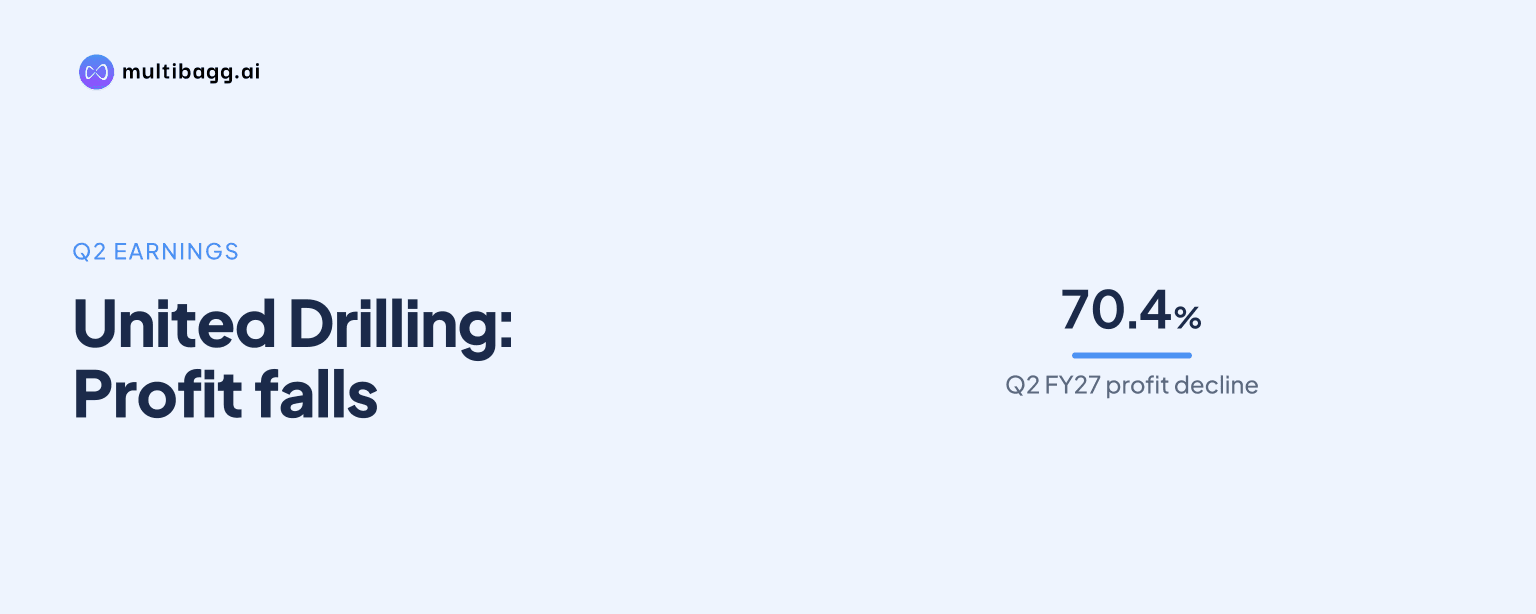
United Drilling Tools Ltd reported consolidated net profit of ₹1.70 crore for the quarter ended September 30, 2026, down 70.4% year on year, as revenue from operations fell 68.5% to ₹17.53 crore in Q2 FY27. The result shows a sharp reduction in quarterly business volume despite a better year-on-year operating cost ratio.
Know United Drilling Tools inside out
Results, valuation, peers and who's buying, in one view.
Why did United Drilling Tools' Q2 FY27 profit decline?
United Drilling Tools' profit declined because the company recorded a steep fall in revenue in both year-on-year and sequential comparisons. Consolidated revenue from operations was ₹17.53 crore in Q2 FY27, compared with ₹55.60 crore in Q2 FY26 and ₹34.49 crore in Q1 FY27. Net profit fell from ₹5.75 crore a year earlier and ₹4.30 crore in the preceding quarter.
Total income for the September quarter was ₹18.00 crore, down 68.3% year on year and 48.2% quarter on quarter. Expenditure declined to ₹15.59 crore, but its 67.9% year-on-year reduction was marginally lower than the fall in total income. Profit before tax consequently declined to ₹2.41 crore from ₹8.2 crore in Q2 FY26 and ₹6.1 crore in Q1 FY27.
The reported effective tax rate was broadly stable near 29% across the three periods cited. This indicates that tax was not the main reason for the movement in reported profit. The primary driver was the lower revenue base and the corresponding fall in profit before tax.
What were United Drilling Tools' key Q2 FY27 financial numbers?
United Drilling Tools reported ₹17.53 crore of revenue, ₹18.00 crore of total income and ₹1.70 crore of consolidated net profit in Q2 FY27. Earnings per share stood at ₹0.85, compared with ₹2.83 in Q2 FY26 and ₹2.14 in Q1 FY27.
Net profit was down 60.4% sequentially, while revenue declined 49.2% from the June quarter. The bigger sequential decline in profit relative to revenue reflects the effect of a smaller sales base on fixed expenses, including depreciation and finance costs, as described in the reported results commentary.
The results were approved after the company's board meeting held on November 14, 2026. The board had been scheduled to consider unaudited standalone and consolidated financial results for the quarter and half year ended September 30, 2026, along with a material related-party transaction involving its wholly owned subsidiary.
Did margins improve despite the revenue fall?
United Drilling Tools' operating profitability improved year on year on one reported measure, but margins weakened sequentially and net profitability declined. The results commentary put operating profit margin at 19.00% in Q2 FY27, against 16.39% in Q2 FY26, while noting a decline from 21.25% in Q1 FY27.
A separate results summary calculated operating margin, excluding other income, at 13.3% for Q2 FY27, compared with 17.6% in Q1 FY27 and 14.4% in Q2 FY26. The source uses different operating-margin presentations, so the figures should not be treated as directly interchangeable. Both presentations show sequential margin compression during the quarter.
Net profit margin was reported at 9.44% in the quarterly performance table, down by 2.95 percentage points sequentially and 0.69 percentage points year on year. The result therefore shows that cost reductions did not fully offset the scale of the revenue contraction at the net-profit level.
Got a follow-up? Ask IRIS
What do standalone results indicate about the slowdown?
United Drilling Tools' standalone results indicate that the decline was principally in the core business rather than caused by consolidation adjustments. Standalone revenue was ₹16.24 crore in Q2 FY27, down 70.8% year on year, while standalone profit after tax was ₹1.68 crore, down 70.6% year on year.
The subsidiary's net contribution to consolidated profit after tax was only ₹2.12 lakh during the quarter. That limited contribution supports the conclusion that the consolidated decline broadly reflects the operating trend in the standalone business.
United Drilling Tools manufactures machines and tools used by the oil, gas and drilling industries. The company serves domestic customers that include Vedanta's Cairn Oil and Gas business and Oil India, while its cited export supplies include Baker Hughes in Singapore, Trident East Limited in Russia and Argentera Oil and Gas in Brazil for onward use by Petrobras.
Why do the Q2 results matter for investors and industry observers?
United Drilling Tools' Q2 FY27 results matter because revenue fell sharply after a stronger Q2 FY26 comparison base and a ₹34.49 crore revenue level in the immediately preceding quarter. For investors, the numbers place attention on the pace at which order execution and revenue can recover, because profit fell faster than sales on a sequential basis.
The company has also disclosed entry into India's premium casing and tubing segment. It deployed 5,000 metres of 7-inch premium production casing at an Oil India gas well in Assam, a segment it described as previously dominated by a small number of global suppliers. This operational development provides context for the company's product positioning, although the quarterly results do not quantify any financial contribution from it.
The board's November 14 agenda also included consideration of a material related-party transaction with the wholly owned subsidiary. The supplied information confirms that the matter was to be considered, but does not provide transaction terms or an approval outcome. Investors assessing the quarter therefore have financial data for the period but limited detail in the provided disclosure on the related-party item.
Conclusion
United Drilling Tools reported a material Q2 FY27 slowdown, with consolidated revenue falling 68.5% year on year to ₹17.53 crore and net profit declining 70.4% to ₹1.70 crore. Standalone numbers moved in a similar direction, while the subsidiary made only a ₹2.12 lakh contribution to group profit, indicating that the weakness was concentrated in the underlying operating business.
The next areas to watch are the company's subsequent quarterly revenue trend, operating-margin movement after the sequential decline, and any further disclosure on the material related-party transaction considered by the board. Progress in premium casing and tubing supplies, including the Oil India Assam deployment, may also provide operational context when future financial results are released.