










Unity Small Finance Bank advances rise 20% as margins widen
Key highlights
- Gross advances rose 20% year on year to Rs 13,240 crore in Q2 FY2027.
- Total deposits grew more than 10% quarter on quarter to Rs 13,192 crore.
- Net interest margin increased to 8.45% from 7.15% a year earlier.
- Credit costs, net of recoveries, declined 47% year on year.
powered by IRIS
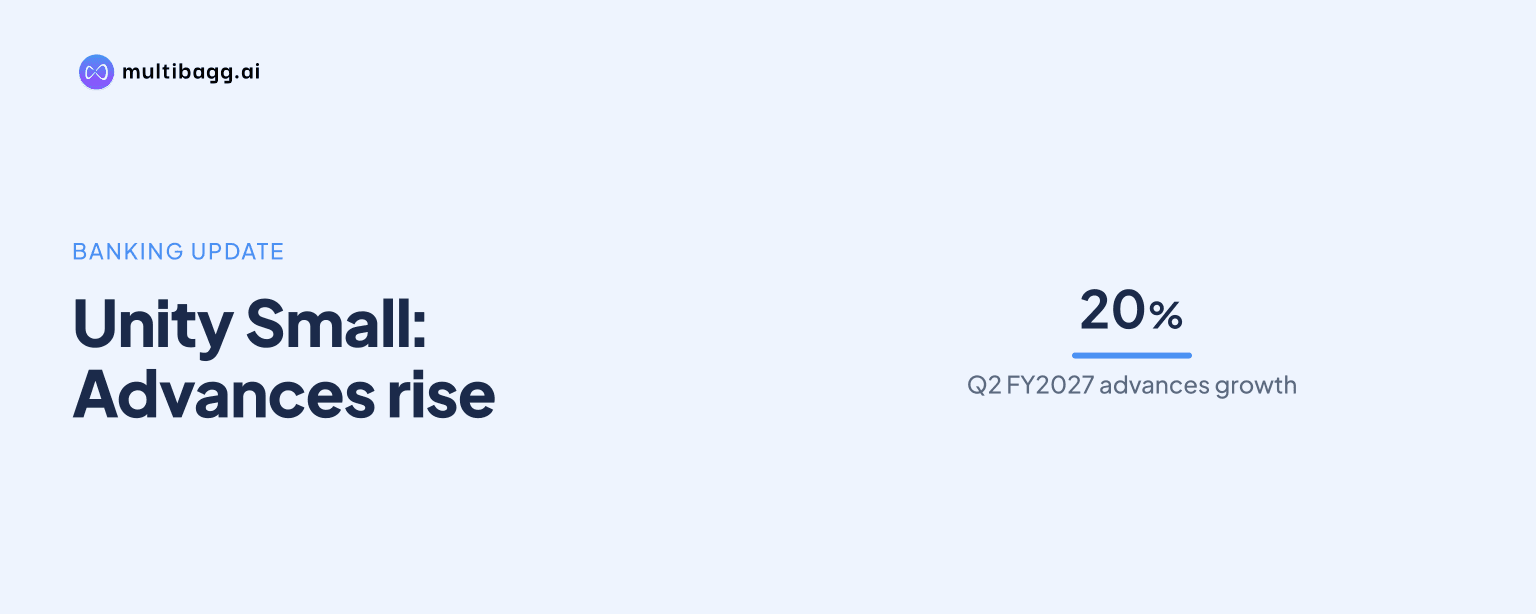
Unity Small Finance Bank reported 20% year-on-year growth in gross advances to Rs 13,240 crore in Q2 FY2027, while net interest margin increased to 8.45% from 7.15% a year earlier. The Bank said lower deposit costs and a 47% decline in credit costs, net of recoveries, supported the operating improvement.
Know Centrum Capital inside out
Results, valuation, peers and who's buying, in one view.
How fast did the Bank's loan book grow?
The Bank's gross advances rose 20% year on year to Rs 13,240 crore in Q2 FY2027. Centrum Capital Limited said Digital Lending and Commercial Banking led the increase, while improved performance in Business and Inclusive Banking also accelerated growth.
The disclosed growth came from several lending verticals rather than one identified product. Digital Lending and Commercial Banking were the specific leading drivers cited for Q2 FY2027, but the announcement does not provide advances, disbursements, yields or growth rates for individual verticals.
Gross advances of Rs 13,240 crore were Rs 48 crore above total deposits of Rs 13,192 crore at the reported period-end. That comparison is based on the two reported balances and is not a loan-to-deposit ratio, because the filing does not specify the calculation methodology or the loan and deposit categories used in such a measure.
What changed in deposits and funding costs?
The Bank's total deposits increased more than 10% quarter on quarter to Rs 13,192 crore, while its current account savings account, or CASA, ratio was 21%. The filing does not state the prior-quarter deposit balance, so it does not allow the exact sequential growth percentage to be calculated.
The cost of deposits fell to 7.44% in Q2 FY2027 from 8.29% a year earlier, a decline of 85 basis points. One basis point equals one-hundredth of a percentage point. The Bank said the lower deposit cost contributed to its higher net interest margin, or NIM.
The Bank's NIM expanded by 130 basis points to 8.45%, and net interest income grew more than 19% year on year. The filing attributes both outcomes to loan-book growth and a lower cost of funds, but does not disclose the absolute net interest income amount, the yield on advances or the deposit mix behind the 7.44% cost.
Got a follow-up? Ask IRIS
Why did the Bank's credit costs decline?
The Bank said credit costs, net of recoveries, declined 47% year on year in Q2 FY2027. Management attributed the reduction to disciplined underwriting, stronger collection efficiency and prudent risk management.
The 47% reduction occurred alongside a 20% year-on-year expansion in gross advances to Rs 13,240 crore. The reported figures therefore show lower credit costs after recoveries while the loan book grew, although the filing does not disclose gross non-performing asset ratios, net non-performing asset ratios, delinquency buckets or collection rates.
The qualification that credit costs are measured net of recoveries is material to interpreting the figure. The filing does not split the 47% decline between lower fresh credit charges, recoveries, write-offs or provisioning, so the combined net credit-cost movement is the only disclosed measure.
How are cards, capital and liquidity developing?
The Bank's credit-card franchise had cards in force nearing 5 lakh as of 30 September 2026, after growing more than 40% during the quarter. The filing does not give exact opening or closing card numbers, so the precise quarterly addition cannot be derived.
The credit-card expansion accompanied the Digital Lending growth that management identified as a lead contributor to the 20% rise in advances. However, the announcement does not disclose card receivables, spending volumes, activation rates, revolving balances, transaction income or card-specific credit costs.
The Bank reported a capital to risk-weighted assets ratio, or CRAR, of approximately 23% and a liquidity coverage ratio, or LCR, of 154%. Centrum Capital Limited said these levels remained above regulatory requirements and provided a foundation for future growth, while the filing does not give capital amounts, risk-weighted assets, applicable regulatory thresholds or the composition of liquid assets.
Conclusion
The Q2 FY2027 update shows a Bank combining 20% year-on-year gross-advance growth with deposits of Rs 13,192 crore, a 130-basis-point increase in NIM to 8.45%, and a 47% fall in credit costs net of recoveries. Lower deposit costs, down to 7.44% from 8.29%, were the stated funding mechanism behind the improved margin.
The next disclosed matter to watch is Centrum Capital Limited's plan to optimise group financing costs over the next 18 to 24 months, including Reserve Bank of India requisite dilution in the Bank. Future disclosures may also indicate whether cards in force move above nearly 5 lakh and whether the approximately 23% CRAR and 154% LCR are maintained as advances expand.