










Urban Company raises Rs 2,500 crore after 6x QIP demand
Key highlights
- Urban Company raised Rs 2,500 crore by allotting 16,02,56,410 QIP shares at Rs 156 each.
- The QIP drew more than Rs 15,000 crore of demand, exceeding six times the Rs 2,500 crore issue size.
- Urban Company allotted shares to 33 investors, including 13 that were not shareholders at the issue date.
- Mutual funds received more than 50% of the QIP allocation, according to Urban Company.
powered by IRIS
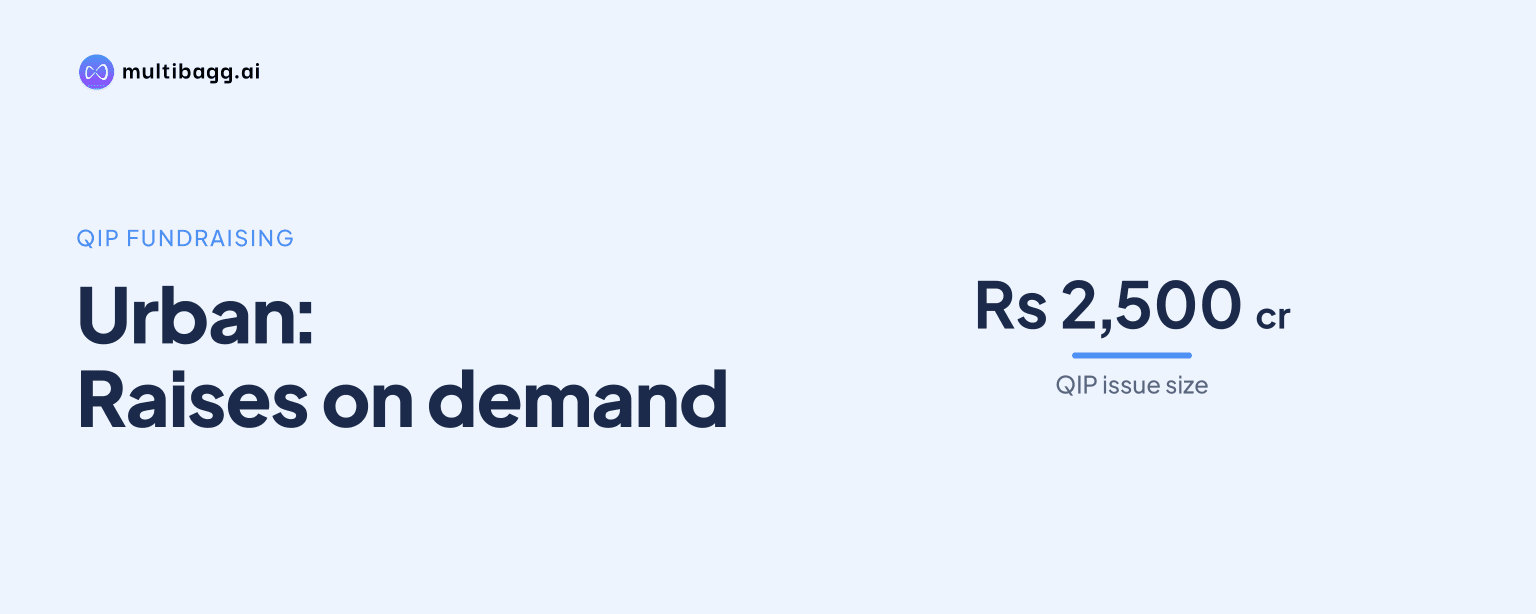
Urban Company Limited raised Rs 2,500 crore through a qualified institutions placement, or QIP, completed on November 19, 2026, after receiving more than Rs 15,000 crore in bids. The issue was oversubscribed more than six times, and Urban Company allotted 16,02,56,410 equity shares at Rs 156 each.
Know Urban Company inside out
Results, valuation, peers and who's buying, in one view.
What were Urban Company's QIP terms?
Urban Company raised Rs 2,500 crore by allotting 16,02,56,410 equity shares on November 19, 2026, at an issue price of Rs 156 per share. The QIP opened on November 16, 2026 and closed on November 19, 2026. Each allotted share has a face value of Rs 1, while the issue price represented a 3.1% discount to the Rs 161.03 floor price calculated under Chapter VI of the Securities and Exchange Board of India, or SEBI, Issue of Capital and Disclosure Requirements Regulations, 2018.
The allotment price was Rs 5.03 below the Rs 161.03 regulatory floor price, while the company raised Rs 2,500 crore through the placement. Urban Company said total bids exceeded Rs 15,000 crore, which was more than six times the issue size. The company announced the completed transaction in its November 20, 2026 press release.
Who received Urban Company QIP shares?
Urban Company allotted shares to 33 investors from bids submitted by more than 60 investors, and 13 allottees had not held Urban Company shares on the issue date. Mutual funds received more than 50% of the QIP allocation, making them the largest disclosed recipient group. Urban Company did not disclose the individual number of shares or value allotted to each of the 33 investors in its November 20, 2026 release.
The 13 mutual fund allottees named by Urban Company were SBI MF, ICICI Prudential MF, Mirae Asset MF, Invesco MF, WhiteOak Capital MF, Motilal Oswal MF, Aditya Birla Sun Life MF, Kotak MF, Nippon India MF, UTI MF, Edelweiss MF, Bandhan MF and JM Financial MF. The QIP also included domestic insurers HDFC Life, Bajaj Life Insurance and Edelweiss Life, alongside domestic institutional investor Premji Invest.
Global institutions named in the release included Goldman Sachs Asset Management, Pictet, Amundi, Norges Bank Investment Management, Arohi Asset Management, Manulife, Dymon Asia and Millennium. The disclosed investor mix covered domestic mutual funds and insurers as well as global institutions. The 13 new shareholders among 33 allottees indicate that the placement added investors that did not hold Urban Company shares at the issue date.
Got a follow-up? Ask IRIS
How will Urban Company use the QIP proceeds?
Urban Company said net QIP proceeds will be used to build the supply ecosystem for InstaHelp by UC. The Rs 2,500 crore raise is also earmarked for brand marketing and business promotion intended to increase awareness and visibility of the platform across segments. The release did not provide a rupee-wise allocation or timetable for these individual uses.
The stated uses also include technology and cloud infrastructure, training infrastructure for service professionals, and research and development for Native products. Urban Company additionally listed potential acquisitions and general corporate purposes among the uses for net proceeds. These are declared uses in the placement document rather than commitments to a specified acquisition, product launch or annual spending amount.
Morgan Stanley India Company Private Limited acted as lead book runner for the Rs 2,500 crore QIP, supported by Kotak Mahindra Capital Company Limited and Emkay Global Financial Services Limited. Shardul Amarchand Mangaldas & Co was legal counsel to Urban Company, while Cyril Amarchand Mangaldas acted as Indian legal counsel and White & Case Pte. Ltd. as international legal counsel to the book-running lead managers.
What operating context did Urban Company disclose with the fundraise?
Urban Company described itself as a technology-driven platform that connects customers with professionals for home and beauty services, including cleaning, repairs, salon and spa services. Its stated QIP uses for the InstaHelp by UC supply ecosystem, professional training, technology and cloud infrastructure link the November 2026 funding plan to service delivery, platform visibility and operating infrastructure.
In its H1 FY27 Earnings Index, Urban Company said average monthly net earnings in hand were Rs 30,708 for all active service professionals, excluding InstaHelp by UC. The company also reported that the top 5% of service professionals earned Rs 56,731. The two figures cover different worker groups, with the latter representing only the highest-earning 5%, rather than a period-on-period change.
Urban Company further said all active service professionals are covered by group life and accidental insurance, including accidental life and disability cover of up to Rs 10 lakh. The company said free accidental hospitalisation and outpatient department, or OPD, treatment coverage scales with a professional's reward tier. The release did not state the number of active professionals, the cost of these benefits or the reward-tier thresholds.
Conclusion
Urban Company's November 2026 QIP brought in Rs 2,500 crore after bids of more than Rs 15,000 crore, with more than half of the allocation going to mutual funds. The transaction placed 16,02,56,410 shares at Rs 156 each, a 3.1% discount to the Rs 161.03 regulatory floor price, and included 13 investors that were not shareholders on the issue date.
The next disclosed matter to watch is Urban Company's deployment of net proceeds across InstaHelp by UC supply, marketing, technology, professional training, Native-product research and potential acquisitions. The company has identified these spending categories but has not disclosed allocations, implementation milestones or a timetable for use of the Rs 2,500 crore raised.