










Urban Enviro Waste Management Limited operates 951 vehicles
Key highlights
- Urban Enviro operates 951 vehicles and assets across municipal waste projects in five states.
- 903 vehicles are assigned to door-to-door collection, including 372 Tata Ace vehicles, 212 Tata CNG vehicles and 157 Tata electric vehicles.
- The Bhilai project handles approximately 120 tonnes of waste per day and employs more than 1,600 people.
- Turnover increased from Rs 102.47 crore in FY 2023-24 to Rs 182.14 crore in FY 2025-26.
powered by IRIS
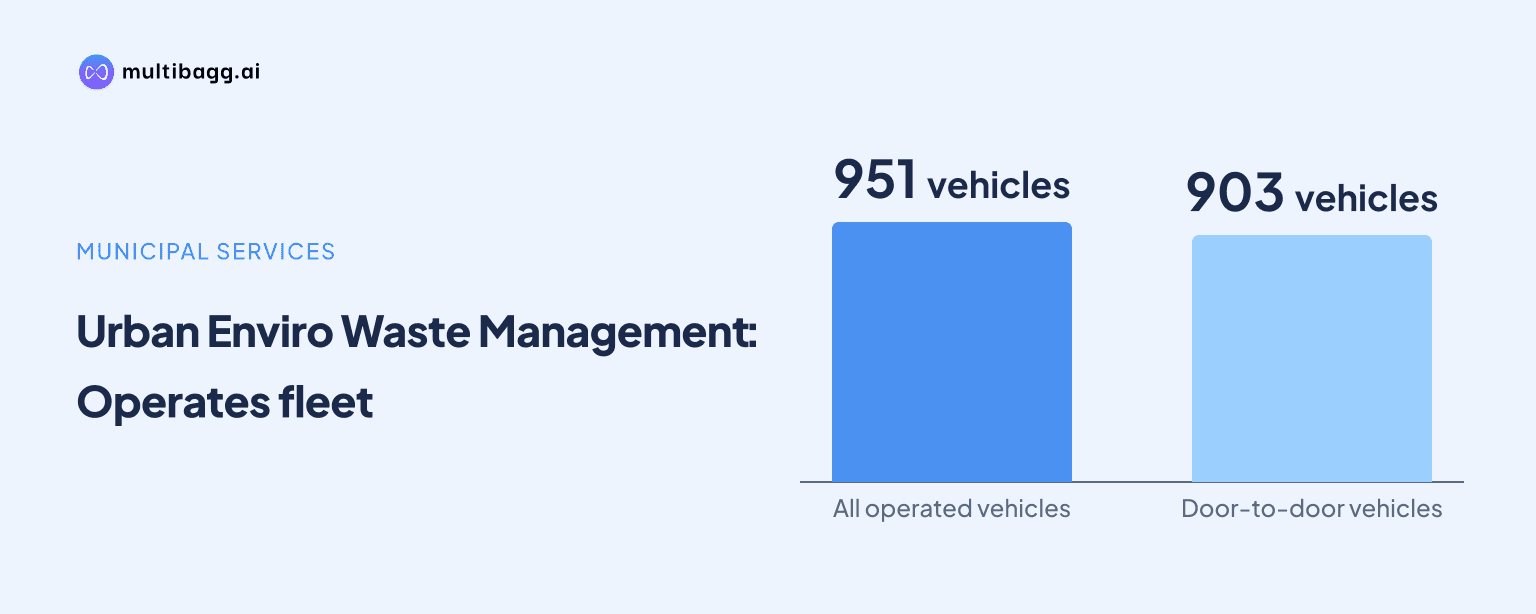
Urban Enviro Waste Management Limited operates a fleet of 951 vehicles and assets for municipal waste work across Maharashtra, Gujarat, Rajasthan, Chhattisgarh and Uttarakhand. Urban Enviro assigns 903 vehicles to door-to-door collection, while its Bhilai project is disclosed as handling approximately 120 tonnes of waste a day with more than 1,600 employees.
Know Urban Enviro Waste Management inside out
Results, valuation, peers and who's buying, in one view.
What does Urban Enviro's 951-vehicle fleet do?
Urban Enviro uses its 951-vehicle fleet for primary waste collection, loading, unloading and secondary transportation of municipal solid waste (MSW). The fleet includes 903 vehicles assigned to door-to-door garbage collection, using Tata Ace, Tata Intra, compressed natural gas (CNG), electric and Ashok Leyland Dost vehicles.
The largest collection category is 372 Tata Ace and Tata Ace Diesel vehicles, followed by 212 Tata CNG vehicles and 157 Tata electric vehicles. Urban Enviro also uses three-wheelers, four-wheelers, auto-tippers, tricycles and bin rickshaws for collection in slums, congested localities and narrow lanes, according to the filing.
Urban Enviro’s 48 vehicles outside the door-to-door fleet include 10 Tata 407 and Mahindra Bolero vehicles, 21 tractors or front-end loaders, four JCB loaders, seven tippers, one dumper placer, four refuse compactors and one Force Ambulance. The filing says specialised vehicles use hydraulic tipping and loading mechanisms for handling and transporting collected MSW to transfer stations, processing facilities, landfill sites or disposal locations.
Where does Urban Enviro operate waste-management projects?
Urban Enviro’s disclosed project footprint spans five states: Maharashtra, Gujarat, Rajasthan, Chhattisgarh and Uttarakhand. Its clients include municipal corporations, municipal councils, Nagar Palikas, Nagar Panchayats and other urban local bodies, while vehicle and asset registrations are stated as being in four states: Maharashtra, Gujarat, Rajasthan and Uttarakhand.
In Maharashtra, Urban Enviro lists five-year collection and transportation projects for Akola Municipal Corporation and Chandrapur Municipal Corporation. The Chandrapur assignment is stated to be ongoing and covers door-to-door collection of segregated waste and transportation to a processing site, directly or through collection points.
Urban Enviro’s Umred Municipal Council scope covers financial years (FY) 2024-25, 2025-26 and 2026-27. It includes collection of wet, dry, sanitary and hazardous waste from households and commercial shops, delivery to a disposal centre, waste classification, composting of degradable material and disposal of non-degradable waste.
In Gujarat, the company lists a five-year Ankleshwar Nagarpalika collection and transportation assignment that also includes manpower and municipal cleaning services. Savarkundla, Thangadh and Palitana projects involve dry and wet waste processing plants on a Design, Build, Operate and Transfer (DBOT) basis, while Thangadh also includes door-to-door MSW collection and transportation.
Got a follow-up? Ask IRIS
Which projects show Urban Enviro's service range?
Urban Enviro’s disclosed projects combine collection work with processing and municipal cleaning services. At Jaipur Nagar Nigam, Heritage, Rajasthan, it provides auto-tippers for segregated waste collection, garbage cleaning and transportation, alongside household surveys, property mapping and monitoring across specified zones.
At Nagar Nigam Pali in Rajasthan, Urban Enviro collects and segregates household waste, takes it to secondary collection points or transfer stations, and transports it onward to a processing site across 65 wards. This scope differs from the Gujarat DBOT projects because it focuses on collection, transfer and transport rather than the stated development of a processing plant.
The Bhilai Nagar Palika Nigam assignment in Chhattisgarh combines door-to-door collection with drain cleaning, mechanised and manual sweeping, waste lifting and transportation to the Jamul solid waste management site. Urban Enviro records this project as handling approximately 120 tonnes a day and employing more than 1,600 people.
Urban Enviro also identifies an ongoing three-year project for Nagar Palika Parishad Kichha in Uttarakhand, covering collection, lifting, transport, unloading and segregation of liquid and dry waste. Outside the five-state footprint, its Amarnath Ji Yatra 2024 assignment in Jammu involved collection, transportation, processing and disposal of waste and is stated as completed.
How does Urban Enviro monitor operations and pursue contracts?
Urban Enviro uses Global Positioning System (GPS)-based vehicle tracking, real-time transport monitoring, property mapping, digital reporting and customised software for vehicle repair and maintenance records. The filing specifically states that GPS is installed on compactors and dumper placer vehicles used to transport waste to landfill sites.
The company also uses biometric face-reader attendance and mobile selfie attendance systems across project locations. These monitoring mechanisms sit alongside its 951-vehicle fleet and are intended by Urban Enviro to support fleet utilisation, operational monitoring and efficiency.
Urban Enviro primarily seeks work through government and public-sector tenders covering MSW management, collection, segregation, transportation, road sweeping, sanitation and related services. Its tender team keeps a state-wise list of procurement portals and assesses contract period, location, eligibility conditions, technical specifications, estimated equipment needs and manpower requirements before deciding whether to bid.
Where a tender requires it, Urban Enviro may conduct a site visit and take part in a pre-bid meeting before submitting a bid. Technically qualified bidders can move to financial evaluation, including lowest evaluated bidder, or L1, processes where specified, but the filing says tender participation does not necessarily result in a contract award.
What is Urban Enviro planning next?
Urban Enviro intends to expand into new states and municipal corporations, participate in additional municipal tenders, improve the efficiency of existing projects and increase technology adoption. Management also proposes to strengthen capabilities in processing, recycling, resource recovery, bio-mining and bio-remediation.
The company’s turnover certificate records turnover of Rs 102.47 crore in FY 2023-24, Rs 141.05 crore in FY 2024-25 and Rs 182.14 crore in FY 2025-26. That represents an increase of Rs 79.67 crore over the two-year period, alongside the operational profile of 951 vehicles and projects in five states.
Conclusion
Urban Enviro’s operating footprint combines a 951-vehicle fleet with contracts that span collection, transportation, processing, street sweeping, drainage cleaning and waste segregation. The 903 vehicles assigned to door-to-door collection form the largest part of that base, while the Bhilai project’s approximately 120 tonnes a day illustrates a separately disclosed measure of operating activity.
What to watch next is the execution of existing work, including Chandrapur’s ongoing five-year project, Kichha’s ongoing three-year assignment and Umred’s scope through FY 2026-27. Management’s stated expansion into new states and municipal corporations depends on tender participation, technical qualification, price evaluation and contract awards by the relevant authorities.