










Urban Enviro tender wins fall as receivables reach Rs 64.67 crore
Key highlights
- Urban Enviro’s tender success ratio fell to 15.8% in FY26 from 42.5% in FY24, despite bids rising from 40 to 171.
- Trade receivables increased by Rs 23.39 crore to Rs 64.67 crore at March 31, 2026, including Rs 10.25 crore outstanding for more than six months.
- Urban Enviro reported Rs 55.27 crore of borrowings and current maturities against cash and cash equivalents of Rs 1.93 crore at March 31, 2026.
- The company reported an order book of Rs 281.08 crore as at September 25, 2026, while net cash from operations was Rs 8.28 crore against fixed-asset spending of Rs 12.65 crore in FY26.
powered by IRIS
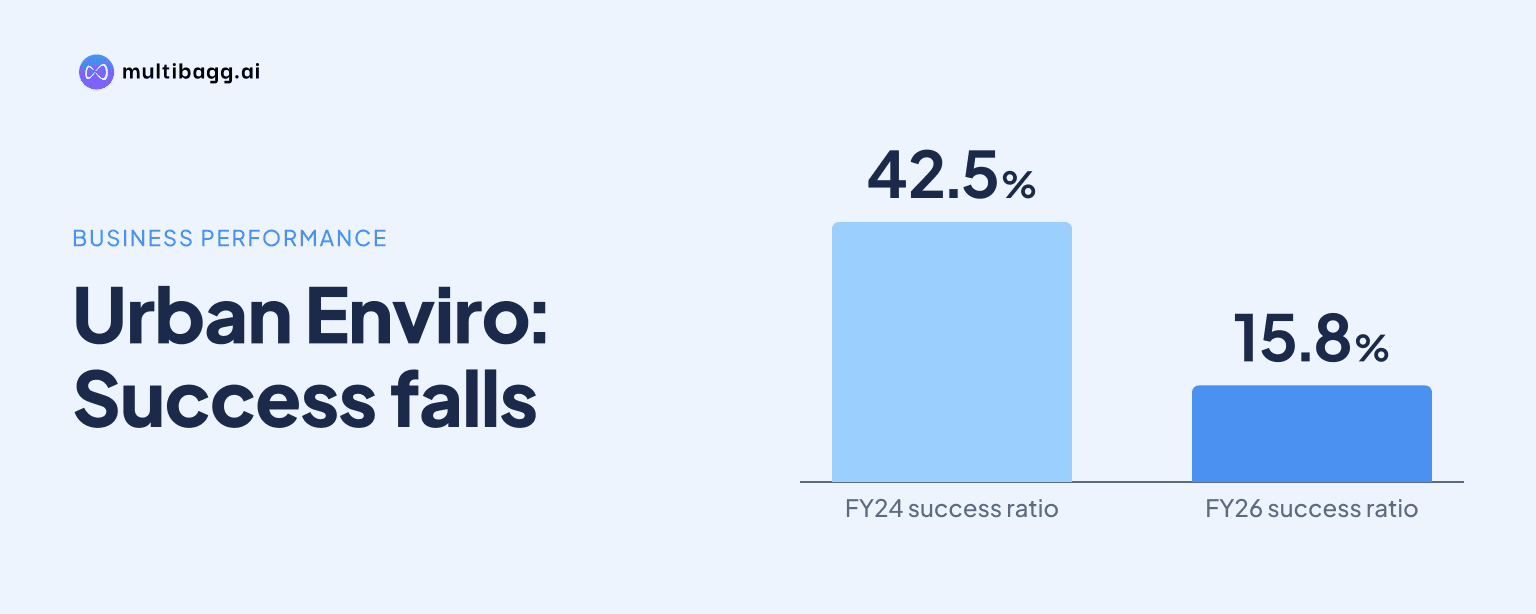
Urban Enviro Waste Management Limited reported a decline in tender success as its bid-win ratio fell to 15.8% in FY26 from 42.5% in FY24, even as trade receivables rose to Rs 64.67 crore at March 31, 2026. The disclosure also shows Rs 24.22 crore tied up in tender and contract-related deposits at September 2026.
Know Urban Enviro Waste Management inside out
Results, valuation, peers and who's buying, in one view.
What happened to Urban Enviro’s tender win rate?
Urban Enviro’s tender win rate declined in each of the three reported fiscal years, falling to 15.8% in FY26 from 42.5% in FY24. It participated in 40 bids and won 17 in FY24, then entered 75 bids and won 19 in FY25, before submitting 171 bids and winning 27 in FY26.
Bid participation increased by 131 between FY24 and FY26, while successful bids rose by 10. Aggregate order value fell from Rs 129.24 crore in FY24 to Rs 76.36 crore in FY26 despite the much higher number of bids. Urban Enviro says awards depend on authority-specific eligibility, technical, commercial and financial conditions, as well as the relevant tender evaluation process.
Urban Enviro relies substantially on tenders from municipal corporations, government authorities and urban local bodies for services including door-to-door collection, transportation, segregation, processing and disposal of municipal solid waste. The company says future tender outcomes may be affected by municipal budgets, project priorities, administrative decisions, competitive intensity and tender conditions.
How do municipal contracts require Urban Enviro to commit cash?
Urban Enviro had Rs 9.07 crore of earnest money deposits, or EMD, blocked at September 2026, alongside Rs 15.15 crore of security deposits, performance bank guarantees, or PBG, and additional security deposits. These commitments are required for participation in tenders and execution of contracts, creating cash requirements before service revenues are collected.
EMD is generally released by the relevant municipal corporation after an award or non-award, typically within about 120 days, according to the filing. However, Urban Enviro says a delay in its release can affect working capital and liquidity, particularly when the company is also funding mobilisation and project operations.
Urban Enviro’s municipal contracts carry specified tenures, performance standards and service-level requirements. Failure to meet these obligations can result in penalties, deposit forfeiture or PBG invocation, termination or non-renewal, meaning the cash committed for a project can remain exposed to execution conditions.
Management proposes to expand into new states and municipal corporations, participate in new tenders and adopt technology-enabled waste-management systems. It also intends to build capabilities in recycling, resource recovery, bio-mining and bio-remediation, but the filing says expansion may increase working-capital needs if operating cash flows or external finance are insufficient.
Got a follow-up? Ask IRIS
Why have Urban Enviro’s receivables become a liquidity issue?
Urban Enviro’s trade receivables rose by Rs 23.39 crore to Rs 64.67 crore at March 31, 2026, from Rs 41.28 crore at March 31, 2025. Of the March 2026 balance, Rs 10.25 crore had been outstanding for more than six months, including Rs 9.21 crore aged from six months to one year and Rs 1.03 crore aged from one to two years.
Payments under municipal contracts can depend on certification of work, invoice submission and verification, record reconciliation, budgetary processes and release of funds. Urban Enviro also says certain minimum-wage claims and other receivables may require review or reconciliation with municipal authorities before collection.
The rise in receivables occurred alongside turnover growth from Rs 102.47 crore in FY24 to Rs 141.05 crore in FY25 and Rs 182.14 crore in FY26. Net worth increased from Rs 21.62 crore at March 31, 2024 to Rs 46.77 crore at March 31, 2026, but the company separately identifies delayed realisation of government-body receivables as a business weakness.
Urban Enviro states that significant or prolonged collection delays, deductions, invoice disputes or non-recovery could affect its cash flows and ability to meet financial and operational obligations. The company may need additional working capital or alternative funding when municipal collections are delayed.
What debt, cash flow and cash resources did Urban Enviro report?
Urban Enviro reported Rs 24.80 crore of long-term borrowings, Rs 8.87 crore of short-term borrowings and Rs 21.60 crore of current maturities of long-term borrowings at March 31, 2026. The combined amount was Rs 55.27 crore, with the current maturities representing long-term debt repayments falling due in the current period.
Cash and cash equivalents were Rs 1.93 crore at March 31, 2026, down from Rs 3.67 crore a year earlier. Urban Enviro reported a net decrease of Rs 1.74 crore in cash and cash equivalents during FY26, and says borrowings create interest-cost, repayment and refinancing obligations.
Net cash generated from operating activities was Rs 8.28 crore in FY26, while capital expenditure on fixed assets was Rs 12.65 crore. Fixed-asset spending therefore exceeded reported operating cash generation by Rs 4.37 crore, while increases in trade receivables, other current assets and short-term loans and advances adversely affected operating cash flow.
Urban Enviro reported an order book of Rs 281.08 crore as at September 25, 2026. However, it says orders may be modified, cancelled, delayed, suspended, put on hold or terminated, and that amounts due may not be fully realised, so the order book is not presented as assured income or cash collection.
Conclusion
Urban Enviro’s disclosures show that its municipal-contract model requires simultaneous management of lower tender conversion, deposits committed to bids and contracts, and the timing of municipal collections. The FY26 position combined Rs 64.67 crore of receivables with Rs 55.27 crore of borrowings and current debt maturities, while cash and cash equivalents stood at Rs 1.93 crore.
The next issue to watch is execution and collection from the Rs 281.08 crore order book reported at September 25, 2026, including whether receivable recoveries and release of the Rs 24.22 crore of disclosed deposits support working capital. Management’s plan to enter new municipal markets and add technology and waste-processing capabilities will require funding alongside those commitments.