










Usha Martin lifts wire rope share as LRPC revenue falls
Key highlights
- Wire rope contributed 75% of Usha Martin revenue in H1 FY27, compared with 74% in FY26.
- Value-added applications represented 71% of Usha Martin’s wire-rope business in H1 FY27.
- Wire revenue increased 35.1% year on year to Rs 123 crore in Q2 FY27.
- LRPC revenue declined 36.1% sequentially to Rs 57 crore in Q2 FY27.
powered by IRIS
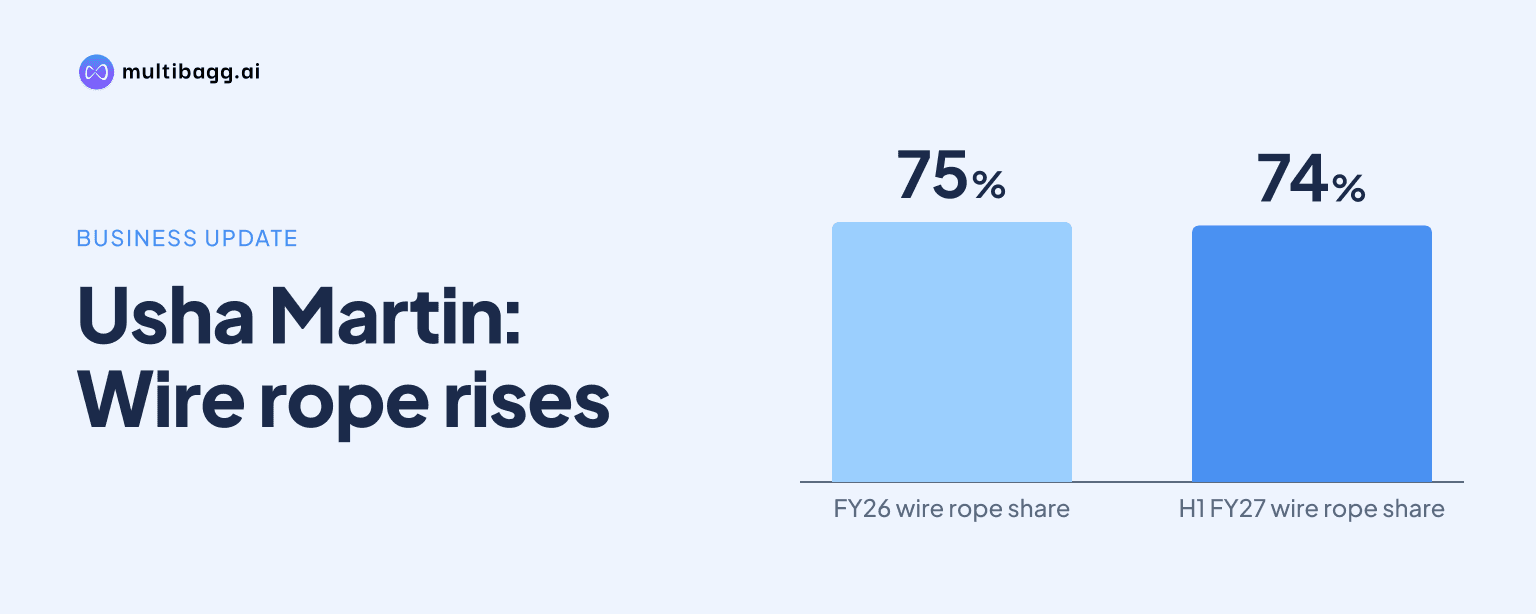
Usha Martin Ltd lifted wire rope’s revenue contribution to 75% in H1 FY27 from 74% in FY26, while value-added applications made up 71% of wire-rope business and low-relaxation prestressed concrete, or LRPC, revenue fell 2.6% to Rs 145 crore. The presentation does not disclose total or product-level sales volumes.
Know Usha Martin inside out
Results, valuation, peers and who's buying, in one view.
How did Usha Martin’s revenue mix change in H1 FY27?
Usha Martin increased wire rope’s share of consolidated revenue to 75% in H1 FY27, from 74% in FY26. Wire represented 12% of H1 FY27 revenue, LRPC accounted for 7%, and other products made up 6%, showing that wire rope remained the largest reported product category.
The quarterly revenue figures show growth in wire rope and wire but contraction in LRPC. Wire rope revenue was Rs 765 crore in Q2 FY27, up 12.9% year on year from Rs 678 crore in Q2 FY26 and 1.0% above Rs 757 crore in Q1 FY27. Wire revenue increased 35.1% year on year to Rs 123 crore from Rs 91 crore, although it was marginally lower than Rs 124 crore in Q1 FY27.
LRPC revenue was Rs 57 crore in Q2 FY27, down 11.3% from Rs 64 crore a year earlier and down 36.1% from Rs 89 crore in Q1 FY27. Its Q2 FY27 sales share was 6%, compared with 9% in FY26, while the presentation provides no volume, price or demand explanation for the decline.
Which end markets make up Usha Martin’s value-added wire-rope business?
Usha Martin said value-added applications accounted for 71% of its wire-rope business in H1 FY27. It identifies crane, oil and offshore, elevator, mining and fishing as those value-added applications, but does not disclose their individual revenue, profit or volume contributions within wire rope.
Oil and offshore accounted for 20% of total H1 FY27 revenue and crane for 19%, making them the two largest named value-added end industries. Elevator represented 9%, mining 5% and fishing 2%; these end-industry percentages apply to all product segments, according to the presentation.
Engineering was the largest end industry overall at 24% of H1 FY27 revenue, ahead of oil and offshore at 20% and crane at 19%. Construction and infrastructure and elevator each contributed 9%, while auto represented 8%, indicating that the reported customer base extended beyond the five applications classified as value-added wire rope.
Did higher wire-rope sales coincide with revenue and margin growth?
Usha Martin reported revenue from operations of Rs 2,021 crore in H1 FY27, up 14.8% from Rs 1,760 crore in H1 FY26. Wire rope revenue rose 15.3% to Rs 1,522 crore, wire revenue increased 33.4% to Rs 247 crore, and LRPC revenue declined 2.6% to Rs 145 crore.
Q2 FY27 revenue from operations was Rs 1,000 crore, 12.4% above Rs 890 crore in Q2 FY26 but 2.1% below Rs 1,021 crore in Q1 FY27. In that sequential comparison, wire rope grew 1.0%, wire was nearly unchanged, and LRPC fell 36.1%, making the product movements uneven across the three reported segments.
Operating earnings before interest, tax, depreciation and amortisation, or EBITDA, rose 16.5% to Rs 202 crore in Q2 FY27 from Rs 173 crore in Q2 FY26. Operating EBITDA margin increased to 20.2% from 19.5%; management attributed the expansion to favourable product mix, better realisations and a greater focus on higher-value business.
For H1 FY27, operating EBITDA increased 28.5% to Rs 410 crore from Rs 319 crore, and margin rose to 20.3% from 18.1%. Profit after tax increased 20.6% to Rs 278 crore from Rs 231 crore, with the presentation stating that the figures cover continuing operations and prior periods were restated to exclude the discontinued cables business.
Got a follow-up? Ask IRIS
What do steel prices and EBITDA per tonne show?
Usha Martin reported a steel price of Rs 57,891 per tonne in Q2 FY27, compared with Rs 57,217 in Q1 FY27 and Rs 51,052 for FY26. EBITDA per tonne was Rs 40,733 in Q2 FY27, slightly above Rs 40,581 in Q1 FY27 and above Rs 34,107 in FY26.
The H1 FY27 averages were Rs 57,537 per tonne for steel price and Rs 40,684 per tonne for EBITDA per tonne. The company calculates EBITDA per tonne without other income and excluding UM Cables, but does not provide a calculation connecting steel prices, product realisations and profitability by segment.
The higher per-tonne EBITDA coincided with a 2.2-percentage-point increase in H1 operating EBITDA margin to 20.3%. However, because Usha Martin does not disclose tonnes sold by wire rope, wire or LRPC, the presentation supports a comparison of revenue mix and profitability rather than a conclusion on aggregate sales volumes.
How geographically diversified was Usha Martin’s H1 FY27 revenue?
Usha Martin reported that international business accounted for 57% of H1 FY27 revenue despite geopolitical disruption. India contributed 43%, Europe 27%, Asia Pacific 12%, and the Middle East and Africa and the Americas each accounted for 9%.
Wire rope’s 75% product share and international business’s 57% revenue share show that overseas markets are material to the reported mix. The presentation does not disclose country-level revenue, regional wire-rope volumes, customer concentration or profitability for the Europe, Asia Pacific, Middle East and Africa, or Americas regions.
Conclusion
Usha Martin’s H1 FY27 results show a revenue mix increasingly centred on wire rope, whose contribution rose by 1 percentage point to 75%, alongside a 71% value-added application share within that business. Wire and wire rope revenue increased year on year, while LRPC declined, and operating EBITDA margin rose to 20.3% from 18.1%.
The next reporting periods should clarify whether LRPC recovers from Rs 57 crore of Q2 FY27 revenue and whether wire rope retains its 75% share of revenue. They will also show how the movement in steel prices from Rs 57,217 per tonne in Q1 FY27 to Rs 57,891 in Q2 FY27 affects the mix and realisation benefits cited by management.