










Hindware Home Innovation Limited Pipes EBIT Loss Persists
Key highlights
- Hindware Home Innovation pipes revenue rose to Rs 227 crore in Q2 FY27 from Rs 153 crore in Q1 FY27.
- Hindware Home Innovation pipes reported a Rs 2 crore EBIT loss in Q2 FY27, versus a Rs 6 crore loss in Q1 FY27.
- Hindware Home Innovation pipes sales volume reached 14,176 MT in Q2 FY27, up from 10,221 MT in Q1 FY27.
- Hindware Home Innovation’s Roorkee plant began commercial production on 30 January 2026 with 12,500 MTPA capacity.
powered by IRIS
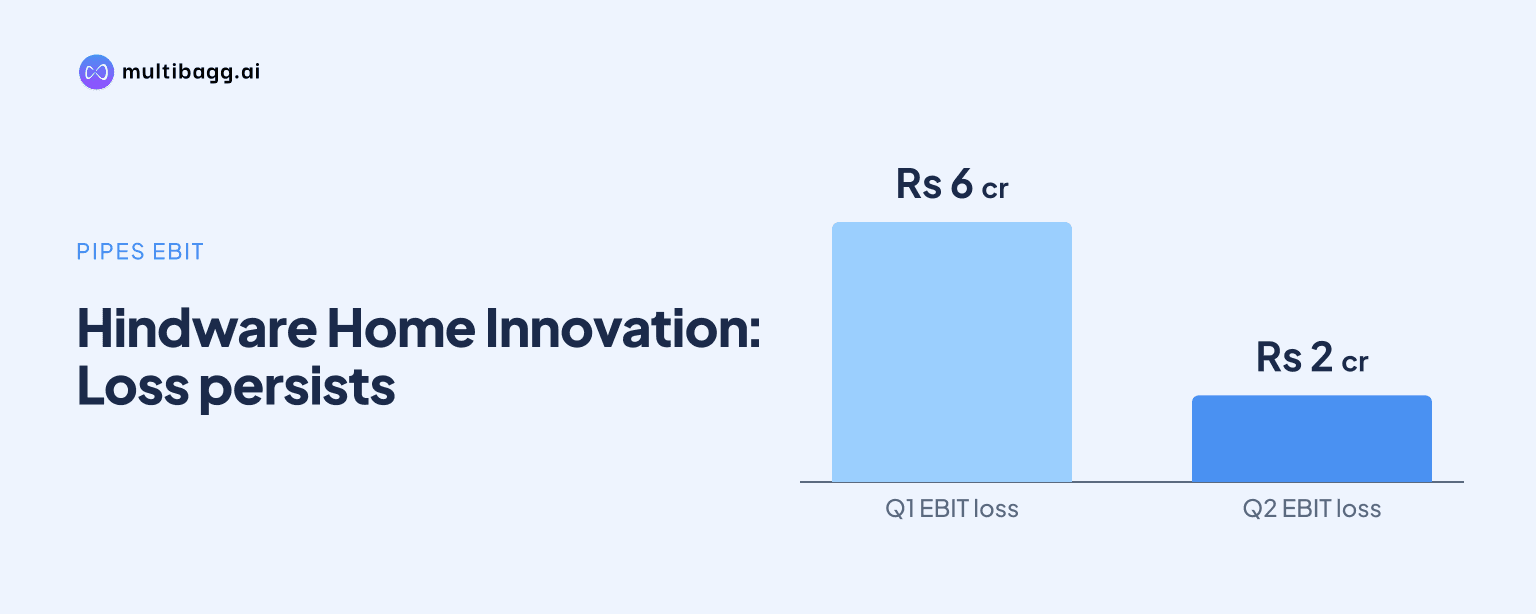
Hindware Home Innovation Limited’s pipes and fittings business reported a Rs 2 crore EBIT loss in Q2 FY27 despite revenue rising to Rs 227 crore and sales volume reaching 14,176 metric tonnes. Management identified the Roorkee plant ramp-up, currency and PVC resin-price volatility, aggressive competition and pricing pressure as H1 FY27 headwinds.
Know Hindware Home Innovation inside out
Results, valuation, peers and who's buying, in one view.
What drove Hindware Home Innovation pipes revenue rebound in Q2 FY27?
Hindware Home Innovation pipes revenue rose to Rs 227 crore in Q2 FY27 from Rs 153 crore in Q1 FY27 and Rs 196 crore in Q2 FY26. Sales volume increased to 14,176 metric tonnes (MT) from 10,221 MT in the preceding quarter and 11,884 MT a year earlier, alongside the quarterly revenue recovery.
The Q2 recovery lifted H1 FY27 revenue to Rs 380 crore from Rs 315 crore in H1 FY26. However, the half-year result still contained the lower Rs 153 crore Q1 FY27 revenue base, while the Q2 result produced a Rs 74 crore sequential increase. The comparison below shows that revenue and volume recovered in Q2, while EBIT and profit before tax remained negative.
Why did Hindware Home Innovation pipes remain loss-making?
Hindware Home Innovation reported Rs 8 crore of earnings before interest, tax, depreciation and amortisation (EBITDA) in Q2 FY27, but recorded a Rs 2 crore loss at earnings before interest and tax (EBIT). EBITDA improved from Rs 5 crore in Q1 FY27, while the EBITDA margin increased to 4% from 3%; it was below Rs 12 crore and 6%, respectively, in Q2 FY26.
The result remained negative further down the reported profit measure. Profit before tax (PBT) was a Rs 11 crore loss in Q2 FY27, compared with a Rs 15 crore loss in Q1 FY27 and a Rs 5 crore loss in Q2 FY26. The presentation states that EBITDA, EBIT and PBT include other income.
For H1 FY27, EBITDA declined to Rs 13 crore from Rs 20 crore in H1 FY26, and the margin declined to 3% from 6%. EBIT changed from a Rs 2 crore profit in H1 FY26 to a Rs 7 crore loss in H1 FY27, while PBT widened from a Rs 15 crore loss to a Rs 26 crore loss over the same periods.
How is the Roorkee plant affecting Hindware Home Innovation pipes capacity?
Hindware Home Innovation’s Roorkee, Uttarakhand facility started commercial production on 30 January 2026 with 12,500 metric tonnes per annum (MTPA) of capacity. Alongside the 66,000-plus MTPA Sangareddy, Telangana flagship integrated facility, the business has total installed capacity of more than 78,500 MTPA.
Management listed the newly commissioned Roorkee plant’s capacity ramp-up among the factors affecting H1 FY27 results. Quarterly capacity was 19,926 MT in Q2 FY27, compared with 19,710 MT in Q1 FY27 and 16,639 MT in Q2 FY26. Sales volume was 14,176 MT in the latest quarter, leaving a difference of 5,750 MT between quarterly capacity and sales volume.
The Q2 volume increase exceeded the 216 MT sequential rise in available quarterly capacity. Sales volume rose by 3,955 MT from Q1 FY27, when it stood at 10,221 MT, and was 2,292 MT above Q2 FY26. The source does not disclose plant-specific utilisation, production volume or a timetable for Roorkee to complete its ramp-up.
Got a follow-up? Ask IRIS
What market pressures did Hindware Home Innovation identify?
Hindware Home Innovation said H1 FY27 was affected by currency volatility, PVC resin-price volatility, Roorkee capacity ramp-up, aggressive competition and pricing pressure. These disclosed factors coincided with H1 revenue increasing by Rs 65 crore year on year while EBIT changed from a Rs 2 crore profit to a Rs 7 crore loss.
Chlorinated polyvinyl chloride (CPVC) products represented about 36% of total value mix in Q2 FY27. Management attributed that mix to typical first-half seasonal softness in plumbing demand. The product portfolio also includes CPVC, unplasticised polyvinyl chloride (UPVC) and PVC systems, soil-waste-rainwater pipes, double-wall corrugated pipes, column pipes, tanks and fire sprinklers.
Working-capital days improved to 83 in Q2 FY27 from 87 in Q1 FY27 and 90 in Q2 FY26. Net bank debt declined to Rs 420 crore from Rs 427 crore sequentially and Rs 446 crore year on year; the measure excludes the inter-company loan extended by Hindware Home Innovation Limited to Hindware Limited.
What is Hindware Home Innovation pipes recovery plan?
Management’s roadmap is to introduce value-added products, manage costs and expand distribution to capture market opportunities. It identifies double-wall corrugated pipes, PTMT bath fittings and Foam Core pipes as higher-value categories, while its product range comprises more than 2,500 stock-keeping units (SKUs).
Hindware Home Innovation reported a distribution network of more than 320 distributors and 30,000 dealers, plus a plumber community exceeding 100,000 people reached through training programmes and campaigns. These are the channel mechanisms the company cites alongside its product expansion plans, but the presentation does not give a revenue or margin target for the roadmap.
The business is undergoing a Bureau of Indian Standards (BIS) audit for fire sprinkler certification. Management said the audit is intended to strengthen compliance and support wider acceptance across certified applications. The presentation does not disclose an audit-completion date, expected certification date or projected sales contribution from fire sprinklers.
Conclusion
Hindware Home Innovation’s Q2 FY27 pipes performance combined a revenue and sales-volume rebound with continued losses at EBIT and PBT. Revenue increased to Rs 227 crore and volume to 14,176 MT, while the EBIT loss narrowed to Rs 2 crore from Rs 6 crore in Q1 FY27. Against Q2 FY26, however, EBITDA margin declined from 6% to 4% and EBIT moved from a Rs 4 crore profit to a loss.
The next reported matters to watch are Roorkee’s ongoing ramp-up, management’s cost, product and distribution programme, and the BIS audit for fire sprinklers. The source provides no timing or profitability target for these measures, while Q2 FY27 net working-capital days were 83 and net bank debt was Rs 420 crore, excluding the specified inter-company loan.