










HHIL targets Rs 500 crore revenue as Q2 PBT falls to Rs 3 lakh
Key highlights
- HHIL reported Q2 FY27 revenue of Rs 86 crore, up 2% year on year from Rs 84 crore.
- Q2 FY27 EBITDA was Rs 4 crore and the EBITDA margin was 5%, versus Rs 7 crore and 8% in Q2 FY26.
- Q2 FY27 PBT was Rs 3 lakh, compared with Rs 3 crore in Q2 FY26.
- HHIL aims for revenue above Rs 500 crore within two years and Rs 700 crore to Rs 750 crore by FY31.
powered by IRIS
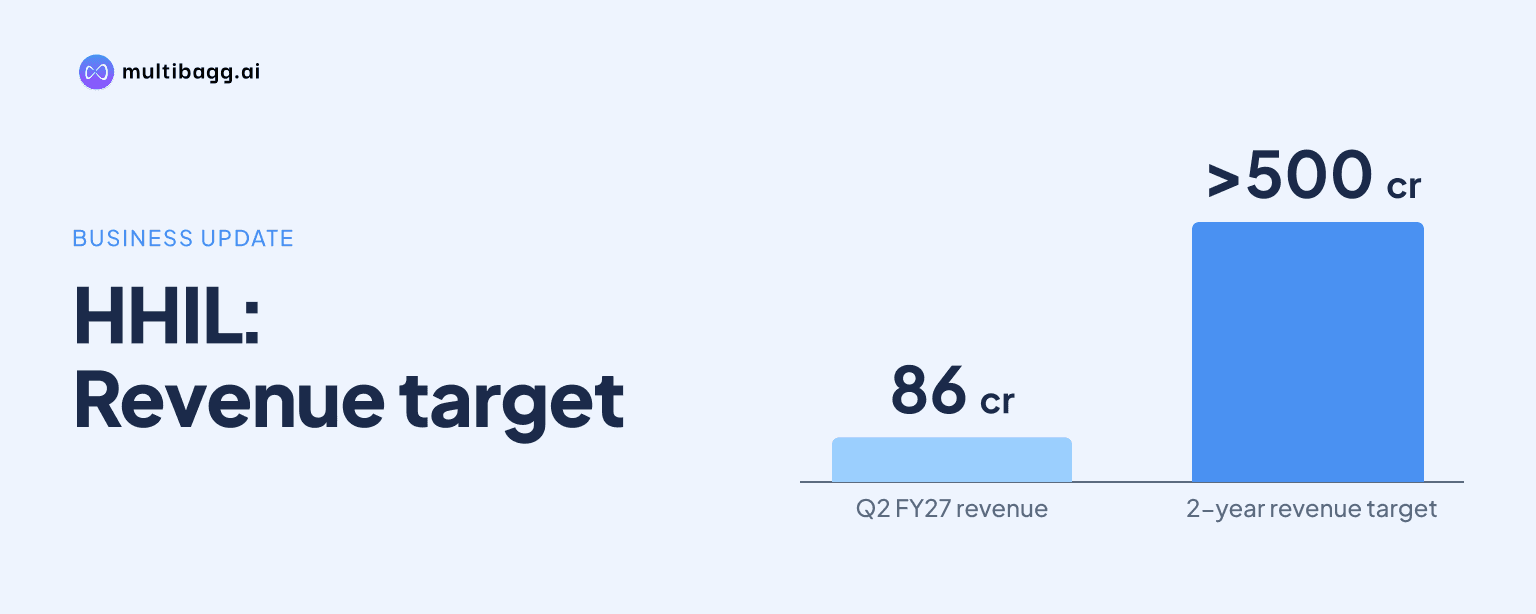
Hindware Home Innovation Limited is targeting revenue above Rs 500 crore within two years, while its Q2 FY27 profit before tax (PBT) was Rs 3 lakh, or 0.03% of Rs 86 crore revenue, after earnings before interest, taxes, depreciation and amortisation (EBITDA) fell to Rs 4 crore.
Know Hindware Home Innovation inside out
Results, valuation, peers and who's buying, in one view.
What is HHIL's consumer-appliances revenue target?
HHIL aims to take consumer-appliances revenue above Rs 500 crore within two years and to Rs 700 crore to Rs 750 crore by FY31. The presentation places the current Q2 FY27 revenue run rate at about Rs 86 crore, with year-on-year growth of 2% from Rs 84 crore in Q2 FY26. The target is therefore a stated management roadmap rather than a reported forecast for a specified fiscal year within the two-year period.
HHIL says the growth plan is centred on kitchen appliances and water heaters, with a premium-led approach. Its portfolio rationalisation focuses on what it calls continuous-selling products: chimneys, hobs and sinks. The company says this selection is intended to ensure sustained demand and sharper product focus, while its broader margin narrative assumes gross margins of 35% to 40% as scale builds.
How did HHIL perform in Q2 FY27?
HHIL reported Q2 FY27 revenue of Rs 86 crore, EBITDA of Rs 4 crore and an EBITDA margin of 5%, compared with Rs 84 crore, Rs 7 crore and 8%, respectively, in Q2 FY26.
Revenue increased by Rs 2 crore year on year and by Rs 3 crore sequentially from Q1 FY27, but EBITDA declined by Rs 3 crore from Q2 FY26 and Rs 2 crore from Q1 FY27. PBT moved from Rs 3 crore, or 4%, in Q2 FY26 to Rs 1 crore, or 2%, in Q1 FY27, before reaching Rs 3 lakh in Q2 FY27. The presentation states that EBITDA and PBT include other income and are before exceptional items.
Why did HHIL's first-half margins decline?
The presentation does not quantify the causes of the first-half margin decline, which saw H1 FY27 revenue rise to Rs 168 crore from Rs 155 crore while EBITDA fell to Rs 10 crore from Rs 17 crore and the EBITDA margin declined to 6% from 11%. The first-half comparison shows Rs 13 crore revenue growth alongside a Rs 7 crore reduction in EBITDA. It also extends the quarterly pattern, where Q2 FY27's 5% EBITDA margin was below both the 7% recorded in Q1 FY27 and the 8% reported a year earlier.
PBT for H1 FY27 was Rs 1 crore, or 1%, versus Rs 8 crore, or 5%, in H1 FY26. Instead of assigning individual reasons for the reduction in EBITDA or PBT, HHIL says it is resolving past operational bottlenecks by FY27. It presents its future margin path as dependent on scale, gross margins of 35% to 40%, and expansion of overall margins into double digits.
Got a follow-up? Ask IRIS
What actions does HHIL plan to take to improve profitability?
HHIL says it is expanding its market footprint by scaling its dealer network and selectively opening exclusive brand stores. Its channel plan covers general trade, modern retail, institutional sales and e-commerce, rather than relying on a single route to market. The strategy accompanies the Rs 500 crore-plus revenue objective within two years and the Rs 700 crore to Rs 750 crore target by FY31.
HHIL also lists support-cost optimisation in warehousing, logistics and after-sales service as an operational action. On product development, it has launched smart kitchen appliances, including low-decibel chimneys. The company connects these initiatives with quality and cost optimisation, while its stated profitability goal is to move overall margins into double digits as the business gains scale; it does not provide a dated margin target in the presentation.
What does the HPL restructuring mean for HHIL?
HHIL says Hintastica Private Limited, or HPL, became a wholly owned subsidiary in Q1 FY27 and now operates with a leaner, asset-light model. The company presents this ownership and financial restructuring as a mechanism to support scalable growth. It does not disclose the transaction value, HPL's standalone revenue, or any quantified cost saving from the Q1 FY27 transition.
The Q1 FY27 timing matters because Q2 FY27 revenue was Rs 86 crore, compared with Rs 83 crore in the preceding quarter, while EBITDA declined from Rs 6 crore to Rs 4 crore. The presentation does not attribute the quarter-on-quarter EBITDA change to HPL. Instead, it links the model to the longer-term goal of addressing operational bottlenecks by FY27 and pursuing gross margins of 35% to 40%.
Conclusion
HHIL has set a substantial revenue ambition against a period of lower reported profitability. Q2 FY27 revenue was Rs 86 crore, only Rs 2 crore above Q2 FY26, while EBITDA fell from Rs 7 crore to Rs 4 crore and PBT declined from Rs 3 crore to Rs 3 lakh. H1 FY27 similarly combined revenue growth to Rs 168 crore with EBITDA falling to Rs 10 crore.
The next disclosed milestones are the resolution of past operational bottlenecks by FY27, revenue above Rs 500 crore within two years, and Rs 700 crore to Rs 750 crore by FY31. Readers can watch whether dealer expansion, selective exclusive stores, channel diversification, the HPL asset-light model and the focus on chimneys, hobs and sinks coincide with the stated aim of double-digit overall margins.