










Hindware targets positive EBITDA in FY27 after category exits
Key highlights
- Hindware expects a positive EBITDA swing in FY27 after legacy costs are removed and high-loss categories are pruned.
- Management targets Consumer Appliances revenue above Rs 500 crore within two years and Rs 700 crore to Rs 750 crore by FY30.
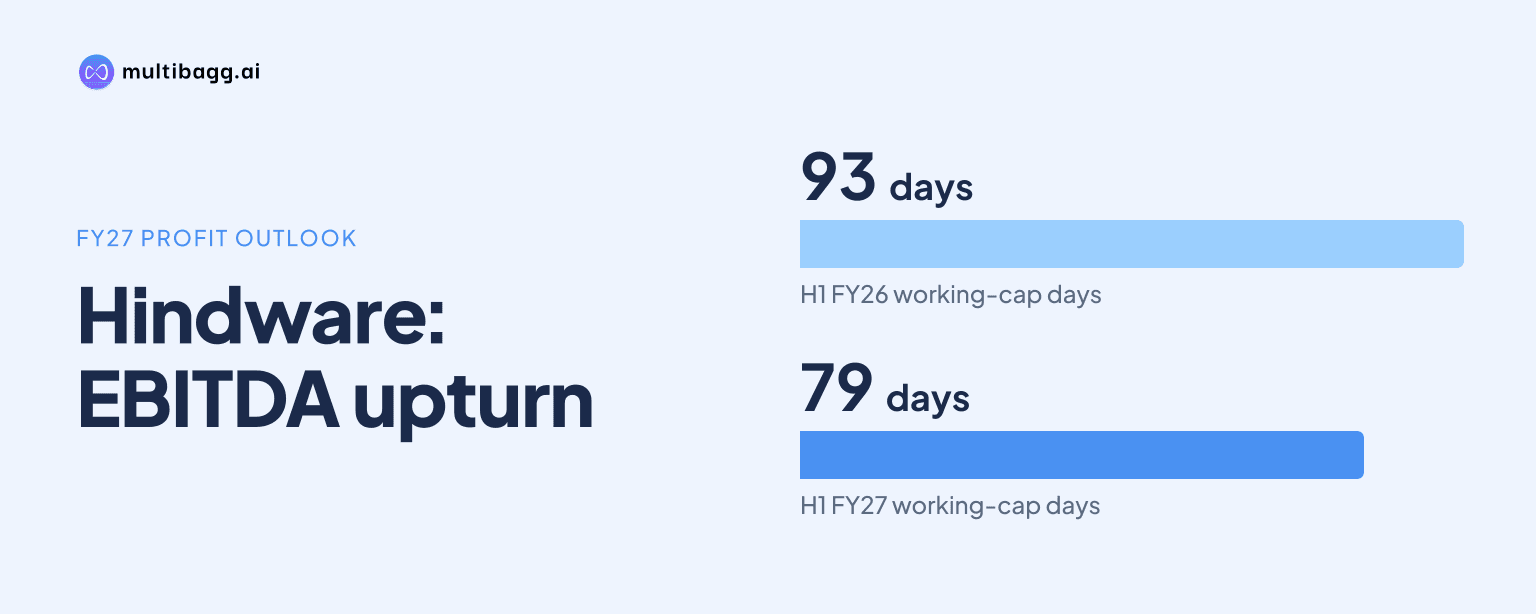
- Working-capital days improved from 93 in H1 FY26 to 79 in H1 FY27.
- Net bank debt remained Rs 24 crore in both H1 FY26 and H1 FY27, with about Rs 5 crore of annual capital expenditure planned.
powered by IRIS
Hindware Home Innovation Limited expects its Consumer Appliances business to turn EBITDA-positive in FY27 after pruning high-loss categories and eliminating legacy costs, while management targets revenue above Rs 500 crore within two years. The plan centres on core kitchen products, aggressive e-commerce, dealer and exclusive-brand-store expansion, and an asset-light sourcing model.
Know Hindware Home Innovation inside out
Results, valuation, peers and who's buying, in one view.
How does Hindware plan to become EBITDA-positive in FY27?
Hindware plans to reach positive EBITDA in FY27 by removing legacy costs, having already pruned high-loss categories, and concentrating Consumer Appliances on its core kitchen portfolio. The presentation describes this as a positive EBITDA swing in FY27, rather than reporting that profitability has already been achieved. Management also says there will be no new categories in the near term, with the immediate priority being to consolidate and deepen the existing business.
The core portfolio consists of chimneys, hobs, cooktops and sinks, while e-commerce is identified as an area for aggressive expansion. Hindware’s route to scale also includes increasing dealers and exclusive brand stores. This approach directs growth spending towards retained kitchen categories after the exit from loss-making lines, while seeking to remove the cost burden associated with the previous portfolio by FY27.
The presentation says bottom-line growth is intended to outpace top-line growth as scale increases. Its margin guidance specifies a 35% to 40% gross-margin range and says the margin trajectory should become double-digit as scale builds. Hindware does not provide a Consumer Appliances revenue base or an EBITDA amount in these pages, so the FY27 objective is a profitability milestone rather than a quantified earnings forecast.
What revenue and margin goals has Hindware set?
Hindware management targets Consumer Appliances revenue of more than Rs 500 crore within two years and Rs 700 crore to Rs 750 crore by FY30. These targets sit alongside an expected 15% to 20% compound annual growth rate, or CAGR, over the next two to three years. The two time horizons indicate that management expects the business to first cross Rs 500 crore before pursuing a further Rs 200 crore to Rs 250 crore of annual revenue by FY30.
The stated gross-margin range of 35% to 40% is the presentation’s principal margin benchmark for Consumer Appliances. Management links the prospect of double-digit margins to greater scale and says the legacy overhang should be cleared by FY27. The FY27 objective is therefore a move from legacy loss costs to positive EBITDA, while the longer-term margin outcome depends on the business building scale.
Hindware’s revenue plan is tied to distribution and portfolio execution rather than a move into fresh product categories. The presentation identifies scaling dealers and exclusive brand stores as the go-to-market plan, while making e-commerce a major sales focus. It frames the Rs 500 crore objective as expansion of the retained kitchen platform, not growth from another category launch.
Got a follow-up? Ask IRIS
Which products and channels are central to Hindware’s turnaround?
Hindware is centring the turnaround on chimneys, hobs, cooktops and sinks, supported by e-commerce, dealers and exclusive brand stores. The business has ruled out new categories in the near term, signalling that the next phase is intended to deepen participation in the kitchen segment. The stated 15% to 20% growth ambition over two to three years is consequently tied to expanding reach for this defined product set.
Water heaters remain relevant through Hintastica Private Limited, or HPL, which became a wholly owned subsidiary in Q1 FY27. Hindware describes HPL as leaner and nearly debt-free, and says it will use an asset-light model to scale the water-heater operation. The presentation also notes that HPL is near debt-free following a plant sale, though it does not disclose the sale proceeds, timing or HPL’s separate revenue.
The channel mix combines physical expansion with online sales. Dealer scaling and exclusive brand stores are named as the go-to-market mechanisms, while aggressive e-commerce is part of the profitability path. This pairing is intended to support the more than Rs 500 crore revenue target within two years without adding a new category, although the presentation provides no Consumer Appliances figures for dealer additions, online sales mix or store count.
How do sourcing, working capital and debt support Hindware’s plan?
Hindware says its asset-light model is supported by sourcing about 75% domestically, with localisation planned for brushless direct-current, or BLDC, motors and sensors. Management says this is intended to reduce foreign-exchange and freight risk. It is also confident of industry price pass-through for input-cost movements, although the presentation gives no price-rise percentage or timetable for such pass-through.
Working-capital days declined to 79 in H1 FY27 from 93 in H1 FY26, a reduction of 14 days. Inventory days fell by eight days to 85, while debtor days declined by 15 days to 54. Hindware attributes the lower working-capital intensity to leaner stock-keeping units, or SKUs, and the asset-light model.
Net bank debt was unchanged at Rs 24 crore in H1 FY26 and H1 FY27. Hindware characterises this as working-capital borrowing only, with no term loan, and indicates annual capital expenditure of about Rs 5 crore. The unchanged debt position contrasts with the 14-day improvement in working-capital days over the same periods.
Conclusion
Hindware’s Consumer Appliances plan combines category exits with a narrower kitchen portfolio, 35% to 40% gross-margin guidance and an asset-light operating model with about 75% domestic sourcing. The reported reduction in working-capital days to 79 in H1 FY27 from 93 a year earlier provides an operating comparison, while net bank debt remained Rs 24 crore.
The next items to watch are management’s execution of legacy-cost removal during FY27, progress towards revenue above Rs 500 crore within two years, and whether scale supports the stated margin trajectory. Separately, the companies are to file the National Company Law Tribunal order with the Registrar of Companies, after which the listing process for HHIL Limited and Hindware Limited with BSE and NSE will be initiated in due course.