










Hindware targets EBITDA uplift despite 58% brass inflation
Key highlights
- Hindware targets mid-teen bathware revenue growth in FY27, including high-teen faucet growth and double-digit sanitaryware growth.
- Bathware EBITDA was about 11% in Q2 FY27 and H1 FY27; management targets a 2-4 percentage-point uplift over 18-24 months.
- Brass prices increased about 58% year on year in Q2 FY27 versus Q2 FY26.
- Working-capital days improved to 83 in H1 FY27 from 100 in H1 FY26, while net bank debt fell to Rs 192 crore from Rs 277 crore.
powered by IRIS
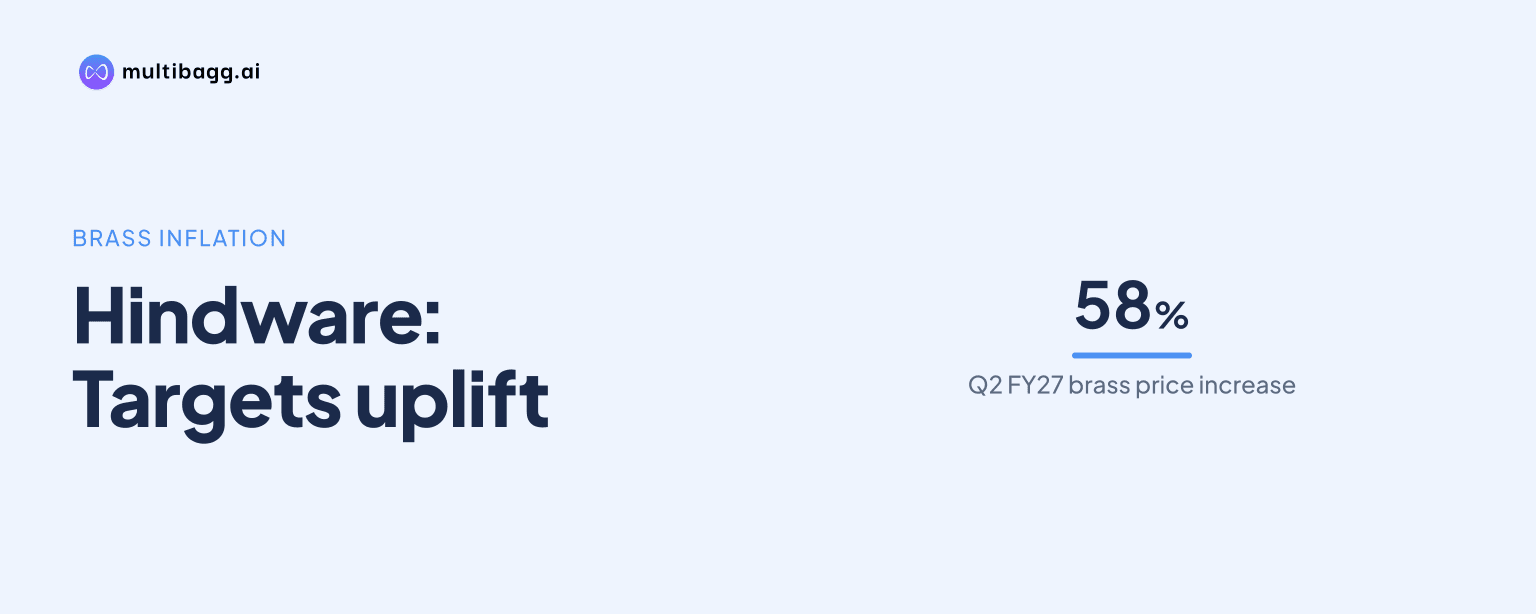
Hindware Home Innovation Limited targets mid-teen bathware revenue growth in FY27 and a 2-4 percentage-point EBITDA uplift over 18-24 months, despite brass prices rising about 58% year on year in Q2 FY27. Management plans to use premiumisation, weighted-dealer growth, manufacturing cost-outs and greater in-house production to support the target.
Know Hindware Home Innovation inside out
Results, valuation, peers and who's buying, in one view.
How fast does Hindware expect bathware revenue to grow?
Hindware expects mid-teen bathware revenue growth in FY27, with high-teen growth in faucets and double-digit growth in sanitaryware. Management identifies weighted dealers, new products and a premium push as the growth drivers, alongside investment in the brand and higher growth from weighted dealers.
The sales mix gives the channel strategy added importance: Tier 2 and Tier 3 markets contribute about 70% of bathware sales, while institutional business accounts for about 25%. Management says institutional sales have lower margins than general trade, so the composition of FY27 growth may matter alongside the stated mid-teen revenue objective.
Brand stores account for about 30% of general-trade sales. Management says this store investment is net positive and intended to build brand visibility, while its capacity plan is limited to debottlenecking rather than a major expansion programme.
How is premiumisation meant to lift Hindware’s margins?
Hindware’s premium products represented about 40% of bathware mix in H1 FY27, and management plans an increase of about 5% over the next 18-24 months. The company says premium ranges earn gross margins 2-3% higher than mass and mass-premium products, linking mix expansion to the margin plan.
Queo is Hindware’s super-premium offering, with a management revenue target of Rs 180-200 crore within five years. The “Designed for Sukoon” multimedia campaign is live, but the presentation does not disclose current Queo revenue, so progress towards that target cannot be calculated from the available figures.
Premiumisation is being pursued alongside broad distribution rather than instead of it. About 70% of sales come from Tier 2 and Tier 3 markets and brand stores contribute about 30% of general-trade sales; the disclosed 2-3% gross-margin difference applies to product ranges, not to total bathware gross margin.
What is Hindware’s bathware EBITDA roadmap?
Hindware reported bathware EBITDA, or earnings before interest, tax, depreciation and amortisation, of about 11% in Q2 FY27 and H1 FY27, matching the approximately 11% level management cites for FY26. Management targets an additional 2-4 percentage points over 18-24 months through operating leverage and manufacturing cost-outs.
The comparison indicates that EBITDA was broadly unchanged across FY26, H1 FY27 and Q2 FY27, rather than already reflecting the planned uplift. Management cautions that quarterly EBITDA can vary with market conditions and says annual EBITDA gives a more balanced reflection of core operating performance.
In-house production is another specified lever: Hindware makes about 50% of faucets and about 70% of sanitaryware internally. Management intends to manufacture high-volume, higher-margin products in-house, while outsourcing lower-margin and lower-volume products to optimise production capacity.
Got a follow-up? Ask IRIS
Can Hindware manage the rise in brass costs?
Hindware faces a significant raw-material challenge because brass prices increased about 58% year on year in Q2 FY27 versus Q2 FY26. Management says brass and fuel-price volatility may challenge market demand, although faucet selling prices have risen progressively over the past year.
The presentation does not quantify the portion of the brass-price increase recovered through faucet price increases. It therefore does not establish the net impact on gross margin; the stated response is progressive pricing, a premium mix, manufacturing cost-outs and increased in-house production of selected products.
Manufacturing utilisation was about 93% in sanitaryware and about 89% in faucets in H1 FY27. Hindware has no capacity expansion underway beyond debottlenecking and brand-store investment, and management has indicated FY27 capex of about Rs 50 crore.
What has changed in Hindware’s working capital and debt?
Hindware reduced working-capital days to 83 in H1 FY27 from 100 in H1 FY26, a 17-day reduction. Inventory days stayed at 98 in both periods, while debtor days fell to 45 from 60, indicating that receivables discipline accounted for the reported improvement.
Net bank debt declined to Rs 192 crore in H1 FY27 from Rs 277 crore in H1 FY26. The disclosed measure excludes the inter-company loan extended by Hindware Home Innovation Limited to Hindware Limited, and management is aiming for a further 10-15% working-capital optimisation over 18-24 months.
Management also targets return on capital employed, or ROCE, of 16-18% over 18-24 months. Its stated spending plan remains focused on debottlenecking, brand stores and about Rs 50 crore of FY27 capex, rather than a new manufacturing-capacity programme.
Conclusion
Hindware’s bathware plan combines mid-teen FY27 revenue growth with a 2-4 percentage-point EBITDA uplift target over 18-24 months. The disclosed mechanisms are a 40% premium mix in H1 FY27, a 2-3% gross-margin advantage for premium ranges, about 50% in-house faucet production, about 70% in-house sanitaryware production and lower working-capital days of 83 versus 100 a year earlier.
The next measures to watch are the planned increase of about 5% in premium mix, movement in brass prices after the 58% year-on-year rise reported for Q2 FY27, and progress towards the 10-15% working-capital optimisation and 16-18% ROCE targets. Management’s 18-24 month timetable, and its view that annual EBITDA better reflects operations than a single quarter, makes full-year margin delivery a key disclosed checkpoint.