










Hindware Home Innovation Limited targets 15% pipes growth, 4-5% EBITDA
Key highlights
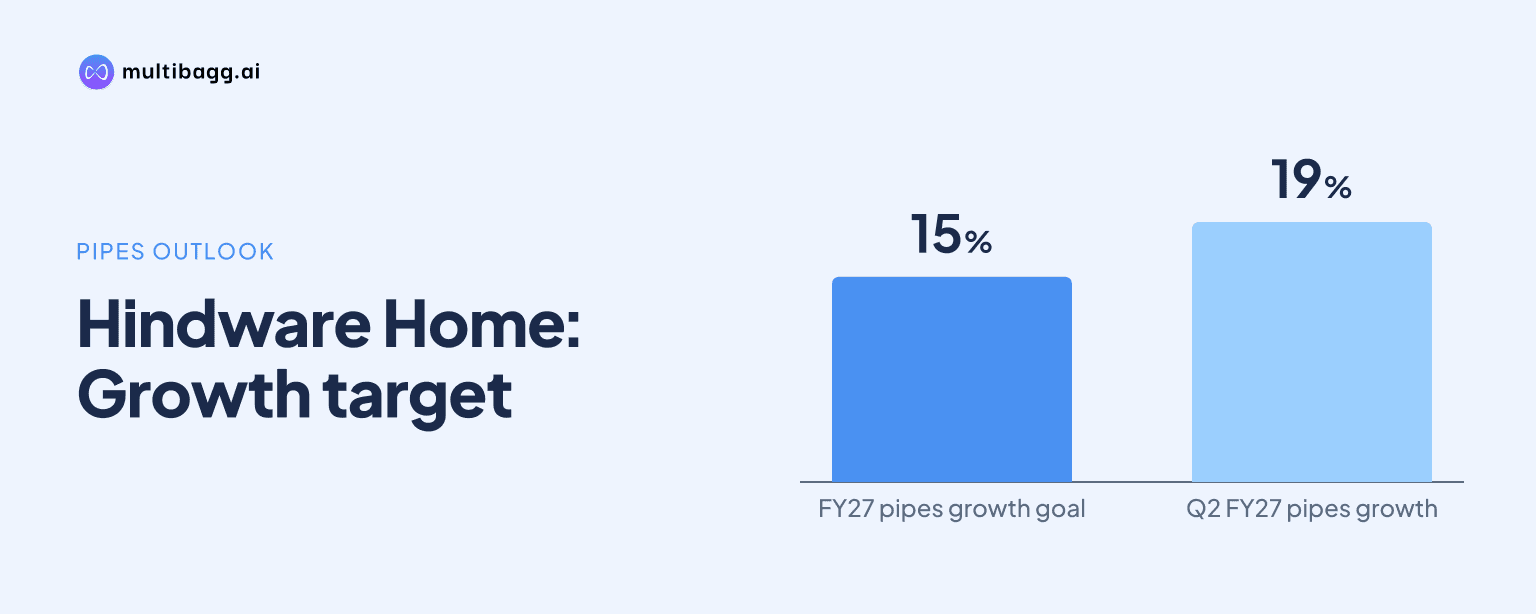
- Hindware Home Innovation targets approximately 15% pipes sales-volume growth in FY27.
- Hindware Home Innovation reported Q2 FY27 pipes volume of 14,176 MT, about 19% higher year on year.
- Hindware Home Innovation targets FY27 pipes EBITDA of 4-5%, versus about 3% in H1 FY27.
- Hindware Home Innovation's Roorkee plant has 12,500 MT annual capacity and needs another two to three quarters to ramp up.
powered by IRIS
Hindware Home Innovation Limited targets about 15% pipes sales-volume growth in financial year 2027 (FY27) and EBITDA of 4-5%, after reporting about 3% EBITDA in the first half. The Roorkee plant, which began commercial production in January 2026, needs another two to three quarters to improve utilisation amid northern competition and pricing pressure.
Know Hindware Home Innovation inside out
Results, valuation, peers and who's buying, in one view.
What is Hindware Home Innovation's FY27 pipes growth outlook?
Hindware Home Innovation is targeting approximately 15% sales-volume growth in its pipes business in FY27, while resin and other raw-material volatility may affect value growth. The business reported pipes sales volume of 14,176 metric tonnes (MT) in the second quarter (Q2) of FY27, representing about 19% year-on-year growth. That quarterly volume performance exceeded the full-year growth objective, but the presentation does not provide a corresponding pipes revenue figure or value-growth target.
Management expects new products to contribute during the year, naming fire-sprinkler and foam-core products alongside other additions. Its distribution expansion included 46 distributors added in Q2 FY27, while its top 30 distributors accounted for about 53% of sales in that quarter. Management said stability in polyvinyl chloride (PVC) resin would help channel partners stock products and stabilise selling prices.
Product mix also affects the margin outcome. Chlorinated polyvinyl chloride (CPVC) represented about 36% of pipes value mix in Q2 FY27, with management noting that the first half is a lean season for plumbing. Management also stated that CPVC and unplasticised polyvinyl chloride (UPVC) earn margins above the blended pipes margin, making a higher contribution from these categories part of its profitability roadmap.
Why is the Roorkee plant taking longer to ramp up?
Hindware Home Innovation says Roorkee needs a further two to three quarters to improve capacity utilisation because aggressive competition and pricing pressure in northern markets are slowing the ramp-up. Commercial production at the plant began in January 2026. The presentation does not disclose Roorkee’s current utilisation rate, so the pace of production absorption cannot be quantified from the disclosed information.
Roorkee has annual capacity of 12,500 MT, compared with 66,000 MT at the Isnapur plant. The new facility therefore adds capacity in the north, but management’s comments indicate that production availability alone will not determine the speed of the ramp-up. Distribution-channel confidence, selling-price stability and local competitive intensity are identified as factors affecting conversion of capacity into sales.
The business links the utilisation issue directly to profit recovery. Its stated route includes greater use of installed capacity to absorb fixed overheads over more output. Alongside a higher CPVC mix and cost optimisation, this operating leverage is intended to lift return on capital employed (RoCE), although Hindware Home Innovation provides no pipes-specific RoCE target or timetable beyond the FY27 margin objective.
Got a follow-up? Ask IRIS
Can Hindware Home Innovation lift pipes EBITDA to 4-5%?
Hindware Home Innovation targets a 4-5% pipes EBITDA margin in FY27 through cost-optimisation plans, after reporting approximately 4% in Q2 FY27 and approximately 3% in the first half of FY27. The quarter was therefore about 1 percentage point above the first-half margin, but the FY27 target still requires improvement from the first-half level. Management did not disclose a specific cost-saving amount or a quarterly EBITDA forecast.
The stated profit levers are value-added products, a greater CPVC mix, demand growth, distribution expansion and higher capacity utilisation. Management identifies CPVC and UPVC as products with margins above the blended business margin. This makes mix material to the target, particularly because CPVC was around 36% of Q2 FY27 value mix and the company describes first-half plumbing demand as seasonally lean.
Pricing and input conditions remain central to that path. Hindware Home Innovation says PVC resin and currency volatility may affect FY27 margins, while stability in both could reduce widespread channel discounting and restore pricing discipline. Management also says lower raw-material-price volatility would create channel confidence and smooth the price war, linking external price conditions to both Roorkee’s ramp-up and the 4-5% EBITDA goal.
How are working capital, debt and capex changing?
Hindware Home Innovation reduced pipes working-capital days to 83 in the first half (H1) of FY27 from 90 in H1 FY26, driven by lower inventory days, although debtor days increased. Inventory fell to 61 days from 87 days, while debtor days rose to 101 from 86. Management says lean inventory is intended to cushion the business against inventory volatility and targets a further 10-15% working-capital optimisation over the next 18-24 months.
Net bank debt, excluding an inter-company loan extended by Hindware Home Innovation Limited to Hindware Limited, was Rs 446 crore in H1 FY26 and Rs 420 crore in the second half (H2) of FY27, as labelled in the presentation. Management says its major capital-expenditure programme has been completed, expects earnings to reduce debt, and has indicated FY27 capital expenditure of around Rs 15 crore.
The disclosed working-capital measures changed in different directions. Inventory and total working-capital days fell, while debtor days rose by 15 days to 101 in H1 FY27. With major capacity investment described as complete and FY27 capex set at around Rs 15 crore, management’s stated focus is on using existing assets more fully rather than announcing another large pipes capacity programme.
Conclusion
Hindware Home Innovation’s pipes plan combines a roughly 15% FY27 volume-growth target with a 4-5% EBITDA target, against Q2 FY27 volume growth of about 19% and EBITDA of about 4%. The difference between first-half EBITDA of about 3% and the full-year target means the business is relying on cost measures, higher CPVC and UPVC mix, distribution growth and better absorption of Roorkee’s fixed costs.
The next disclosed milestone is Roorkee’s additional two to three quarters of utilisation improvement, alongside the FY27 margin outcome. Management’s plan also depends on more stable PVC resin and currency conditions to reduce channel discounting, while its 10-15% working-capital optimisation target over 18-24 months will be measured against debtor days of 101 in H1 FY27.