










V2 Retail: Tighter Discounts Lift Q2 Gross Margin by 310 Basis Points
Key highlights
- V2 Retail said Q2 gross margin increased by 310 basis points, led mainly by shallower discounts.
- Core-product costs increased by 3%-7%, while MRPs rose by 5%-10% on affected products.
- V2 Retail said first-half ASP declined 3% as value and economy assortment options expanded.
- Management guided for 29%-30% full-year gross margin and said winter fill rates were almost 20% higher than a year earlier.
powered by IRIS
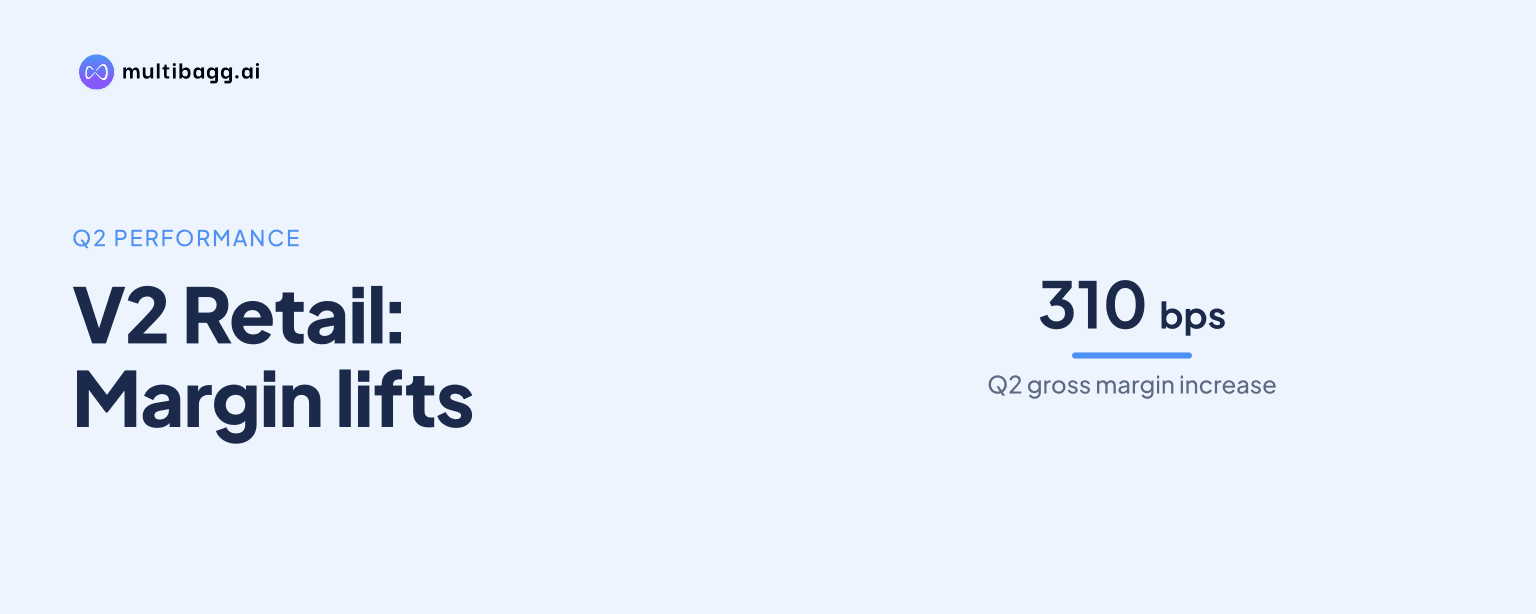
V2 Retail said its Q2 gross margin rose 310 basis points, primarily through shallower discounts and product-mix changes, despite a 3%-7% rise in core-product costs. Management said it increased maximum retail prices, or MRPs, by 5%-10% on affected merchandise while first-half average selling price, or ASP, fell 3%.
Know V2 Retail inside out
Results, valuation, peers and who's buying, in one view.
How did V2 Retail improve Q2 gross margin despite inflation?
V2 Retail said lower discount depth was the principal reason for the 310-basis-point Q2 gross-margin increase, where 100 basis points equal one percentage point. Management said the share of goods sold at full price does not measure the depth of discounts given on discounted goods, making the two measures materially different.
An analyst said full-price sales declined year on year to 91% in Q2 while gross margin improved by about 300 basis points. Management said a similar quantity of discounted products can produce different margins if the average discount changes, illustrating this with a reduction from a 50% average discount to a 30% average discount.
Management also cited retail-calendar effects. It said the Dussehra bill-buster offer occurred in September in the previous year but was scheduled for October in the current year. In Q1, gross margin was 1% lower because Adhik Maas required V2 Retail to begin discounting earlier than expected.
What pricing and assortment actions is V2 Retail taking?
V2 Retail said it raised MRPs by 5%-10% for products affected by raw-material inflation because it could not absorb the full cost increase in its margin. Management put the increase in costs for core products and products sold in volume at 3%-7%.
The retailer is using more blended fabrics rather than 100% cotton fabrics to manage cost pressure. Management said that where premium and super-premium products represented 30% of a category, it expanded value and economy options to retain broadly similar customer price points and average basket sizes.
That mix shift meant first-half ASP declined 3% even after MRP increases for some products. Management said the lower ASP reflected a larger proportion of value and economy merchandise, rather than an absence of inflation in merchandise costs, and it did not believe the pass-through was then affecting sales.
Got a follow-up? Ask IRIS
What full-year gross margin does V2 Retail expect?
V2 Retail management guided for full-year gross margin of 29%-30%. This is a management target rather than a reported outcome, and it relies on discount control, assortment changes and the timing of promotional campaigns through the rest of the year.
The Q1 and Q2 contrast shows how the promotional calendar can affect reported margins. Q1 gross margin was 1% lower after earlier discounting during Adhik Maas, whereas Q2 benefited from lesser discounting and the movement of the bill-buster campaign from September to October.
V2 Retail said the gross-margin improvement also offset some pressure from lower sales per square foot, or PSF, caused by rapid store additions. Management said earnings before interest, tax, depreciation and amortisation, or EBITDA, margin before Indian Accounting Standards, or Ind AS, declined by only 0.2% despite the Durga Puja timing shift.
How could demand and store additions affect V2 Retail's margin plan?
V2 Retail said new stores initially operate at PSF levels 35%-40% below mature stores, reducing the network-wide average during expansion. Management said stores historically take two to three years to mature, but the FY25 cohort may take 2.5 to 3.5 years after a muted first half.
Q2 PSF was Rs 700, compared with Rs 938 cited by an analyst for the prior quarter. Management said Q2 PSF is historically 40%-45% below the annual average when the quarter does not include a festival, while the last-12-month average was above Rs 730-Rs 740 for newer stores and about Rs 1,100 for older stores.
Management reported a 1% decline in average bill value and a 3% fall in footfall in Q2. It said state-level, cohort-level and competitor analysis did not identify one cause, but early winter demand was positive and winter fill rates were almost 20% higher than in the previous year.
V2 Retail opened 106 stores in the first half and planned another 60-70 in the second half. Management said it could reduce next year's openings to 100 from an earlier target of 150-200 if muted same-store sales growth continues through Q3, which would lower its sales-growth expectation from about 50% to 35%-40%.
Conclusion
V2 Retail's Q2 gross-margin gain was chiefly the result of shallower discounting and a changed merchandise mix, rather than higher MRPs alone. The 310-basis-point improvement came as core-product costs increased 3%-7% and first-half ASP declined 3%, reflecting management's effort to preserve value price points while protecting margin.
The next test is Q3, which management called its largest quarter because it includes festivals and winter demand. Investors will watch whether the almost 20% improvement in winter fill rates supports the 29%-30% full-year gross-margin target and whether Q3 trading leads management to retain or reduce its store-opening plan.