










Veegaland Q2 profit rises 92% as EBITDA margin expands 550 bps
Key highlights
- Veegaland reported Q2 FY27 revenue from operations of Rs 106.3 crore, up 28.7% year on year.
- Q2 FY27 EBITDA rose 77.8% to Rs 22.8 crore and EBITDA margin increased 550 basis points to 20.9%.
- Q2 FY27 PAT increased 92.3% to Rs 16.0 crore, with PAT margin rising 470 basis points to 14.7%.
- H1 FY27 PAT rose 123.1% to Rs 25.7 crore, while revenue increased 45.5% to Rs 180.7 crore.
powered by IRIS
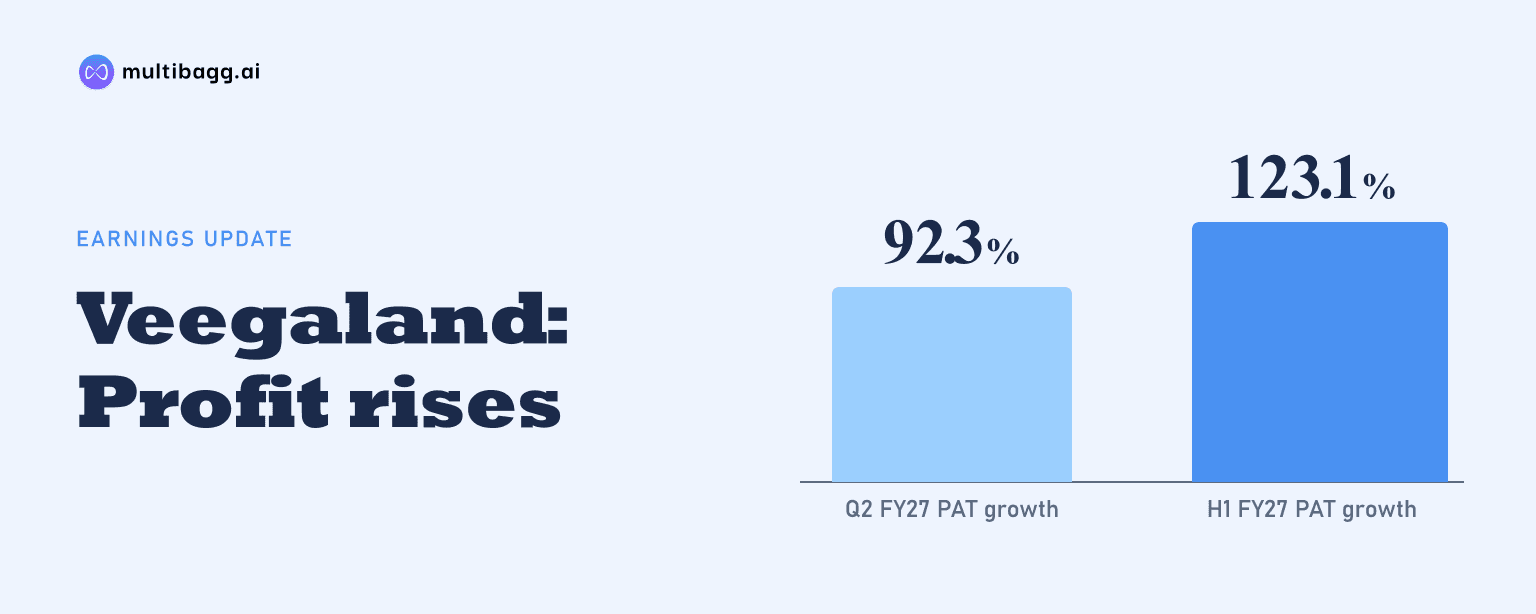
Veegaland Developers Limited reported Q2 FY27 profit after tax of Rs 16.0 crore, up 92.3% year on year, as its EBITDA margin rose 550 basis points to 20.9% in the quarter ended September 30, 2026. Revenue from operations increased 28.7% to Rs 106.3 crore.
Know Veegaland Developers inside out
Results, valuation, peers and who's buying, in one view.
How did Veegaland perform in Q2 FY27?
Veegaland’s Q2 FY27 revenue, operating earnings and profit all increased from Q2 FY26, with profit growing faster than revenue. Revenue from operations rose by Rs 23.6 crore to Rs 106.3 crore, while earnings before interest, tax, depreciation and amortisation, or EBITDA, increased by Rs 10.0 crore to Rs 22.8 crore. Profit after tax, or PAT, increased by Rs 7.7 crore from Rs 8.3 crore to Rs 16.0 crore. The company reported these consolidated figures on November 5, 2026, for the quarter ended September 30, 2026.
The comparison shows a widening gap between revenue growth of 28.7% and EBITDA growth of 77.8% in Q2 FY27. PAT grew 92.3%, the fastest of the three reported measures. Veegaland also reported basic earnings per share of Rs 4.46 for Q2 FY27, compared with Rs 2.88 in Q2 FY26. EBITDA in the release includes other income, which is relevant when comparing the reported operating-earnings figure with revenue from operations.
How did Veegaland’s Q2 FY27 margins change?
Veegaland’s EBITDA margin rose to 20.9% in Q2 FY27 from 15.4% in Q2 FY26, an improvement of 550 basis points. A basis point is one-hundredth of a percentage point, so the reported change equals 5.5 percentage points. The expansion accompanied EBITDA of Rs 22.8 crore on revenue of Rs 106.3 crore, compared with EBITDA of Rs 12.8 crore on revenue of Rs 82.7 crore a year earlier.
PAT margin also improved, reaching 14.7% in Q2 FY27 versus 10.0% in Q2 FY26. That was a 470-basis-point increase, or 4.7 percentage points, alongside PAT of Rs 16.0 crore versus Rs 8.3 crore. The source does not break out cost lines, project-level contributions or other drivers of the margin movement, so the filing supports the reported margin change but does not quantify its individual causes.
What do Veegaland’s first-half FY27 results show?
Veegaland reported that first-half FY27 growth exceeded its Q2 revenue growth rate, with revenue from operations rising 45.5% to Rs 180.7 crore from Rs 124.2 crore in H1 FY26. EBITDA nearly doubled, increasing 96.2% to Rs 37.1 crore from Rs 18.9 crore. PAT rose 123.1% to Rs 25.7 crore, compared with Rs 11.5 crore in the first half of the prior financial year.
Margins were also higher for H1 FY27 than H1 FY26. EBITDA margin increased 500 basis points to 20.1% from 15.1%, while PAT margin increased 490 basis points to 14.2% from 9.3%. Basic earnings per share for H1 FY27 was Rs 7.38, compared with Rs 4.28 in H1 FY26. The half-year figures place Q2 FY27 revenue of Rs 106.3 crore within reported first-half revenue of Rs 180.7 crore.
Got a follow-up? Ask IRIS
What did management say about Veegaland’s plans?
Veegaland said its focus is to strengthen its presence across Kerala’s key residential markets and build a portfolio of quality homes using biophilic designs. Founder, vice chairman and whole-time director Kochouseph Thomas Chittilappilly made those comments alongside the November 5, 2026 results release, which reported Q2 FY27 revenue of Rs 106.3 crore. Management also cited eco-friendly building techniques, local-market understanding and quality as elements of its long-term customer-confidence approach.
Management said it remains focused on project execution, operational efficiencies and continuous improvement as it pursues its next phase of growth. These are stated priorities rather than quantified financial guidance: the release gives no future revenue, margin, sales, launch or completion target. Its disclosed Q2 FY27 result was EBITDA of Rs 22.8 crore and PAT of Rs 16.0 crore, but the company cautioned that forward-looking statements are subject to risks and uncertainties.
What business footprint has Veegaland disclosed?
Veegaland was incorporated in 2007 as part of the group’s diversification strategy and began real-estate operations in 2011. It says it now operates across four key cities in Kerala and serves different homebuyer segments through five residential segments. The release describes the company as Kerala-based and focused on residential spaces in established and emerging micro-markets.
The company said it was recognised as Kerala’s fastest-selling real-estate developer in an ICRA report dated December 8, 2025. That statement identifies a third-party report and date, but the earnings release does not provide sales volume, booking value, inventory, project count or city-level financial data. Consequently, the Q2 FY27 revenue increase of 28.7% can be compared with Q2 FY26, but not allocated across the four cities or five residential segments from this filing.
Conclusion
Veegaland’s September-quarter results show that reported profit and EBITDA increased faster than revenue: PAT rose 92.3% to Rs 16.0 crore, EBITDA rose 77.8% to Rs 22.8 crore and revenue rose 28.7% to Rs 106.3 crore. The associated margin changes were 550 basis points for EBITDA and 470 basis points for PAT, while H1 FY27 also showed higher revenue and margins than H1 FY26.
The next disclosed matters to watch are Veegaland’s execution and operational-efficiency focus, its stated aim of expanding across Kerala’s key residential markets, and whether later disclosures provide targets or project-level detail. The November 5, 2026 release did not provide guidance beyond these plans, and it noted that forward-looking statements may be affected by regulatory, political, economic and other risks.