










Venus Pipes & Tubes Limited cash conversion reached 59% in FY26
Key highlights
- Venus Pipes & Tubes’ cash conversion ratio rose from 13% in FY23 to 59% in FY26.
- Net cash from operating activities increased from Rs 8.7 crore in FY23 to Rs 112.4 crore in FY26.
- FY26 net investing cash outflow was Rs 202.8 crore, while financing activities generated Rs 93.7 crore.
- Inventory days were 121 in FY26 versus 110 days in FY23, while revenue reached Rs 1,166.8 crore.
powered by IRIS
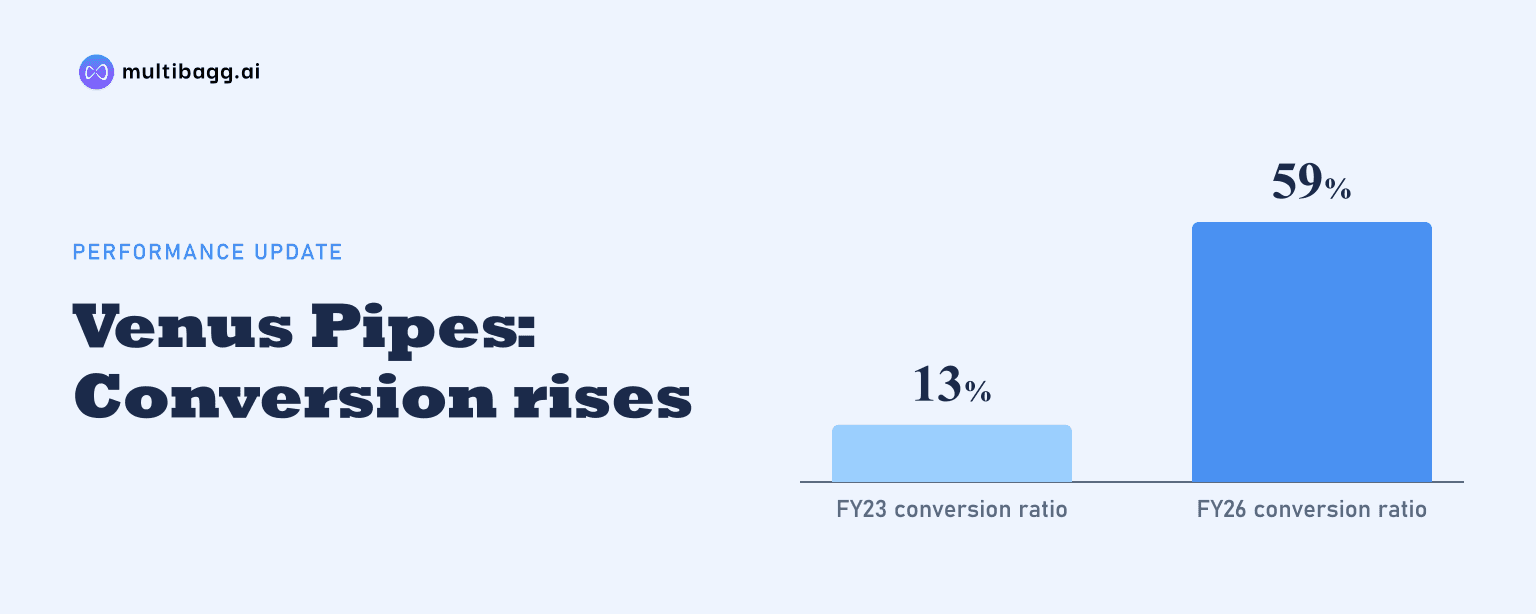
Venus Pipes & Tubes raised operating cash conversion to 59% in FY26 from 13% in FY23, as net cash from operating activities increased to Rs 112.4 crore against earnings before interest, tax, depreciation and amortisation (EBITDA) of Rs 190.6 crore. Management attributes the improvement to working-capital management and stabilisation following expansion.
Know Venus Pipes & Tubes inside out
Results, valuation, peers and who's buying, in one view.
How did Venus Pipes & Tubes’ cash conversion change?
Venus Pipes & Tubes’ cash conversion increased by 46 percentage points from FY23 to FY26, rising each year from 13% to 36%, 41% and 59%. The presentation defines the ratio through its comparison of cash flow from operations with EBITDA, showing that operating cash growth exceeded the increase in EBITDA over the four-year period.
The historical cash-flow statement reports net cash from operating activities of Rs 8.7 crore in FY23, Rs 52.2 crore in FY24, Rs 68.7 crore in FY25 and Rs 112.4 crore in FY26. EBITDA rose from Rs 69.1 crore in FY23 to Rs 190.6 crore in FY26, while revenue from operations increased from Rs 552.4 crore to Rs 1,166.8 crore over the same period.
The FY26 ratio remained below 100%, meaning operating cash did not equal the year’s EBITDA of Rs 190.6 crore. Profit after tax increased from Rs 44.2 crore in FY23 to Rs 101.9 crore in FY26, but the cash-flow statement also records continuing working-capital absorption and direct tax payments during the period.
What drove Venus Pipes & Tubes’ higher operating cash flow?
Venus Pipes & Tubes attributes the improved ratio to tighter working-capital management and stabilisation in expanded operations. Operating profit before working-capital changes increased from Rs 66.8 crore in FY23 to Rs 196.3 crore in FY26, while the working-capital outflow rose from Rs 39.4 crore to Rs 50.8 crore, a smaller share of the higher pre-working-capital profit.
Cash generated from operations before tax rose from Rs 27.4 crore in FY23 to Rs 145.5 crore in FY26. Direct taxes paid, net of refunds, were Rs 33.1 crore in FY26, compared with Rs 18.7 crore in FY23, resulting in net cash from operating activities of Rs 112.4 crore in FY26.
Non-cash items and other investment or financial adjustments increased to Rs 59 crore in FY26 from Rs 7.1 crore in FY23. Depreciation rose from Rs 1.9 crore to Rs 23.6 crore as property, plant and equipment increased from Rs 59.8 crore at March 2023 to Rs 396.1 crore at March 2026.
Did working capital still absorb cash at Venus Pipes & Tubes?
Yes, Venus Pipes & Tubes reported a Rs 50.8 crore working-capital outflow in FY26 despite the higher operating cash conversion. Inventory increased to Rs 386.9 crore at March 2026 from Rs 166.9 crore at March 2023, while trade receivables rose to Rs 259.9 crore from Rs 70.5 crore.
Inventory days were 121 in FY26 versus 110 in FY23, after reaching 103 days in FY24 and 131 days in FY25. Revenue grew to Rs 1,166.8 crore in FY26 from Rs 552.4 crore in FY23, and the presentation calculates inventory days as inventory divided by revenue, multiplied by 365.
Management links the inventory requirement to an order book of about Rs 450 crore, exports of about Rs 400 crore and longer execution visibility of five to six months, compared with about 60 days earlier. It also cites wider product sizes, stock-keeping units and grades, hollow-pipe manufacturing, and inspection or approval-based dispatches.
Got a follow-up? Ask IRIS
How did Venus Pipes & Tubes fund its expansion?
Venus Pipes & Tubes’ FY26 net investing cash outflow of Rs 202.8 crore exceeded net operating cash of Rs 112.4 crore. Investing outflows were Rs 167.4 crore in FY23, Rs 99.7 crore in FY24 and Rs 114.2 crore in FY25, while capital work in progress stood at Rs 123.7 crore at March 2026.
Financing activities provided Rs 93.7 crore in FY26, following Rs 47.4 crore in FY25 and Rs 169.4 crore in FY23. Total borrowings, comprising current and non-current borrowings, increased to Rs 285.6 crore at March 2026 from Rs 90.5 crore at March 2023; the reported debt-to-equity ratio was 0.5 in FY26 versus 0.3 in FY23.
The combination of FY26 operating, investing and financing movements produced a Rs 3.3 crore increase in cash and cash equivalents to Rs 6.2 crore at year-end. That followed a Rs 1.9 crore increase in FY25 and a Rs 9.7 crore decrease in FY24, illustrating the continued cash requirements of the expansion programme.
What does Venus Pipes & Tubes expect after capacity expansion?
Venus Pipes & Tubes says major capacity expansion is largely complete and expects healthy cash conversion and stronger free cash flow generation going forward. This is management’s expectation, supported by FY26 net operating cash of Rs 112.4 crore and its stated focus on inventory optimisation, receivables management and disciplined execution.
The future outcome will also depend on operating profitability and working capital as the business executes its order book. EBITDA margin declined to 16.3% in FY26 from 17.5% in FY25 and 18.2% in FY24, while FY26 inventory was Rs 386.9 crore and trade receivables were Rs 259.9 crore.
Conclusion
The FY23-to-FY26 cash-flow record shows a business whose operating cash generation rose alongside revenue and EBITDA after capacity additions. However, the same period included inventory and receivable growth, Rs 202.8 crore of FY26 investing outflow, and Rs 93.7 crore of financing inflow, placing the higher conversion ratio in the context of a capital-intensive build-out.
The next development to watch is whether management’s expectation of stronger free cash flow follows the stated completion of major expansion. Future disclosures on operating cash, investing outflows, borrowings, inventory and receivables will indicate whether inventory optimisation, receivables management and execution discipline are reducing cash requirements.