










Veranda targets Rs 600 crore revenue, Rs 120-140 crore EBITDA
Key highlights
- Veranda targets Rs 600 crore revenue within five years, compared with Rs 175 crore expected this year.
- Veranda targets Rs 120 crore to Rs 140 crore EBITDA within five years, versus Rs 45 crore expected this year.
- Veranda plans four Karnataka centres this year and four next year, with Rs 30 lakh to Rs 35 lakh required per centre.
- Veranda is targeting 30 schools over the next three years and entered preschool through Veranda Sprouts.
powered by IRIS
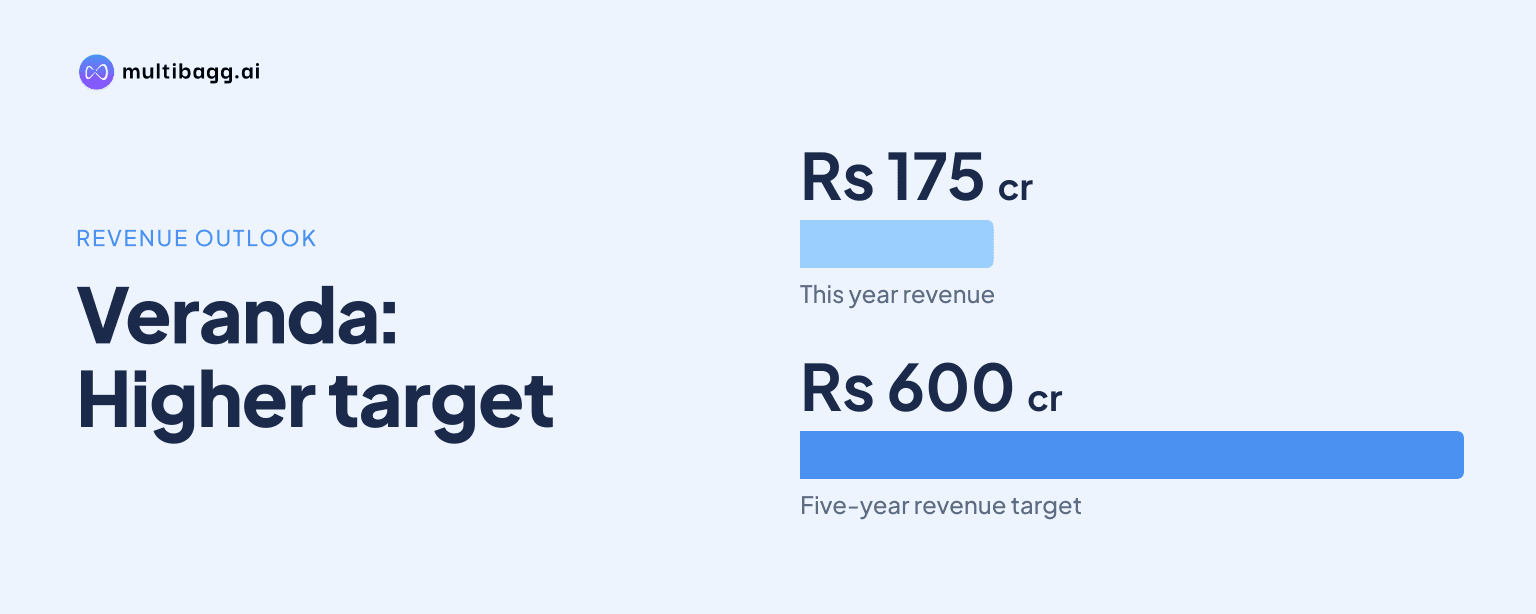
Veranda Learning has set a five-year target of Rs 600 crore revenue and Rs 120 crore to Rs 140 crore of earnings before interest, tax, depreciation and amortisation (EBITDA), compared with this year's expectations of Rs 175 crore and Rs 45 crore for its continuing government test-preparation and schools businesses.
Know Veranda Learning Solutions inside out
Results, valuation, peers and who's buying, in one view.
What is Veranda's five-year operating target?
Veranda's long-term target is Rs 600 crore of revenue and Rs 120 crore to Rs 140 crore of EBITDA within the next five years. Management said the plan covers the government test-preparation and schools businesses after the commerce vertical was demerged, and described the figures as prospective targets set for individual teams.
The starting point management provided is Rs 175 crore of revenue and Rs 45 crore of EBITDA expected this year. Veranda did not disclose annual milestones to the five-year endpoint or divide the Rs 600 crore revenue target between government test preparation and schools, making this an aggregate target rather than segment-level guidance.
The Rs 600 crore revenue ambition is Rs 425 crore above this year's expectation and is about 3.4 times the stated starting level. The Rs 120 crore to Rs 140 crore EBITDA range is Rs 75 crore to Rs 95 crore above the current expectation, equivalent to about 2.7 times to 3.1 times the Rs 45 crore reference point.
What profitability does Veranda's target imply?
Veranda's target implies EBITDA of 20.0% to 23.3% of its Rs 600 crore revenue objective. The current expectation of Rs 45 crore EBITDA on Rs 175 crore revenue equates to about 25.7%, so the five-year plan assumes a larger operating base without requiring a higher combined EBITDA margin than the current arithmetic indicates.
Management separately said EBITDA margins of 23% to 25% in government test preparation were sustainable. It attributed that position to annual fee increases of about 7% to 10%, against average annual cost increases of about 4%, as well as higher student numbers being accommodated through existing centre capacity.
Veranda's academic segment reported first-half revenue of Rs 19 crore, up 12% from Rs 17 crore a year earlier, while EBITDA rose to Rs 15 crore from Rs 11 crore. Management said the second-quarter decline from the first quarter reflected book sales concentrated in the admission season, rather than a decline in first-half performance.
Got a follow-up? Ask IRIS
Which businesses are expected to deliver Veranda's plan?
Veranda expects government test preparation and schools to deliver the Rs 600 crore revenue target. In government test preparation, management identified fee increases, greater use of existing capacity and new programmes including Junior IAS and Union Public Service Commission offerings as growth mechanisms.
In Karnataka, Veranda said it opened a Mysore centre two days before the call and planned four centres this year and another four next year. Management expects the Karnataka business to grow at a compound annual growth rate of 30% to 35%, with a longer-term aim of reaching Rs 20 crore to Rs 25 crore of EBITDA, comparable with its Tamil Nadu and Kerala operations.
The schools business is the other component of the five-year plan, with management targeting 30 schools in the next three years. Veranda said it had added only one international school since the acquisition period began, as the first year focused on management transition and the following two years on systems, processes, compliance, regulations and reporting.
Veranda introduced a new curriculum for standards 1 to 12 over the previous six to seven months and is entering preschool this year through Veranda Sprouts. Management said the curriculum, preschool entry and managed-school expansion provide the groundwork for growth, but it did not disclose their individual revenue contribution to the Rs 600 crore target.
What execution factors could shape Veranda's plan?
Veranda expects each Karnataka centre to require Rs 30 lakh to Rs 35 lakh for interiors and rental deposits. Management clarified that the amount is not solely capital expenditure, and it did not disclose a total investment budget for the eight centres planned over this year and next year.
Management said it had not invested aggressively in school growth during the preceding 14 to 15 months because earnings were being used for finance costs related to corporate actions. It said finance costs had fallen by more than 58% from the prior year, allowing cash flows to be directed towards growth investment alongside the systems already put in place.
New-centre costs and product growth will need to be balanced as Karnataka expands. Management said initial costs from new locations are expected to be offset by growth in new product lines, while fee increases and use of existing capacity support the stated 23% to 25% government test-preparation margin range.
Conclusion
Veranda's five-year plan sets an operating scale target of Rs 600 crore in revenue and Rs 120 crore to Rs 140 crore in EBITDA, compared with this year's expectations of Rs 175 crore and Rs 45 crore. Management's route to that target combines government test-preparation growth through pricing, capacity use and Karnataka centres with a larger schools and preschool platform.
The next disclosed execution markers are four Karnataka centres planned this year, another four next year, and the objective of 30 schools over three years. Veranda has not provided annual revenue or EBITDA milestones for the five-year plan, so quarterly disclosures will be the available measure of progress toward the target.