










Vikran standalone H1 revenue rises 26.5%, margin falls to 11.4%
Key highlights
- Vikran’s standalone H1 FY27 revenue from operations rose 26.5% to Rs 424.1 crore.
- Vikran’s standalone H1 FY27 EBITDA margin declined to 11.4% from 14.3%.
- Vikran’s Q2 FY27 EBITDA fell 20.8% to Rs 20.1 crore while revenue rose 24.9%.
- Vikran’s standalone H1 FY27 PAT increased 71.6% to Rs 25.4 crore.
powered by IRIS
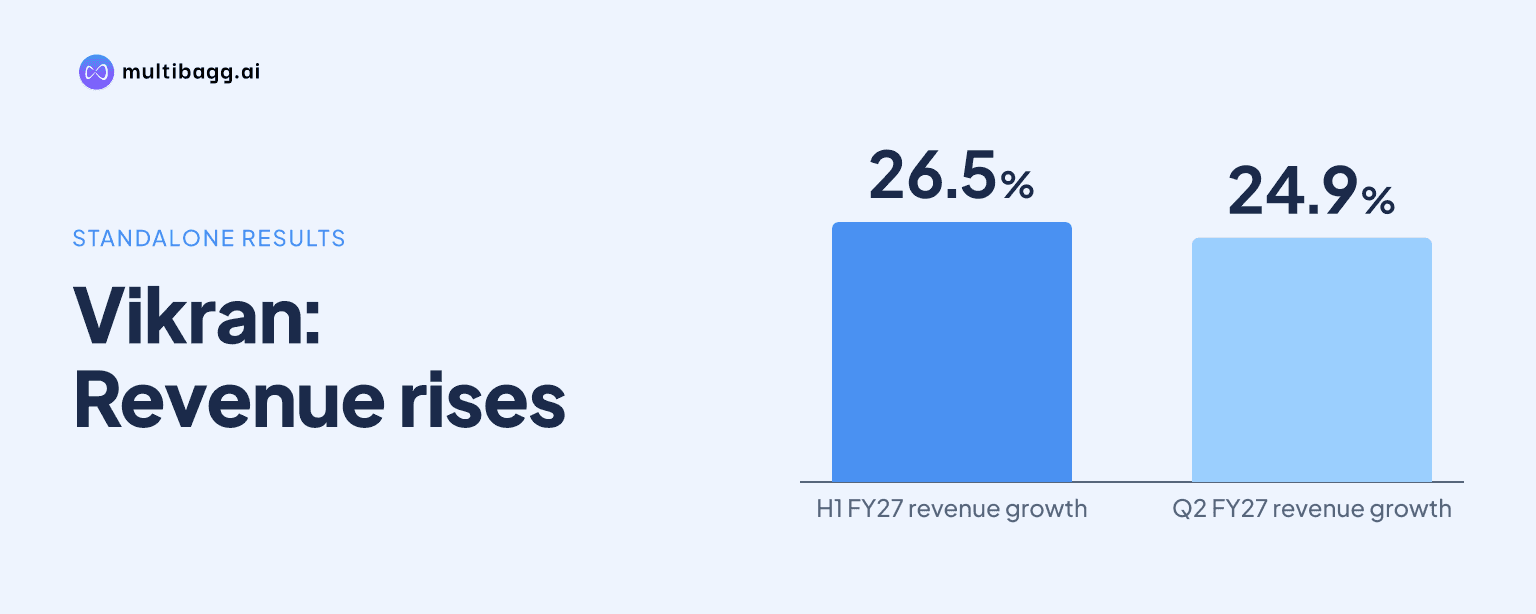
Vikran Engineering Limited reported standalone H1 FY27 revenue from operations of Rs 424.1 crore, up 26.5% year on year, while EBITDA margin fell to 11.4% from 14.3%. Vikran’s EBITDA was almost unchanged at Rs 48.1 crore, whereas profit after tax rose 71.6% to Rs 25.4 crore.
Know Vikran Engineering inside out
Results, valuation, peers and who's buying, in one view.
Why did Vikran’s H1 FY27 EBITDA margin fall?
Vikran’s standalone EBITDA margin fell by 2.9 percentage points to 11.4% in H1 FY27 because EBITDA remained almost flat while revenue and key operating costs increased. EBITDA, or earnings before interest, tax, depreciation and amortisation, is calculated by Vikran excluding other income. EBITDA was Rs 48.1 crore in H1 FY27, compared with Rs 48.1 crore in H1 FY26, while revenue increased from Rs 335.4 crore to Rs 424.1 crore.
The cost movements were led by materials and project expenses. Cost of materials consumed increased to Rs 208.7 crore from Rs 154.6 crore, and project-related expense rose to Rs 83.2 crore from Rs 57.8 crore. Employee benefits expense increased to Rs 49.4 crore from Rs 40.2 crore, while other expenses were nearly unchanged at Rs 34.8 crore against Rs 34.7 crore a year earlier.
How did Vikran perform in Q2 FY27?
Vikran’s standalone Q2 FY27 revenue rose 24.9%, but EBITDA and profit after tax both declined year on year. Revenue from operations reached Rs 220.1 crore, compared with Rs 176.3 crore in Q2 FY26. EBITDA fell 20.8% to Rs 20.1 crore from Rs 25.4 crore, reducing the EBITDA margin to 9.1% from 14.4%.
Project-related expense rose to Rs 40.7 crore in Q2 FY27 from Rs 6.9 crore a year earlier, while material costs increased to Rs 117.7 crore from Rs 101.1 crore. Employee benefits expense rose to Rs 26.0 crore from Rs 22.2 crore, although other expenses fell to Rs 15.6 crore from Rs 20.6 crore. The increase in project and material costs coincided with a Rs 5.3 crore fall in quarterly EBITDA.
Vikran’s Q2 FY27 profit after tax was Rs 7.9 crore, down 13.2% from Rs 9.1 crore in Q2 FY26, and PAT margin fell to 3.6% from 5.2%. Profit before tax nevertheless increased 4.1% to Rs 10.2 crore because other income increased to Rs 12.3 crore from Rs 3.0 crore. Finance cost rose to Rs 21.3 crore from Rs 18.0 crore and tax expense increased to Rs 2.3 crore from Rs 0.7 crore.
What lifted Vikran’s H1 FY27 profit after tax?
Vikran’s standalone H1 FY27 profit after tax rose to Rs 25.4 crore because profit before tax increased 93.1% to Rs 33.2 crore, despite almost unchanged EBITDA. The increase in profit after tax came alongside a 71.6% rise from Rs 14.8 crore in H1 FY26, and the PAT margin increased to 6.0% from 4.4%.
Other income was Rs 23.4 crore in H1 FY27, compared with Rs 3.7 crore in H1 FY26, lifting total income 32.0% to Rs 447.55 crore. Depreciation and amortisation increased to Rs 2.0 crore from Rs 1.2 crore, while finance cost increased to Rs 36.4 crore from Rs 33.4 crore. The rise in other income exceeded these increases below EBITDA and coincided with the higher profit before tax.
The first-half result remains below the FY26 full-year scale. Vikran reported FY26 standalone revenue from operations of Rs 1,249.3 crore and EBITDA of Rs 175.1 crore, with a 14.0% EBITDA margin. H1 FY27’s 11.4% margin was therefore 2.6 percentage points below the FY26 full-year margin, and the presentation provides no FY27 full-year revenue or margin target.
Got a follow-up? Ask IRIS
Why is Vikran’s consolidated profit lower than standalone profit?
Vikran’s consolidated H1 FY27 profit is lower because consolidation eliminates intra-group engineering, procurement and construction transactions with NOPL Solar Projects. Standalone revenue from operations was Rs 424.1 crore, whereas consolidated revenue was Rs 353.4 crore. Vikran attributes the Rs 70.7 crore difference to inter-company EPC revenue eliminated under Indian Accounting Standards, or Ind AS, consolidation accounting.
The elimination also reduced standalone EBITDA of Rs 48.1 crore to consolidated EBITDA of Rs 33.5 crore. Consolidated EBITDA margin was 9.5%, compared with standalone EBITDA margin of 11.4%. Vikran attributes the difference to eliminated inter-company EPC margin and temporary overhead absorption without external top-line recognition.
Consolidated profit after tax was Rs 6.7 crore, compared with Rs 25.4 crore on a standalone basis, while consolidated earnings per share were Rs 0.26 against Rs 0.98 standalone. Vikran attributes the Rs 18.7 crore PAT difference to eliminated internal profit and corresponding tax adjustments. Consolidated H1 FY27 EBITDA was also 30.3% below the Rs 48.1 crore reported in H1 FY26.
Conclusion
Vikran’s H1 FY27 standalone result combined a 26.5% increase in revenue with nearly flat EBITDA, reducing EBITDA margin by 2.9 percentage points to 11.4%. Higher material, project and employee costs accompanied the revenue increase, while higher other income contributed to the rise in profit before tax and profit after tax. Q2 showed a sharper operating decline, with EBITDA down 20.8% and PAT down 13.2% year on year.
Investors will next watch whether management’s stated focus on operating efficiency, disciplined project selection and working-capital management changes the margin trend. Management is also executing the NOPL Solar Projects development across 152 Maharashtra locations with planned capacity of 969 megawatts alternating current, supported by a term-loan facility from Indian Renewable Energy Development Agency of up to Rs 2,941.19 crore at 9.15%, with disbursements linked to progress across eight project clusters.