










Vinsys reports Rs 164.55 lakh standalone first-half loss
Key highlights
- Vinsys reported a Rs 164.55 lakh standalone loss after tax for the half year ended September 30, 2026, versus a Rs 169.38 lakh profit a year earlier.
- Standalone cash and cash equivalents fell to Rs 38.30 lakh at September 30, 2026 from Rs 3.5711 crore at March 31, 2026.
- Vinsys used Rs 5.0739 crore in standalone operating activities, compared with a Rs 6.2371 crore outflow in the prior-year half.
- Standalone revenue from operations declined to Rs 23.0113 crore, while employee benefit expense rose to Rs 9.8014 crore.
powered by IRIS
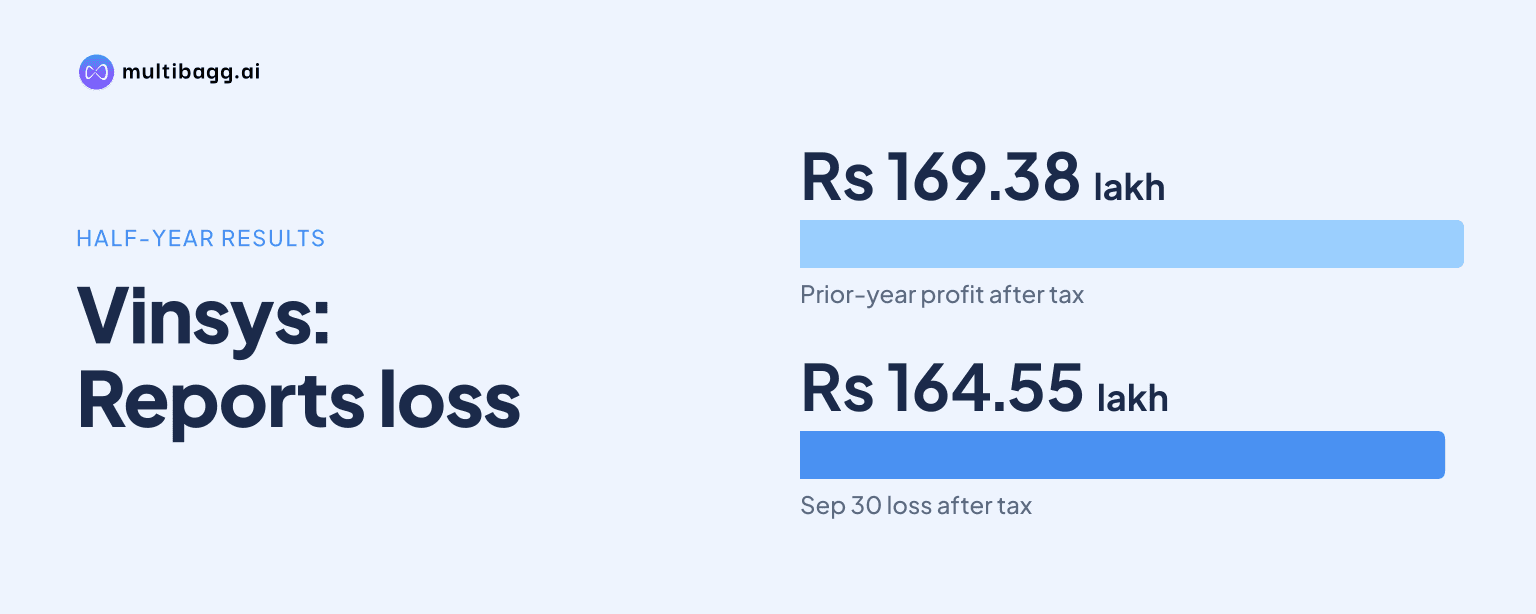
Vinsys IT Services India Limited reported a standalone loss of Rs 164.55 lakh for the half year ended September 30, 2026, reversing a Rs 169.38 lakh profit a year earlier, while standalone cash and cash equivalents declined to Rs 38.30 lakh from Rs 3.5711 crore at March 31, 2026.
Know Vinsys IT Services India inside out
Results, valuation, peers and who's buying, in one view.
Why did Vinsys report a standalone loss in the first half?
Vinsys reported a Rs 164.55 lakh loss after tax because total expenses of Rs 27.0842 crore exceeded total revenue of Rs 25.4445 crore in the half year ended September 30, 2026. In the corresponding half year ended September 30, 2025, it reported a Rs 169.38 lakh profit after total revenue of Rs 29.0761 crore exceeded expenses of Rs 26.8131 crore.
Revenue from operations fell to Rs 23.0113 crore from Rs 27.2403 crore a year earlier, while other income rose to Rs 2.4332 crore from Rs 1.8358 crore. The increase in other income did not offset the reduction in operating revenue and the expense base, resulting in a pre-tax loss of Rs 1.6397 crore against a pre-tax profit of Rs 2.2630 crore in the prior-year half.
The September 2026 half also reversed the immediately preceding half year ended March 31, 2026, when Vinsys reported a Rs 5.3359 crore profit after tax on total revenue of Rs 37.0492 crore. The company said its standalone business has one segment, Software IT Solution and Consulting Services.
Which costs changed in Vinsys's standalone business?
Vinsys's employee benefit expense increased to Rs 9.8014 crore in the September 2026 half from Rs 7.5331 crore a year earlier, while cost of delivery of services declined to Rs 11.8103 crore from Rs 13.0423 crore. Finance cost increased to Rs 1.8625 crore from Rs 1.5457 crore during the period of lower operating revenue.
Other expenses decreased to Rs 2.1440 crore from Rs 3.1873 crore, and depreciation and amortisation declined to Rs 1.4660 crore from Rs 1.5046 crore. Those reductions did not prevent total expenses of Rs 27.0842 crore from exceeding the Rs 25.4445 crore of total revenue in the September 2026 half.
Vinsys disclosed that employee stock options granted to eligible employees vested and were exercised during the half year. It said the difference between the market price of the shares on exercise and face value was recognised as employee benefit expense, while paid-up equity share capital rose to Rs 14.7499 crore at September 30, 2026 from Rs 14.6779 crore at March 31, 2026.
How did Vinsys's cash flow change during the half year?
Vinsys used Rs 5.0739 crore in operating activities in the half year ended September 30, 2026, compared with an outflow of Rs 6.2371 crore in the corresponding 2025 half. The operating cash outflow followed the Rs 1.6397 crore standalone pre-tax loss, a Rs 1.6091 crore increase in trade receivables and a Rs 2.1948 crore increase in short-term loans and advances.
Investing activities generated Rs 1.0163 crore of cash, compared with an outflow of Rs 3.0063 crore a year earlier. The September 2026 investing result included Rs 2.4332 crore of investment income and Rs 1.3277 crore from the reported decrease in investments, partly offset by Rs 2.1957 crore spent on property, plant and equipment.
Financing activities provided Rs 86.95 lakh, versus Rs 8.8762 crore in the prior-year half, according to the standalone cash-flow statement. Vinsys reported Rs 2.6601 crore from borrowings, Rs 7.19 lakh of proceeds from share capital and Rs 1.8625 crore of interest paid; together, the three cash-flow categories resulted in a Rs 3.1881 crore net decrease in cash.
Got a follow-up? Ask IRIS
What does Vinsys's September balance sheet show?
Vinsys ended September 30, 2026 with Rs 38.30 lakh of cash and cash equivalents, down from Rs 3.5711 crore at March 31, 2026 and Rs 90.40 lakh at September 30, 2025. Current assets totalled Rs 105.5999 crore, including Rs 45.1308 crore in short-term loans and advances, Rs 36.4441 crore in trade receivables and Rs 9.5245 crore in current investments.
Trade receivables rose from Rs 34.8350 crore at March 31, 2026 to Rs 36.4441 crore at September 30, matching the Rs 1.6091 crore working-capital outflow in the cash-flow statement. Short-term loans and advances increased from Rs 42.9360 crore to Rs 45.1308 crore over the same period, representing another stated use of operating cash.
Total standalone assets declined to Rs 143.3365 crore from Rs 144.0077 crore at March-end. Current liabilities increased to Rs 24.4436 crore from Rs 23.4127 crore, partly as short-term borrowings rose to Rs 20.4628 crore from Rs 16.5666 crore, while long-term borrowings fell to Rs 26.5421 crore from Rs 27.7782 crore.
How does Vinsys's standalone result compare with its consolidated cash flow?
Vinsys's standalone loss contrasts with Rs 6.7285 crore of consolidated profit before taxation reported in the consolidated cash-flow statement for the half year ended September 30, 2026. The consolidated statement reported Rs 3.2462 crore of net operating cash inflow, whereas the standalone statement recorded a Rs 5.0739 crore operating outflow.
The reporting difference also extends to cash balances: consolidated cash and cash equivalents ended the period at Rs 27.9433 crore after a Rs 17.4760 crore net increase, while standalone cash closed at Rs 38.30 lakh after a Rs 3.1881 crore decrease. The consolidated and standalone statements cover different reporting perimeters, so consolidated cash should not be treated as cash held by the standalone company.
Vinsys's statutory auditors conducted a limited review of the standalone results and, according to the company, expressed an unmodified opinion. Vinsys also reported that it received and resolved two investor complaints as of September 30, 2026.
Conclusion
Vinsys's September 2026 standalone filing shows a move from profit to a Rs 164.55 lakh loss as revenue from operations declined to Rs 23.0113 crore and employee benefit expense increased to Rs 9.8014 crore. The Rs 5.0739 crore operating cash outflow, combined with investment and financing flows, reduced standalone cash to Rs 38.30 lakh, despite a different consolidated cash-flow outcome.
The filing does not disclose a numerical management target, a recovery plan or a scheduled operating milestone after the Board approved the results on November 6, 2026. The disclosed balance-sheet items to monitor in subsequent reporting are Rs 36.4441 crore of trade receivables, Rs 45.1308 crore of short-term loans and advances, and the Rs 38.30 lakh standalone cash balance.