










Vipul auditor says Lavanya timing breached merger scheme
Key highlights
- Vipul’s auditor said Lavanya Project revenue and costs were recognised in FY 2025-26 instead of from 1 April 2022.
- The NCLT, Delhi approved Vipul’s five-subsidiary amalgamation scheme on 17 April 2026.
- Vipul filed the certified NCLT order with the Registrar of Companies, Delhi on 15 May 2026.
- Vipul’s board approved in principle a further six-subsidiary merger on 15 September 2026.
powered by IRIS
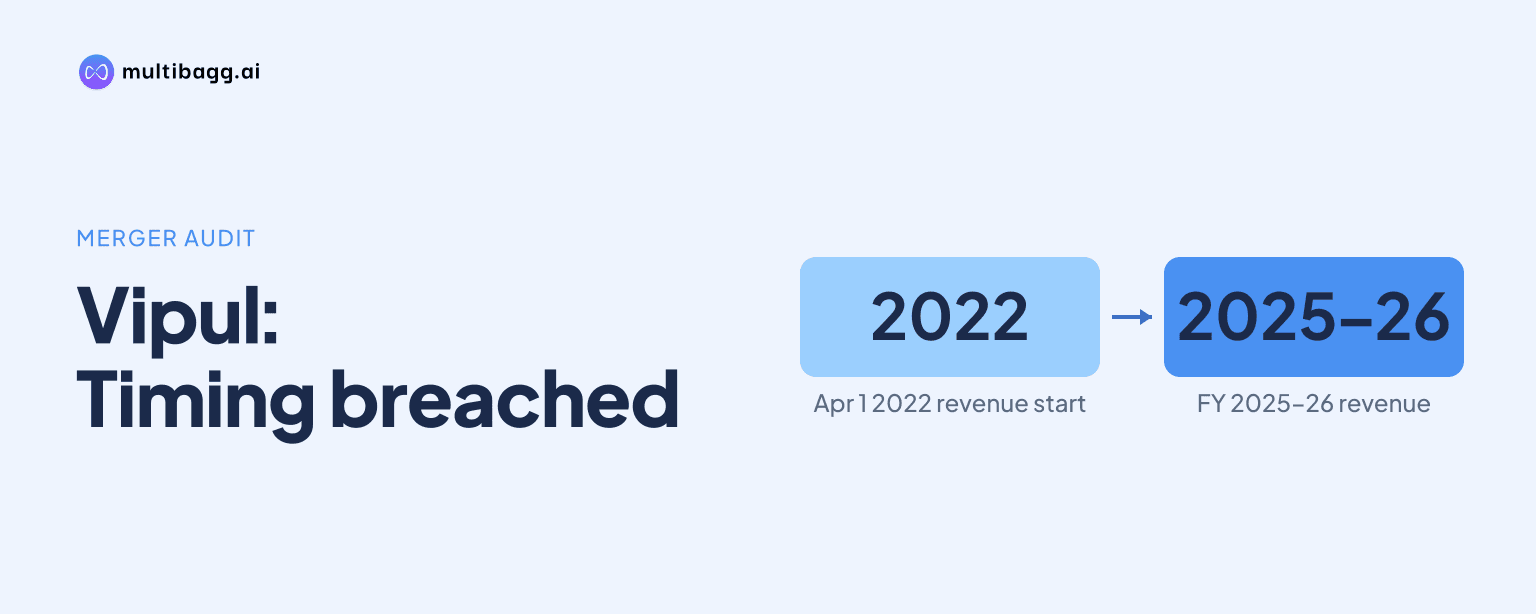
Vipul Limited’s auditor said cumulative Lavanya Project revenue and costs were recognised in FY 2025-26 rather than from the scheme’s 1 April 2022 appointed date, a treatment it said breached the NCLT-approved merger scheme and Indian Accounting Standards in the 30 September 2026 standalone review.
Know Vipul inside out
Results, valuation, peers and who's buying, in one view.
What did Vipul’s auditor find in the Lavanya Project accounting?
Vipul’s auditor found that cumulative revenue and project costs from the Lavanya Project were recorded in the year ended 31 March 2026 instead of being accounted for from 1 April 2022. The matter relates to a Joint Development Agreement, or JDA, among Vipul and entities amalgamated into the company for development of the Lavanya Project.
The auditor placed the matter under its basis for qualified conclusion for Vipul’s unaudited standalone financial results for the quarter and half year ended 30 September 2026. The report, dated 5 November 2026, was issued following a limited review under Standard on Review Engagements, or SRE, 2410, which relies mainly on inquiry and analytical procedures rather than a full audit.
The finding concerns the timing of recognition, not a statement that Lavanya revenue and costs should never have been booked. The auditor said the cumulative effect was recognised in FY 2025-26, while the scheme required accounting effects from its 1 April 2022 appointed date; it did not disclose a separate rupee amount for either revenue, costs or the net impact.
Why is 1 April 2022 important for Vipul’s merger accounting?
1 April 2022 is important because it was the retrospective appointed date for Vipul’s scheme to amalgamate five wholly owned subsidiaries with Vipul. The National Company Law Tribunal, or NCLT, Delhi approved that scheme on 17 April 2026, and Vipul filed a certified copy of the order with the Registrar of Companies, Delhi on 15 May 2026.
Vipul said it otherwise gave effect to the scheme from 1 April 2022 and used the pooling-of-interest method because the transferor companies were wholly owned subsidiaries. The auditor said the Indian Accounting Standards, or Ind AS, requirements and the NCLT-approved scheme required the amalgamation’s accounting effects to be recognised from that appointed date.
The auditor’s objection was therefore not to the NCLT order of 17 April 2026 or the merger of five subsidiaries itself. It was that the Lavanya JDA revenue and project-cost effects were treated differently from the scheme’s retrospective basis, with amounts accumulated through the 31 March 2026 financial year rather than reflected from 1 April 2022.
Which Vipul financial statement measures are affected?
Vipul’s revenue, project costs, profit or loss, assets, liabilities and reserves for the current quarter are affected by the Lavanya accounting matter, according to the 5 November 2026 report. The auditor also said comparative information was affected because the corresponding Lavanya revenue and project costs were not restated from the 1 April 2022 appointed date.
This means comparisons involving the 30 September 2026 standalone quarter and half year do not present Lavanya amounts on the retrospective basis required by the scheme. The report does not quantify the difference, so it does not support calculating how much of FY 2025-26 revenue, project costs or profit relates to the cumulative recognition.
The report also does not state whether the net effect on profit or loss is positive or negative. Because both revenue and project costs are involved, and because no separate Lavanya figures were supplied, the direction and size of the profit effect cannot be derived from the limited review.
Got a follow-up? Ask IRIS
What other matters qualified Vipul’s standalone review?
Vipul’s auditor identified several additional recoverability and impairment matters in the 30 September 2026 standalone review, separate from Lavanya accounting. These included Rs 60.8631 crore advanced to Flying Fox Private Limited, whose net worth had been eroded, for which Vipul had not recognised an impairment provision.
The report also cited Rs 35.885 crore of Amritsar Project advances subject to litigation, for which recovery was described as doubtful, and Rs 145.4143 crore of secured and unsecured loans and advances in current assets. Vipul was still finalising recovery terms for the latter amounts, and the auditor said the loans and advances should have been impaired, with profit for the year potentially overstated to that extent.
For another set of project advances, Vipul had provided Rs 12 crore in FY 2025-26 against Rs 24 crore due from Shri Kamala Priya Auto and General Agencies Private Limited and an associated person. The auditor said the company named in the report had subsequently been struck off from the Register of Companies and recovery of the remaining balance was uncertain.
What does the qualified conclusion mean for Vipul’s September results?
The qualified conclusion means the auditor identified specified matters affecting Vipul’s standalone results for the quarter and half year ended 30 September 2026, including the Lavanya timing issue. Subject to the matters described in its qualified-conclusion and disclaimer sections, the auditor said nothing had come to its attention indicating that the statement failed to meet the required disclosure framework under Regulation 33.
This was not an audit opinion because the auditor expressly said it had not performed an audit. Vipul’s management prepared the unaudited statement under Ind AS 34, Interim Financial Reporting, and Vipul’s board approved the results on 5 November 2026.
The Lavanya issue applies to the standalone limited review described on pages 2 and 3 of the filing. The filing also contains a separate consolidated review report, but the supplied Lavanya qualification is expressly framed around Vipul’s standalone financial statements and should not be assumed to apply in identical form to each consolidated measure.
What should readers watch in Vipul’s next disclosures?
Readers should watch for disclosures addressing the absence of restated comparative Lavanya figures, given the auditor’s statement that revenue and project costs were not reflected from 1 April 2022. The report does not disclose a quantified correction, revised comparative statement or timetable for any accounting action.
A separate future event is Vipul’s proposed fast-track amalgamation of six wholly owned subsidiaries under Section 233 of the Companies Act, 2013. Vipul’s board granted in-principle approval on 15 September 2026, and the auditor said the scheme remained subject to requisite approvals and had no impact on the 30 September 2026 results.
Conclusion
Vipul’s standalone limited review identifies a mismatch between the 1 April 2022 retrospective appointed date in its five-subsidiary merger scheme and the FY 2025-26 recognition of cumulative Lavanya Project revenue and costs. The auditor said that treatment was inconsistent with Ind AS and the scheme, affecting current-period measures and comparative information without quantifying the amount.
The next disclosed event to watch is the approval process for Vipul’s proposed Section 233 merger of six wholly owned subsidiaries, which had no effect on the September 2026 results as of 5 November 2026. Readers can also monitor whether later filings explain or revise the Lavanya comparative information that was not restated from the appointed date.