










Viviana Power Tech’s top five customers made up 96.14% of FY26 sales
Key highlights
- Viviana Power Tech’s top five customers accounted for 96.14% of FY 2025-26 sales.
- Viviana Power Tech’s largest customer, a state DISCOM, contributed 39.37% of FY 2025-26 sales.
- Viviana Power Tech’s top eight customers generated 99.87% of FY 2025-26 sales.
- Viviana Power Tech’s top five suppliers represented 57.86% of FY 2025-26 purchases.
powered by IRIS
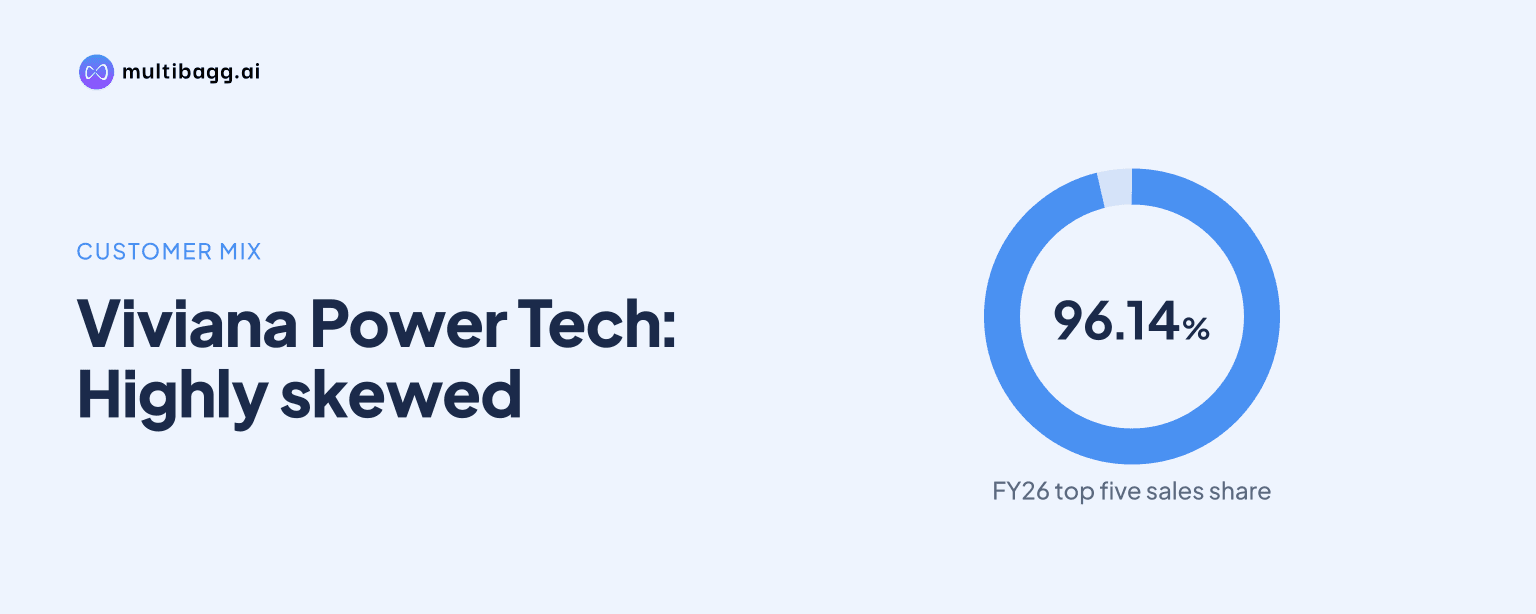
Viviana Power Tech reported that its top five customers accounted for 96.14% of total sales in FY 2025-26, with its largest customer, a state DISCOM, contributing 39.37%. The company identifies this customer dependence as a material risk because contract awards, project progress, client financial conditions and payment outcomes can affect sales and cash flows.
Know Viviana Power Tech inside out
Results, valuation, peers and who's buying, in one view.
How concentrated were Viviana Power Tech’s FY 2025-26 sales?
Viviana Power Tech derived 96.14% of FY 2025-26 sales from its top five customers, according to the customer-concentration table in its draft letter of offer. Its top customer alone accounted for 39.37% of sales and was classified as a state DISCOM. The top-five group comprised state DISCOM and Transcom customers.
The concentration increased to 99.87% when the next three customers were included. Viviana Power Tech’s top eight customers included state DISCOMs, Transcom customers and private parties, leaving 0.13% of FY 2025-26 sales outside that group. The four customers ranked below the largest customer but within the top five collectively contributed 56.77% of sales.
The top-five share was 3.73 percentage points below the top-eight share in FY 2025-26, showing that most disclosed sales were concentrated among five buyers rather than spread across the additional three. The filing does not name the customers in this table, and it does not give customer-level sales values beyond the largest customer’s 39.37% contribution.
Why does customer concentration matter for Viviana Power Tech?
Customer concentration matters because Viviana Power Tech says the loss of, or a significant reduction in, contracts from a few customers could adversely affect its business. Revenue from an individual client may vary between reporting periods based on the nature of ongoing projects, their implementation schedules and their stages of completion. Larger contracts from few customers can therefore increase exposure to individual project and contract outcomes.
Viviana Power Tech operates an engineering, procurement and construction, or EPC, business model through two verticals: supply of materials and equipment, and project execution through engineering, erection, testing and commissioning services. A customer-led project delay, stoppage or design change can affect both material supply and execution activity. The filing also identifies failure by clients to obtain regulatory permits as a potential adverse factor.
Viviana Power Tech says it cannot assure investors that historical project-order levels from these clients will continue or that replacement customers will be available if existing clients are lost. It identifies adverse market conditions, regulatory changes, adverse cash flows, management changes, and client mergers and acquisitions as events that may affect business. If a major client becomes bankrupt or insolvent, the company says it could lose business and may have to write off receivables.
Got a follow-up? Ask IRIS
What could affect repeat orders from Viviana Power Tech’s key customers?
Repeat orders could be affected if Viviana Power Tech does not complete projects within contractual durations or if work quality deteriorates. The filing says its longstanding relationships with certain customers reflect timely and efficient completion of work, but delays or lower quality could strain those relationships. Customers may also be entitled to terminate agreements for delayed work unless the delay falls within agreed exceptions.
Most contracts referenced in the filing have completion-schedule requirements and liquidated-damages provisions where schedules are missed for reasons within Viviana Power Tech’s control. In some contracts, customers can rectify defective work or appoint another party to complete it, then deduct the additional costs from the contract price. These mechanisms can affect contract receipts as well as future customer relationships.
Power-sector projects have long gestation periods before becoming operational, according to the filing. Viviana Power Tech lists changes in policy and regulation, construction delays, environmental-clearance issues, power-demand or power-price changes, and consumers’ willingness and ability to pay as risks. It also says a client’s financial condition can affect project financing and implementation, potentially affecting projects in which it is engaged.
How does Viviana Power Tech’s supplier concentration compare?
Viviana Power Tech’s disclosed supplier concentration was lower than its customer concentration in FY 2025-26, although it remains a separate operational risk. Its largest supplier accounted for 14.99% of purchases, its top five suppliers for 57.86%, and its top 10 suppliers for 76.93%. In comparison, the largest customer represented 39.37% of sales and the top five customers represented 96.14%.
Viviana Power Tech says it has not entered into long-term contracts with suppliers for raw materials and generally procures them through purchase orders. Prices are negotiated for each order, which is placed in advance based on projected requirements. Supply interruptions, an inability to find alternate sources, or changes in raw-material costs could delay deliveries and affect operations, financial condition and cash flows.
The company says it seeks to reduce supplier dependence by maintaining relationships with multiple domestic and international suppliers in each raw-material category, placing orders in advance and keeping buffer inventory. It also reported no replacement of a material supplier for failure to meet safety, quality or performance standards during the half year ended September 30, 2026 and the preceding three financial years. It cautions that these measures are precautionary and do not entirely eliminate supply risks.
Conclusion
Viviana Power Tech’s FY 2025-26 disclosure shows that sales were heavily concentrated among a small group of customers: five contributed 96.14% and eight contributed 99.87%. With the largest state DISCOM contributing 39.37%, contract decisions, project execution, financial conditions and payment performance at individual customers can have a material effect on sales, receivables and cash flows.
The next disclosed matters to watch are whether Viviana Power Tech maintains project orders from key customers and whether projects meet schedules that can otherwise result in liquidated damages or cost deductions. Its proposed rights issue identifies working-capital funding and general corporate purposes as uses of net proceeds, with estimated deployment in FY 2026-27 and FY 2027-28, although the filing does not state the amounts.