










WeAgro Limited to Consider Q2 FY27 Results on 14 November
Key highlights
- WeAgro Limited's board will consider unaudited Q2 and H1 FY27 results on 14 November 2026.
- The results period ends on 30 September 2026, and the trading window remains closed through 16 November 2026.
- A separate supplied data point states Q2 FY27 revenue of ₹40.42 crore and profit after tax of ₹2.47 crore.
- WeAgro's quoted CMP was ₹63.96 in the supplied market data.
powered by IRIS
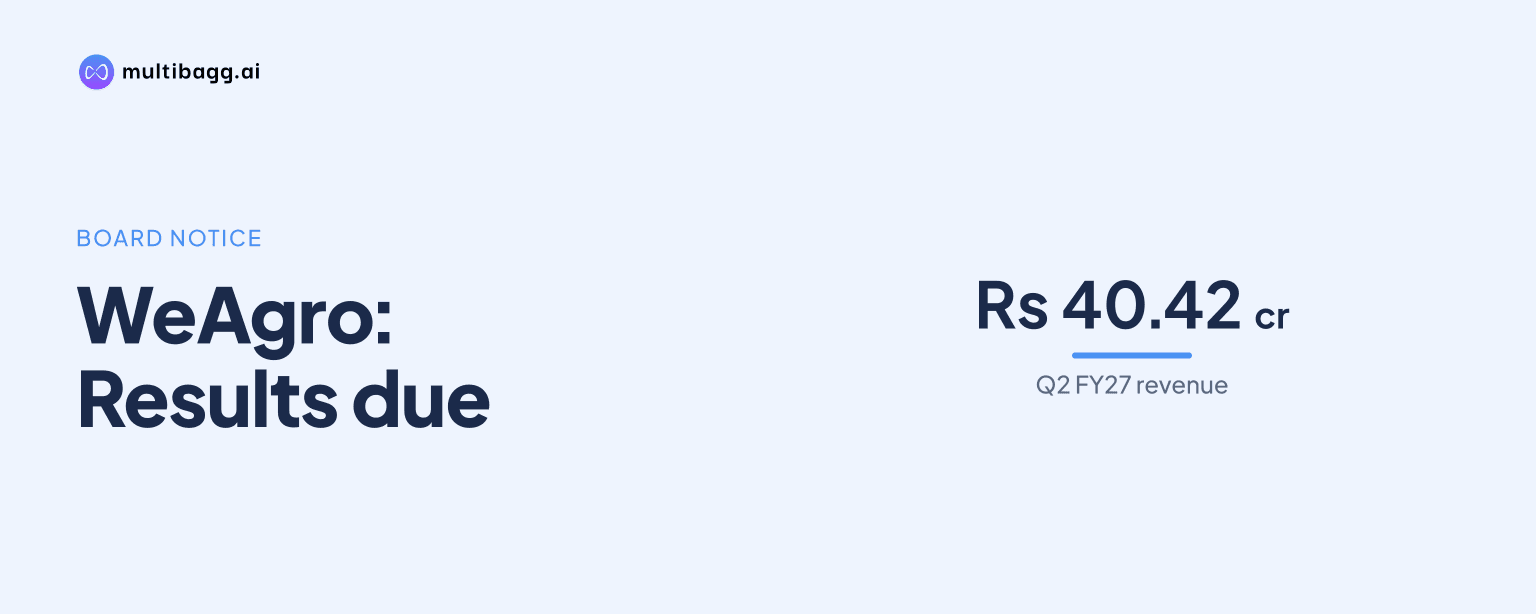
WeAgro Limited will consider unaudited standalone and consolidated Q2 FY27 results on 14 November 2026 for the quarter and half-year ended 30 September 2026. The board-meeting notice is significant because it sets the date for the company's formal earnings approval, with the trading window remaining shut until 16 November.
Know Tejassvi Aaharam inside out
Results, valuation, peers and who's buying, in one view.
What will WeAgro Limited's board consider on 14 November?
WeAgro Limited's board is scheduled to consider and approve unaudited standalone and consolidated financial results for Q2 FY27 and the first half of FY27. The reporting period covers the three and six months ended 30 September 2026. The company disclosed the proposed board meeting through an intimation filed with BSE on 11 November 2026.
The notice is a routine pre-results disclosure under the listed-company reporting framework. It does not, by itself, set out an outlook, operational target, dividend proposal, capital-raising plan, or other board agenda item. The key immediate event for shareholders is the release of the board-approved financial statements and limited-review documentation after the meeting.
WeAgro is the current name of the entity formerly known as Tejassvi Aaharam Limited. The supplied company profile categorises it in garments and apparels and identifies it as a micro-cap company. Its quoted CMP in the supplied market data was ₹63.96, although the notice itself did not report a share-price movement.
What is known about WeAgro's Q2 FY27 financial performance?
The board-meeting intimation itself did not disclose financial figures, so investors should rely on the board-approved filing for the final reported numbers. However, a separate item in the supplied information states that Q2 FY27 revenue was ₹40.42 crore and profit after tax, including exceptional items, was ₹2.47 crore, with earnings per share of ₹2.72.
That separate data point is not accompanied by standalone-versus-consolidated labelling, comparative figures, a detailed profit-and-loss statement, or a stated approval date. It should therefore not be treated as a substitute for the formal board outcome. The meeting notice specifically says that both standalone and consolidated results will be considered, making the basis of any financial figure important.
Other financial figures in the supplied material are inconsistent and appear alongside entries relating to different companies or periods. For example, one entry refers to consolidated revenue of ₹1.04 crore and a loss of ₹0.80 crore, while another refers to substantially higher revenue figures. These figures cannot be combined without a clearly identified filing and reporting basis.
Why is the trading window closed until 16 November?
WeAgro has kept its trading window closed for designated persons from 1 October 2026 through 16 November 2026. The closure covers the period around the preparation, consideration and disclosure of the September-quarter financial results, restricting trading by people covered under the company's insider-trading compliance rules.
The end date comes after the scheduled board meeting. This timing allows for the dissemination of price-sensitive financial information before the window reopens. The disclosure does not identify any trading breach, regulatory proceeding or special restriction beyond the standard results-period closure.
For public shareholders, the trading-window disclosure is mainly a governance and compliance detail. It signals that the company has identified the impending financial results as unpublished price-sensitive information for the relevant designated persons. It does not indicate whether the earnings outcome will be positive or negative.
Got a follow-up? Ask IRIS
How does the wider market context affect the results event?
The results meeting comes after a weaker domestic equity session on 13 November. The Nifty 50 closed at 25,144.30, down 0.61%, while the Sensex ended at 81,592.45, down 0.39%. Bank Nifty fell 0.79% to 61,034.10, and Nifty IT declined 0.72% to 31,931.15.
Broader market gauges also ended lower, with the Midcap 150 down 0.35% to 22,681.25 and the Smallcap 250 down 0.30% to 17,940.55. India VIX, a measure of expected market volatility, declined 5.06% to 15.78. These index moves provide the market backdrop but do not establish a direct effect on WeAgro's shares.
For a micro-cap company, a formal financial-results disclosure can be especially important because investors often have fewer current public data points to assess revenue, profitability, cash flows and balance-sheet changes. The approved filing will also clarify whether the separately supplied Q2 revenue and profit figures correspond to standalone or consolidated accounts.
What should investors look for in the formal Q2 FY27 filing?
Investors should compare the formal Q2 FY27 revenue, profit or loss, and earnings per share with both the preceding quarter and the corresponding quarter of the previous year. They should also distinguish between standalone and consolidated figures, as the board is expected to approve both sets of accounts.
The half-year figures will provide a broader view of performance through 30 September 2026. Investors can also review expenses, exceptional items, cash-flow disclosures where available, auditor observations, related-party disclosures and any management explanation accompanying the results. The supplied material refers to unaudited results, so the limited-review report will be a relevant accompanying document.
Earlier information in the supplied data stated that Tejassvi Aaharam recorded full-year sales of ₹82.08 crore in FY26, compared with ₹17.92 crore in FY25, while its FY26 net loss was ₹1.00 crore. Those historical figures offer context, but the post-meeting filing will be needed to assess the current reporting period on a consistent basis under WeAgro's present identity.
Conclusion
WeAgro's 14 November board meeting is a scheduled corporate disclosure event for approving Q2 and H1 FY27 unaudited standalone and consolidated accounts. The meeting notice confirms the reporting period and insider-trading window closure, while the supplied financial references require confirmation through the formal approved results because their reporting basis is not consistently specified.
The next item to watch is WeAgro's board outcome and the associated financial statements for the period ended 30 September 2026. Investors should look for clearly labelled standalone and consolidated revenue, profitability, EPS, half-year performance and the limited-review report before drawing conclusions from the separately stated Q2 figures.