










Whirlpool H1 revenue rose 12.8% as EBITDA margin fell 270 bps
Key highlights
- Whirlpool reported Apr-Sep’26 consolidated revenue of Rs 4,600 crore, up 12.8% year on year.
- Whirlpool’s H1 EBITDA was Rs 179 crore, with EBITDA margin down 270 basis points to 3.9%.
- Whirlpool’s Apr-Sep’26 PBT bei was Rs 173 crore, down 29.0% year on year.
- Whirlpool’s Jul-Sep’26 consolidated revenue rose 13.7% to Rs 1,873 crore while EBITDA margin was 2.1%.
powered by IRIS
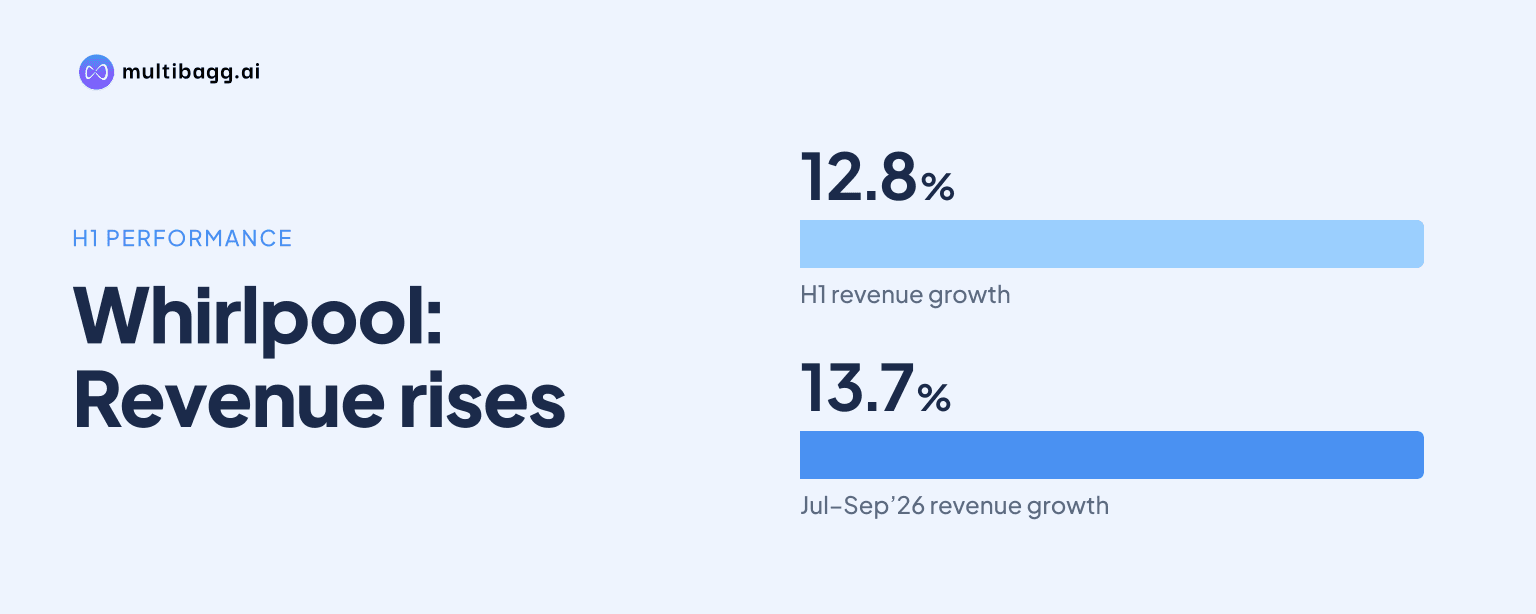
Whirlpool of India Limited reported Apr-Sep’26 consolidated revenue of Rs 4,600 crore, up 12.8% year on year, while earnings before interest, tax, depreciation and amortisation (EBITDA) margin declined 270 basis points to 3.9%. Whirlpool attributed the margin movement to commodity, currency, regulatory, e-waste and investment costs despite pricing and productivity offsets.
Know Whirlpool of India inside out
Results, valuation, peers and who's buying, in one view.
What did Whirlpool report for H1?
Whirlpool reported consolidated EBITDA of Rs 179 crore for Apr-Sep’26, down 33.4% year on year, alongside revenue of Rs 4,600 crore. The consolidated business comprises Whirlpool and Elica, and management linked the 12.8% sales increase to improved market share, air-conditioner and front-load washer growth, up-pricing across categories, and high double-digit growth at Elica.
Profit before tax before exceptional items, or PBT bei, was Rs 173 crore in Apr-Sep’26, down 29.0% year on year. PBT bei represented 3.8% of revenue, a decline of 222 basis points, compared with EBITDA’s 3.9% margin and 270-basis-point year-on-year reduction.
Whirlpool defines EBITDA as PBT before exceptional items, depreciation and amortisation, other income and finance cost. This definition distinguishes the Rs 179 crore EBITDA measure from the Rs 173 crore PBT bei figure, although both measures declined during the Apr-Sep’26 period of lower material margins.
Why did Whirlpool’s Apr-Sep’26 revenue increase?
Whirlpool said improved market share, strong air-conditioner and front-load washer growth, price increases and Elica’s high double-digit growth drove its Rs 4,600 crore Apr-Sep’26 revenue. The presentation does not provide category sales, market-share percentages or Elica revenue, so it does not quantify the contribution of each driver to the 12.8% increase.
The H1 outcome followed 13.7% consolidated revenue growth in Jul-Sep’26, when sales reached Rs 1,873 crore. For that quarter, Whirlpool cited up-pricing, maintained volume shares in a growing and competitive industry, premiumisation including mix, and high double-digit Elica growth; the quarterly growth rate was 0.9 percentage points above the H1 rate.
Elica was identified as a contributor in both Apr-Sep’26 and Jul-Sep’26, and Whirlpool said it continued to deliver double-digit margins. That segment statement contrasts with the group’s 3.9% H1 EBITDA margin, but the presentation gives neither Elica’s exact margin nor its profit amount.
What caused Whirlpool’s EBITDA margin decline?
Whirlpool said commodity-cost increases, currency depreciation and regulatory cost upcharges affected Apr-Sep’26 gross margins. Price increases and its Productivity for Growth, or P4G, programme partly offset those pressures, but EBITDA margin still fell 270 basis points to 3.9% on Rs 4,600 crore of revenue.
Management also attributed the H1 EBITDA and PBT bei decline to lower material margins, incremental e-waste costs and investments described in the presentation as “luxurirem” investments. Fixed-cost leverage provided a partial offset, while the presentation does not quantify the effect of any individual cost factor.
The Jul-Sep’26 disclosure reported the same broad pressure on profitability. Consolidated EBITDA was Rs 40 crore, or 2.1% of revenue, down 31.0% year on year, while PBT bei was Rs 34 crore, or 1.8% of revenue, down 27.9%; Whirlpool cited commodity and foreign-exchange increases, regulatory upcharges, lower material margin and investment in the luxurien launch.
Got a follow-up? Ask IRIS
How did Whirlpool’s H1 results compare with Q2?
Whirlpool’s Apr-Sep’26 EBITDA margin of 3.9% was higher than its 2.1% margin in Jul-Sep’26, while PBT bei margin was 3.8% for H1 and 1.8% for the quarter. Since H1 includes Jul-Sep’26 as well as the preceding quarter, the comparison shows different reported period aggregates rather than a standalone sequential trend.
Whirlpool’s standalone Jul-Sep’26 figures were lower than the consolidated ratios. Standalone revenue was Rs 1,711 crore, up 13.9%, while EBITDA was Rs 15 crore, or 0.9% of revenue, and PBT bei was Rs 9 crore, or 0.6% of revenue; the consolidated EBITDA margin was 2.1% in the same quarter.
What is Whirlpool doing to manage cost pressure?
Whirlpool said P4G continues to generate efficiencies across cost lines, partly offsetting H1 gross-margin pressure from commodities, currency depreciation and regulatory costs. The programme sits within its World Class Manufacturing approach and includes mechanisms such as cost deployment, focused improvement, quality control, logistics and customer services, and energy.
The manufacturing update cited a ramp-up of a four-door premium refrigerator at the Pune plant and the highest-ever washer and front-load washer production in Jul’26. These operating milestones align with Whirlpool’s stated premiumisation and front-load washer growth drivers, but the presentation does not disclose the production volumes, revenue contribution or savings from the ramp-up.
Whirlpool’s stated focus is to continue P4G to improve cost efficiency across all profit-and-loss lines. The Apr-Sep’26 results show that the programme, pricing and fixed-cost leverage were partial offsets, as EBITDA margin nevertheless declined to 3.9%.
Conclusion
Whirlpool’s Apr-Sep’26 results combined 12.8% consolidated revenue growth with lower profitability, as sales drivers including air-conditioners, front-load washers, pricing, market share and Elica did not fully offset higher input, currency, regulatory, e-waste and investment costs. The contrast was also visible in Jul-Sep’26, when revenue grew 13.7% but EBITDA margin was 2.1%.
The disclosed operational plan is continued P4G cost efficiency across profit-and-loss lines, alongside the Pune four-door premium refrigerator ramp-up and July 2026 record washer output. The next disclosed area to watch is whether these measures, price increases and fixed-cost leverage provide a larger offset to the cost categories management identified in Apr-Sep’26.