










Windsor Machines Ltd. injection moulding reaches 53% mix
Key highlights
- Windsor reported Rs 100.2 crore of injection moulding revenue in Q2FY27, up from Rs 75.7 crore in Q1FY27.
- Injection moulding represented 53.0% of Windsor's H1FY27 revenue, compared with 44.0% in FY26.
- Calculated from disclosed divisional revenue, injection moulding represented 54.8% of Rs 182.8 crore Q2FY27 revenue.
- A five-year anti-dumping duty ranging from 0% to 63% took effect in June 2025 on relevant imports from China and Taiwan.
powered by IRIS
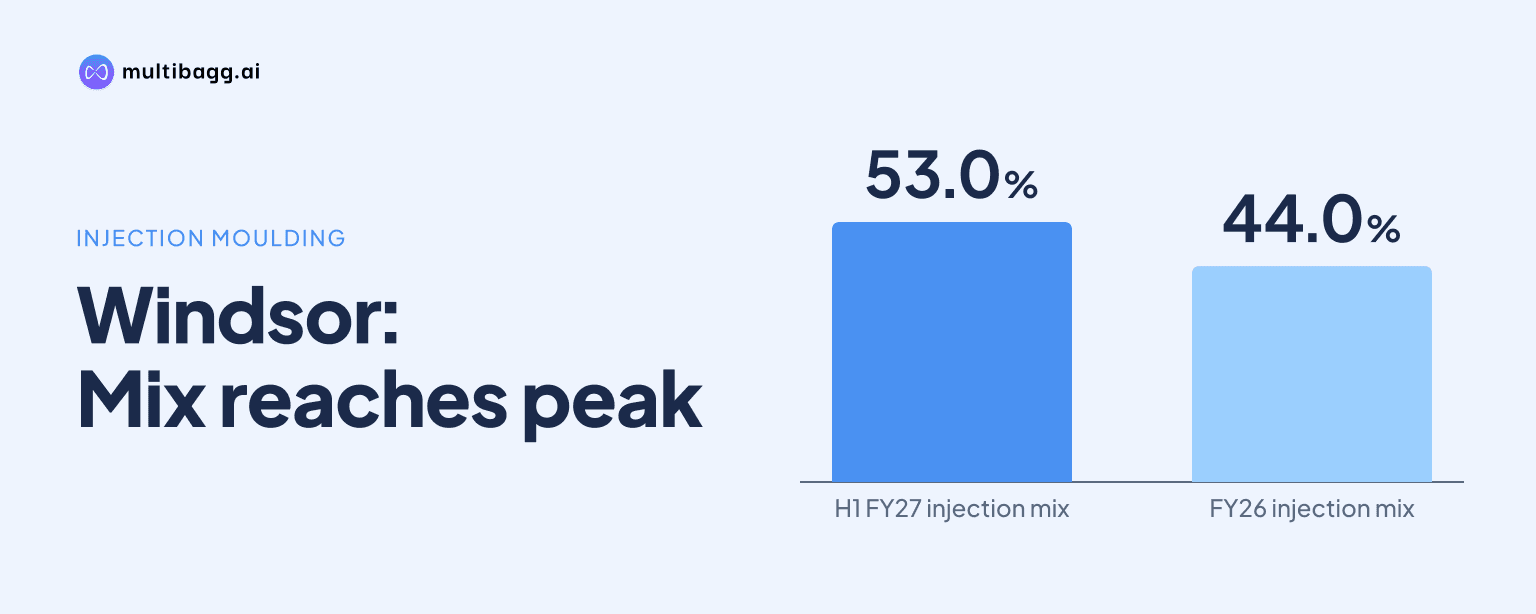
Windsor Machines Ltd. reported that injection moulding supplied 53.0% of first-half financial year 2027 revenue, while the division generated Rs 100.2 crore in Q2FY27, equal to a calculated 54.8% of revenue across its three disclosed divisions. The presentation also says a five-year anti-dumping duty on relevant Chinese and Taiwanese imports took effect in June 2025.
Know Windsor Machines inside out
Results, valuation, peers and who's buying, in one view.
How did Windsor injection moulding reach 55% of Q2FY27 revenue?
Windsor injection moulding accounted for a calculated 54.8% of Q2FY27 revenue across the three divisions disclosed in the presentation. The division reported Rs 100.2 crore, while computer numerical control machinery reported Rs 56.6 crore and extrusion machinery Rs 26.0 crore, producing a combined Rs 182.8 crore. The calculated proportion rounds to 55%, but Windsor did not publish a standalone Q2FY27 revenue-share percentage.
The reported first-half financial year 2027, or H1FY27, mix was 53.0%, up 9.0 percentage points from 44.0% in FY26. Injection moulding was therefore the largest of Windsor's reported divisions by H1FY27 revenue share, ahead of computer numerical control at 31.0% and extrusion at 16.0%. The presentation describes the division as making machinery that transforms plastic granules into discrete shapes through pressure and heat, with a focus on high-tonnage, energy-efficient machines made in India.
How did Windsor injection moulding perform in Q2FY27?
Windsor injection moulding revenue rose to Rs 100.2 crore in Q2FY27 from Rs 75.7 crore in Q1FY27 and Rs 39.9 crore in Q2FY26. Earnings before interest and tax, or EBIT, were Rs 8.8 crore in Q2FY27, compared with Rs 9.1 crore in Q1FY27 and a Rs 4.0 crore loss in Q2FY26. Its EBIT margin was 8.8%, down from 12.1% in Q1FY27 but above the negative 10.0% recorded a year earlier.
Annual revenue increased to Rs 252.8 crore in FY26 from Rs 190.9 crore in FY25, reversing declines from Rs 228.4 crore in FY23 to Rs 203.3 crore in FY24 and then FY25. However, FY26 EBIT fell to Rs 14.9 crore from Rs 22.6 crore in FY25, and the EBIT margin fell by 5.9 percentage points to 5.9%. The quarterly revenue sequence also shows Q2FY27 below the Rs 115.6 crore reported in Q4FY26.
What anti-dumping duty applies to Windsor's injection moulding market?
The presentation says anti-dumping duty applies for five years from June 2025 to injection moulding machines imported from China and Taiwan. The duty ranges from 0% to 63% of cost, insurance and freight, or CIF, value, depending on the producer. It applies to imported injection moulding machines rather than Windsor's entire machinery portfolio.
The policy was in force before Windsor reported Rs 252.8 crore of injection moulding revenue in FY26 and Rs 100.2 crore in Q2FY27. However, the presentation gives no import-volume, order-book, pricing or market-share data that quantifies its effect on Windsor. It therefore does not establish that the duty caused the division's 53.0% H1FY27 revenue share or its Q2FY27 revenue growth.
Windsor lists products across several applications, including KL two-platen machines rated from 350 tonnes to 3,200 tonnes and Sprint hydro-mechanical machines rated from 150 tonnes to 800 tonnes. Its WinFit series for pipe fittings is rated from 100 tonnes to 1,600 tonnes, while Excel and Armour toggle-type machines span 75 tonnes to 900 tonnes. The division identifies automotive, consumer goods, rigid packaging, construction and medical among its served industries.
Got a follow-up? Ask IRIS
How did Windsor injection moulding compare with other divisions?
Windsor injection moulding outpaced the other disclosed divisions in Q2FY27 revenue and EBIT. Its Rs 100.2 crore revenue exceeded computer numerical control machinery's Rs 56.6 crore and extrusion machinery's Rs 26.0 crore. Injection moulding EBIT was Rs 8.8 crore at an 8.8% margin, compared with Rs 2.8 crore at 5.0% for computer numerical control and Rs 0.1 crore at 0.5% for extrusion.
The mix changed from FY26, when injection moulding represented 44.0% of revenue, computer numerical control 33.1% and extrusion 22.9%. By H1FY27, injection moulding's share had increased by 9.0 percentage points, while computer numerical control declined by 2.1 percentage points and extrusion by 6.9 percentage points. In quarter-on-quarter terms, injection moulding revenue increased Rs 24.5 crore from Q1FY27, computer numerical control increased Rs 10.4 crore, and extrusion declined Rs 0.9 crore.
What operating capacity supports Windsor injection moulding?
Windsor shifted its injection moulding division from Chhatral to the integrated Rajkot facility in Q2FY26. The Rajkot site has current injection moulding capacity of 1,500 machines a year within total current capacity of 3,600 machines a year. The presentation says the overall site can be expanded to 8,400 machines a year, although it does not provide a timetable or division-specific allocation for that expansion.
The Chibhada, Rajkot facility consolidated four legacy plants into one location and is described as fully operational. It has more than 11 lakh square feet of constructed area, more than 36 acres of land and more than 800 skilled professionals. Current capacity also includes 1,800 computer numerical control machines and 300 machines classified as EMD, alongside the 1,500 injection moulding machines.
Windsor reported that its top 10 customer concentration was 20% in FY26, compared with 25% in FY25 and 18% in FY24. The presentation specifies that the FY24 and FY25 concentration figures cover only the injection moulding and extrusion divisions, limiting comparison with the FY26 figure across Windsor's expanded business structure. This disclosure does not identify individual customers or the division-level concentration within injection moulding.
Conclusion
Windsor's disclosures show that injection moulding became the largest reported revenue contributor in H1FY27, supported by Rs 100.2 crore of Q2FY27 revenue and a calculated 54.8% share of quarterly revenue across the three disclosed divisions. Revenue rose from both Q1FY27 and Q2FY26, while the Q2FY27 EBIT margin of 8.8% was below the preceding quarter's 12.1%.
The next disclosed matters to watch are use of the Rajkot facility's 1,500-machine annual injection moulding capacity and any progress toward the site's stated 8,400-machine expandable capacity. The five-year duty regime remains relevant through its stated term, but Windsor has not disclosed its impact on orders, pricing or market share.