










Windsor cuts standard-machine delivery time to 15–30 days
Key highlights
- Windsor says standard-machine delivery is now 15–30 days, down from two to three months.
- Windsor plans to increase annual machine capacity from 1,500 to 3,600 machines.
- Windsor has allocated Rs 310 crore of capital expenditure to expand its Rajkot facility.
- Windsor reported Q2FY27 revenue of Rs 182.8 crore and EBITDA of Rs 1.6 crore.
powered by IRIS
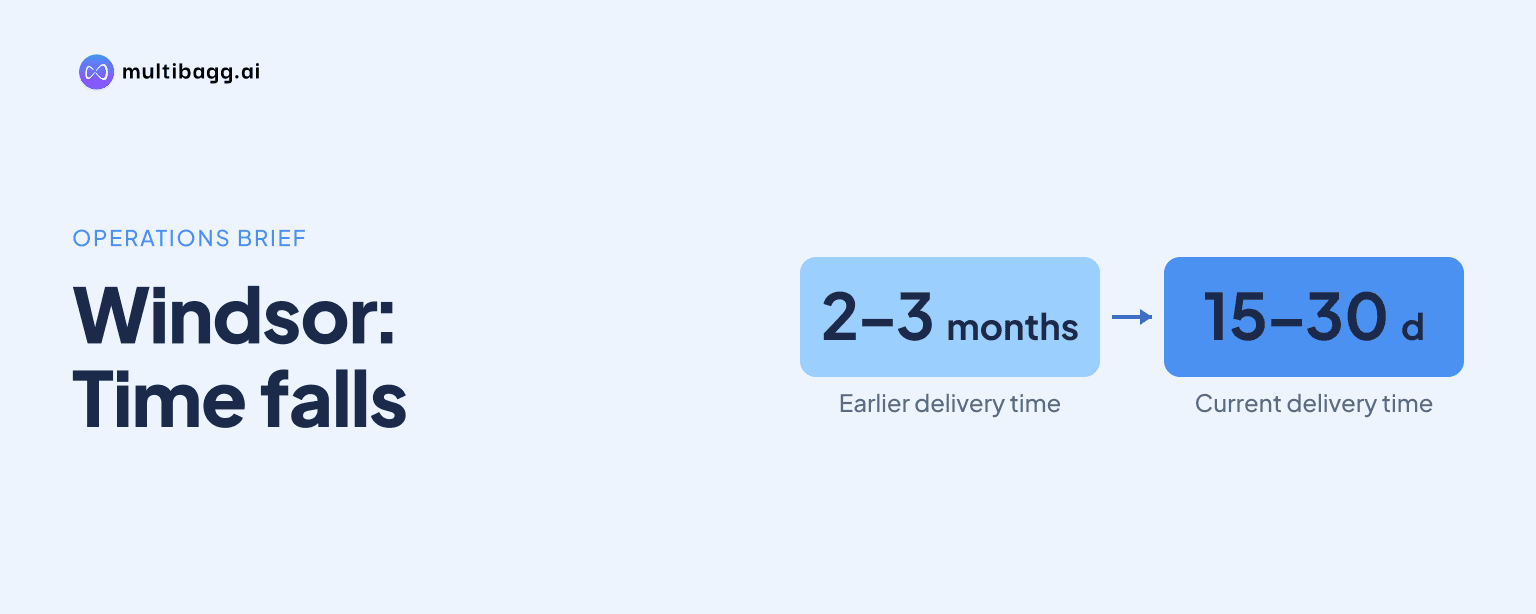
Windsor Machines Ltd. says its make-to-stock model has reduced delivery time for standard units to 15–30 days from two to three months, supported by an increase in annual machine capacity from 1,500 to 3,600 machines. Windsor is funding Rs 310 crore of Rajkot expansion capital expenditure through its concluded fund raise.
Know Windsor Machines inside out
Results, valuation, peers and who's buying, in one view.
How is Windsor reducing delivery time for standard machines?
Windsor is reducing delivery time for standard machines by holding ready stock under an agile make-to-stock model. The company says standard-unit turnaround time is now 15–30 days, compared with two to three months previously, and describes the stock as being available immediately.
The initiative applies to standard units rather than every machine configuration in Windsor’s portfolio. Its product range includes computer numerical control, or CNC, turning centres, vertical machining centres, special-purpose machines, injection-moulding machines, pipe-extrusion lines and blown-film lines, including injection-moulding machines of up to 3,200 tonnes.
Windsor says ready stock and shorter turnaround times are intended to improve service reliability and customer retention. Management also expects the increased capacity and improved delivery timeline to support higher penetration in core markets, although the presentation identifies this as an expected strategic impact rather than a reported result.
What capacity and funding support Windsor’s ready-stock model?
Windsor is expanding annual machine capacity to 3,600 machines from 1,500 machines, an increase of 2,100 machines. The company identifies enhanced operating scale as a source of cost efficiencies and links the additional capacity to its plan to keep standard units on shelf.
Windsor has allocated Rs 310 crore of incremental capital expenditure to expand its Rajkot facility, funded from its concluded fund raise. The presentation says moderate working-capital expansion to support growth is fully funded through that raise, but it does not split the Rs 310 crore between facility expansion and inventory.
Rajkot is Windsor’s integrated manufacturing facility, with sheet-metal forming, fabrication, an in-house paint shop and final assembly. The company presents these capabilities, alongside the 3,600-machine annual capacity target, as the manufacturing base for its existing products and the ready-stock approach.
What does Windsor disclose about working capital and margins?
Windsor discloses that the ready-stock plan requires moderate working-capital expansion, but it does not provide an inventory value, inventory-days measure or a period-on-period inventory comparison in the presentation. Its quantified disclosures are the Rs 310 crore Rajkot capital expenditure, the capacity increase to 3,600 machines and the 15–30-day standard-unit delivery period.
Management expects integrated manufacturing and higher capacity utilisation to deliver structural cost efficiencies and higher margins. That is a management expectation, not a reported margin improvement: Q2FY27 gross margin was 27.5%, up from 26.4% in Q1FY27 but below 29.5% in Q2FY26.
Windsor reported revenue from operations of Rs 182.8 crore in Q2FY27, compared with Rs 148.9 crore in Q1FY27 and Rs 136.6 crore in Q2FY26. Cost of goods sold rose to Rs 132.5 crore from Rs 109.5 crore sequentially, while earnings before interest, tax, depreciation and amortisation, or EBITDA, declined to Rs 1.6 crore from Rs 6.3 crore in Q1FY27 and Rs 8.5 crore in Q2FY26.
For H1FY27, revenue from operations increased to Rs 331.6 crore from Rs 250.0 crore in H1FY26, while EBITDA declined to Rs 7.9 crore from Rs 16.5 crore. EBITDA margin was 2.4% in H1FY27 versus 6.6% a year earlier, so the reported half-year figures show higher revenue alongside lower profitability before the stated cost benefits are reflected.
Got a follow-up? Ask IRIS
How does the ready-stock plan fit Windsor’s revenue mix?
Windsor’s ready-stock plan sits within a portfolio whose revenue mix has shifted toward injection moulding. Injection moulding contributed 55% of Q2FY27 revenue, up from 51% in Q1FY27 and 29% in Q2FY26, while extrusion represented 14%, down from 18% sequentially and 35% a year earlier.
CNC accounted for 31% of Q2FY27 revenue, unchanged from Q1FY27 and below 36% in Q2FY26. The changes show that injection moulding gained 26 percentage points of mix share year on year, while extrusion lost 21 percentage points, based on Windsor’s divisional revenue mix disclosure.
Windsor serves sectors including defence and aerospace, automotive and infrastructure with customised solutions, while the make-to-stock plan is specifically for standard units. The disclosed 15–30-day delivery range therefore does not establish a delivery commitment across all customised products or all three divisions.
How does Unitech add to Windsor’s product strategy?
Windsor acquired a 100% stake in Unitech Workholding Systems Pvt. Ltd. in February 2026, adding precision work-holding products including hydraulic fixtures, modular clamping elements, dies and tools. Unitech had developed more than 4,000 workholding fixtures, and Windsor says the acquisition enables bundled packages of machines, fixtures and tooling.
Unitech’s revenue increased to Rs 18.2 crore in FY26 from Rs 15.2 crore in FY25, following Rs 11.8 crore in FY24 and Rs 8.8 crore in FY23. It reported Rs 4.2 crore of revenue in Q1FY27 and Rs 5.0 crore in Q2FY27, while Windsor states that Unitech was consolidated from February 10, 2026.
The acquisition is separate from the ready-stock plan but forms part of Windsor’s stated strategy of expanding capacity for existing products while diversifying through acquisitions. Windsor says the bundled offering can create synergies with its CNC division and increase market share, which remains a stated strategic rationale rather than a quantified financial outcome.
Conclusion
Windsor has paired a make-to-stock model for standard units with a planned capacity increase of 2,100 machines a year, reducing its stated standard-machine delivery period from two to three months to 15–30 days. The approach is supported by Rs 310 crore of Rajkot expansion capital expenditure and a concluded fund raise that management says also funds moderate working-capital expansion.
The next reported measure to watch is whether higher capacity utilisation and integrated manufacturing deliver the margin improvement management expects. Windsor reported H1FY27 EBITDA of Rs 7.9 crore and a 2.4% EBITDA margin, against Rs 16.5 crore and 6.6% in H1FY26, while the presentation does not disclose inventory value or inventory days for the ready-stock model.