










Workmates says migrations can lift AWS margins to 20%
Key highlights
- Workmates said AWS represented 83% of its Rs 95.21 crore H1 FY27 revenue.
- Workmates disclosed AWS consumption margins of 8% to 12%, rising to 18% to 20% on large migrations.
- Recurring revenue rose 43% year on year to Rs 82.97 crore, equal to 87% of H1 FY27 revenue.
- Workmates reported a weighted H2 FY27 pipeline of Rs 110 crore, including large migration opportunities.
powered by IRIS
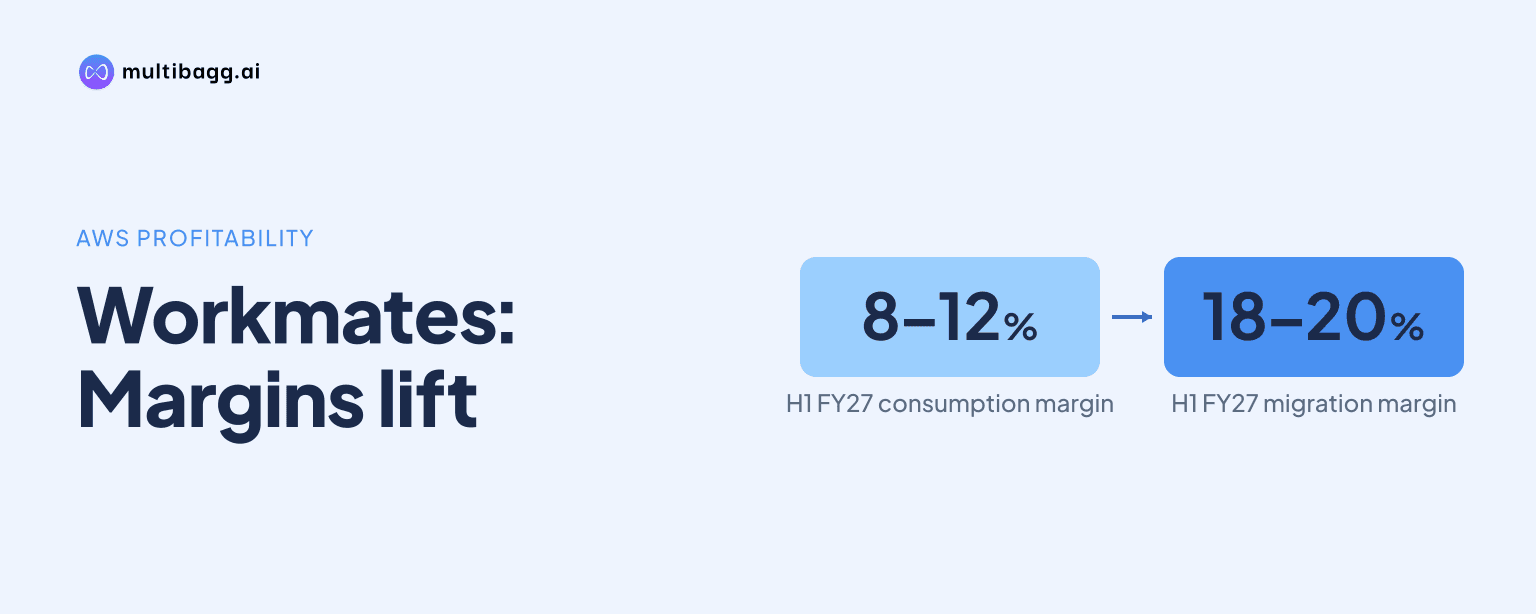
Workmates Core2Cloud Solution Limited said on November 5, 2026 that AWS consumption margins usually range from 8% to 12% but can reach 18% to 20% on large migrations, while AWS represented 83% of H1 FY27 revenue. Management said AI programmes, migration incentives and AWS-funded proofs of concept can add higher-value service work.
Know Workmates Core2cloud Solution inside out
Results, valuation, peers and who's buying, in one view.
How does Workmates make money from AWS consumption?
Workmates earns a margin embedded in AWS cloud consumption, supplemented by project and managed-service revenue. Management said AWS accounted for 83% of the Rs 95.21 crore consolidated revenue from operations reported in H1 FY27, while total services revenue accounted for about 17.5% of that base.
The services category includes project work and managed services, with security offerings spread across those lines. Management said security services form part of managed services, while security implementation and artificial-intelligence, or AI, implementation are included in project revenue. The call did not separately disclose the recurring-revenue share attributable solely to AWS resale or consumption.
Recurring revenue reached Rs 82.97 crore in H1 FY27, up 43% year on year and equal to 87% of total revenue, compared with 77% a year earlier. This increase reflects the company’s annuity model, but management said recurring income includes blended managed services and other value-added work alongside AWS-led consumption.
Why do Workmates migration deals have higher margins?
Workmates said standard compute consumption has a lower margin than AI, analytics and migration engagements that use newer AWS services or frontier models. Management put usual consumption margins at 8% to 12%, said large migrations can generate 18% to 20%, and added that AWS Migration Acceleration Program 2.0, or MAP 2.0, can produce higher economics without giving a maximum rate.
The difference stems from the implementation work surrounding a workload move, modernisation or AI deployment before recurring consumption begins. Project revenue was Rs 12.24 crore in H1 FY27, below a particularly strong H1 FY26 but 51% above H2 FY26. Management said project revenue is cyclical because billing and revenue recognition depend on project completion.
Management identified a large cloud migration for an existing non-banking financial company, or NBFC, and another large migration for a mid-sized global IT services and digital-transformation company in its H2 FY27 pipeline. Its H2 estimate of Rs 107 crore comprises Rs 95.4 crore of contracted recurring revenue, Rs 1.25 crore of new recurring business and Rs 10.35 crore of projects.
The company reported a weighted H2 pipeline of Rs 110 crore, alongside Rs 30 crore of new bookings signed in H1 across recurring and project work. A migration assignment can therefore create both an implementation phase with different economics and a subsequent stream of cloud-consumption and managed-service revenue, although Workmates did not quantify the margin on that later annuity revenue.
Got a follow-up? Ask IRIS
How do AWS programmes help Workmates sell AI services?
Workmates said AWS uses credits and programmes to encourage customers to adopt AI, including funding proofs of concept, or POCs, and minimum viable products, or MVPs. Management said AWS can pay for the company’s service effort in these cases, allowing a customer to test a use case before its cloud consumption starts.
Management did not disclose how much gross profit or earnings before interest, tax, depreciation and amortisation, or EBITDA, comes from AWS programme funding, migration credits or marketplace activity. It said marketplace revenue is currently very small, while programme support varies by technology, client and use case.
AI and cybersecurity together contributed about 5% of revenue at the time of the call. Workmates had six AI accelerators in live production, and management said VoxoRA and VerID had eight to 10 opportunities nearing finalisation. CloudTrustmate had been onboarded by about seven or eight customers and was under evaluation by other customers in India and abroad.
CloudTrustmate is designed for AI token allocation, cost optimisation, observability and guardrails. Enterprise AI Edge provides secure access to the OpenAI stack through Amazon Bedrock, and management said Bedrock gives access to more than 200 models. The OpenAI partnership supports model customisation and customer engagement, but Workmates did not assign it a separate revenue contribution.
What do AWS economics mean for Workmates reported margins and cash?
Workmates reported gross profit of Rs 31.92 crore in H1 FY27, up 24.8% year on year, at a gross margin of 33.5%. That was below the 34.3% recorded in FY26 but above the 31.2% in H2 FY26. Management said cloud consumption’s revenue share increased 72 basis points to 66.5% during the half.
EBITDA rose 24% to Rs 16.44 crore, while the EBITDA margin was 17.3%, compared with 17.7% a year earlier. Profit after tax increased 32.4% to Rs 12.03 crore and the profit-after-tax margin rose to 12.6% from 12.2% in H1 FY26. These results show that the movement in net margin differed from the year-on-year change in gross and EBITDA margins.
Cash conversion remains a stated management priority. Trade receivables rose to Rs 39.5 crore at the H1 FY27 end from Rs 28.99 crore in March, although debtor days declined to 62 from 64. Operating cash flow was negative Rs 4.7 crore, and management said collections were its main financial priority for H2.
Workmates said AWS payment terms are 30 days, while customer terms are generally 45 to 60 days. The company remained debt-free, with cash and liquid investments of Rs 43.88 crore after Rs 2.36 crore of capital expenditure and a Rs 2-per-share FY26 interim dividend. Accelerator-build costs are recorded as intangible assets and are planned to be amortised over five years.
Conclusion
Workmates’ disclosed AWS model combines recurring cloud consumption with project work that can carry different economics. The 8% to 12% consumption-margin range, and the 18% to 20% range cited for large migrations, explain management’s focus on migrations, AI adoption and programmes that can establish later consumption revenue. H1 FY27 recurring revenue of Rs 82.97 crore provides the largest component of the revenue base.
The next measures to watch are execution against management’s Rs 202 crore FY27 outlook, which is less than Rs 8 crore below its Rs 210 crore goal, and conversion of the Rs 110 crore weighted H2 pipeline. Management also plans to begin operations in the US and Middle East, while seeking to reduce debtor days and convert H1 profit into cash.