










WPIL Limited H1 standalone revenue fell 34.8% on execution
Key highlights
- WPIL’s standalone H1-FY27 revenue fell 34.8% year on year to Rs 232.8 crore.
- Standalone H1-FY27 PAT declined 66.4% to Rs 14.8 crore, while EBITDA fell 48.8% to Rs 32.5 crore.
- International revenue increased 38% to Rs 626 crore in H1-FY27, contrasting with domestic revenue of Rs 233 crore, down from Rs 357 crore.
- WPIL reported an international order book of around Rs 2,700 crore and total Project Division backlog of Rs 4,078.6 crore at H1-FY27.
powered by IRIS
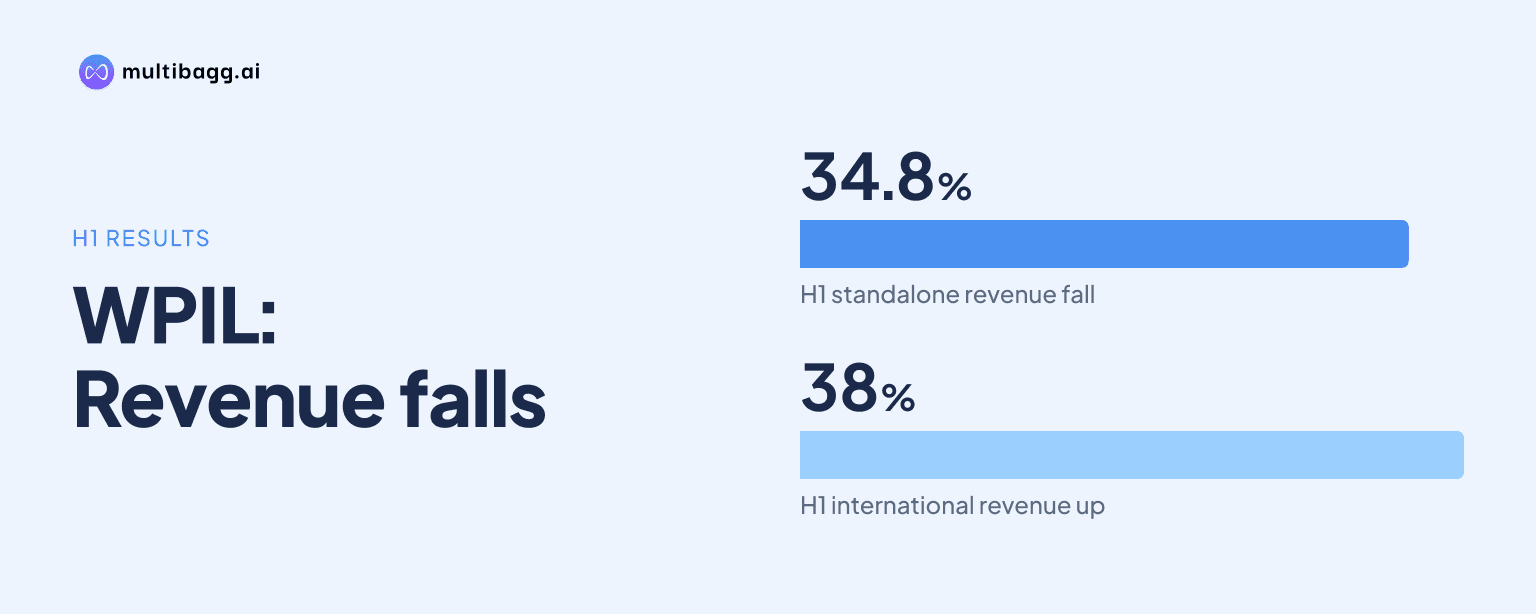
WPIL Limited reported standalone revenue from operations of Rs 232.8 crore in the first half of fiscal 2027 (H1-FY27), down 34.8% year on year, while profit after tax fell 66.4% to Rs 14.8 crore. WPIL attributed the domestic shortfall to subdued project execution and deferred customer dispatches, while management expects improvement in the second half of FY2027.
Know WPIL inside out
Results, valuation, peers and who's buying, in one view.
Why did WPIL’s standalone H1 revenue decline?
WPIL’s standalone revenue declined as domestic project execution remained subdued and clients deferred product dispatches. Domestic revenue was Rs 233 crore in H1-FY27, compared with Rs 357 crore in H1-FY26. Domestic Project Division revenue fell to Rs 99.8 crore from Rs 205.9 crore, while domestic Product Division revenue declined to Rs 133 crore from Rs 151.3 crore.
The quarterly split also showed lower domestic activity in the second quarter of fiscal 2027 (Q2-FY27). Domestic product revenue was Rs 61.7 crore, down from Rs 86.4 crore in Q2-FY26, and domestic project revenue was Rs 56.5 crore, versus Rs 89.5 crore. WPIL said a large number of Product Division dispatches had been deferred at clients’ end.
How much did WPIL’s standalone profitability decline?
WPIL’s earnings before interest, tax, depreciation and amortisation (EBITDA) fell 48.8% to Rs 32.5 crore in H1-FY27, a steeper reduction than the 34.8% revenue decline. EBITDA margin contracted by 382 basis points to 13.96% from 17.78%, as operating expenses decreased 31.8% to Rs 200.3 crore but did not fall as quickly as revenue.
Profit after tax (PAT) fell to Rs 14.8 crore from Rs 44 crore, and PAT margin reduced by 596 basis points to 6.36% from 12.32%. Profit before tax was Rs 20.1 crore, down from Rs 59.4 crore. Other income declined 69.4% to Rs 5.7 crore from Rs 18.6 crore, adding to the reduction in operating profit.
Depreciation increased 29.7% to Rs 4.8 crore in H1-FY27, while finance cost fell 30.0% to Rs 13.3 crore. Taxes declined to Rs 5.3 crore from Rs 15.4 crore as profit before tax decreased. Diluted earnings per share were Rs 1.52, compared with Rs 4.51 in H1-FY26.
Did WPIL’s Q2 standalone result improve from Q1?
WPIL’s Q2-FY27 standalone result improved sequentially from Q1-FY27, although it remained lower than Q2-FY26. Revenue increased 3.1% quarter on quarter to Rs 118.2 crore from Rs 114.7 crore, EBITDA rose 32.1% to Rs 18.5 crore from Rs 14 crore, and PAT increased 38.7% to Rs 8.6 crore from Rs 6.2 crore.
The year-on-year comparison remained negative. Q2-FY27 revenue was 32.8% below Rs 175.9 crore in Q2-FY26, EBITDA was 47.4% below Rs 35.2 crore, and PAT was 65.6% below Rs 25 crore. EBITDA margin rose to 15.65% from 12.21% in Q1-FY27, but was below the 20.01% recorded a year earlier.
Other income in Q2-FY27 was Rs 2.6 crore, down 73.7% from Rs 9.9 crore in Q2-FY26. Finance cost declined 24.0% to Rs 7.3 crore, while depreciation increased 26.3% to Rs 2.4 crore. These movements resulted in profit before tax of Rs 11.4 crore, compared with Rs 33.6 crore in the prior-year quarter.
Got a follow-up? Ask IRIS
How did international operations compare with domestic business?
WPIL said international revenue increased 38% to Rs 626 crore in H1-FY27 from Rs 458 crore in H1-FY26, in contrast to the domestic revenue decline to Rs 233 crore from Rs 357 crore. International project revenue more than doubled to Rs 303.3 crore from Rs 145.1 crore, while international product revenue increased to Rs 318.8 crore from Rs 302.4 crore.
The difference between domestic and international performance was also visible in consolidated results. Consolidated H1-FY27 revenue increased 6.3% to Rs 854.9 crore from Rs 804.6 crore, while consolidated PAT rose 19.5% to Rs 92.6 crore from Rs 77.5 crore. Consolidated EBITDA nevertheless decreased 5.4% to Rs 122.5 crore and its margin narrowed to 14.33% from 16.11%.
WPIL reported that MISA Italy completed legacy projects and booked orders during Q2-FY27, while PCI Africa started new projects. The company also cited a repeat Eigenbau order from Riverton Water Works and reported an international order book of around Rs 2,700 crore. These updates describe operations and orders rather than H1-FY27 standalone revenue.
What could support WPIL’s second-half recovery?
WPIL expects its domestic Project Division revenue to improve in the second half of FY2027 as projects are commissioned and operations and maintenance (O&M) work begins. Management said O&M revenue had started to pick up and could accelerate as more projects are commissioned, after domestic water-sector execution remained subdued during H1-FY27.
The disclosed backlog provides context for that plan. Product Division backlog at H1-FY27 was Rs 1,030.3 crore, split 47.9% domestic and 52.1% international, while Project Division backlog was Rs 4,078.6 crore, split 47.3% domestic and 52.7% international. WPIL also said the domestic Product Division order book had grown to nearly Rs 500 crore.
Conclusion
WPIL’s H1-FY27 standalone decline reflected lower domestic project revenue, deferred product dispatches and reduced other income. Revenue fell by Rs 124.3 crore year on year, EBITDA declined by Rs 31 crore and PAT decreased by Rs 29.2 crore, while international revenue growth supported the consolidated outcome.
The next measure is whether project commissioning translates the reported backlog into domestic revenue during the second half of FY2027. Management has identified accelerating O&M activity, improved domestic execution, resumed client dispatches and further PCI Africa momentum as the mechanisms behind its expected recovery, but the presentation does not provide a second-half revenue or profit target.