








WTi cabs targets 35–40% CAGR above mobility market forecasts
MAX Plan at ₹4,999/yr

Find your next multibaggerBe a Pro Investor
Research stocks and track your picks on the go. Download the app.
Key highlights
- WTi cabs targets a 35–40% revenue CAGR over five years.
- WTi cabs reported FY26 revenue from operations of Rs 826.50 crore, versus Rs 548.60 crore in FY25.
- WTi cabs cites 11% corporate-car-rental growth and 5.34% employee-transportation growth through 2030.
- WTi cabs plans to consolidate operations across more than 250 cities and cites 800-plus corporate clients.
powered by IRIS
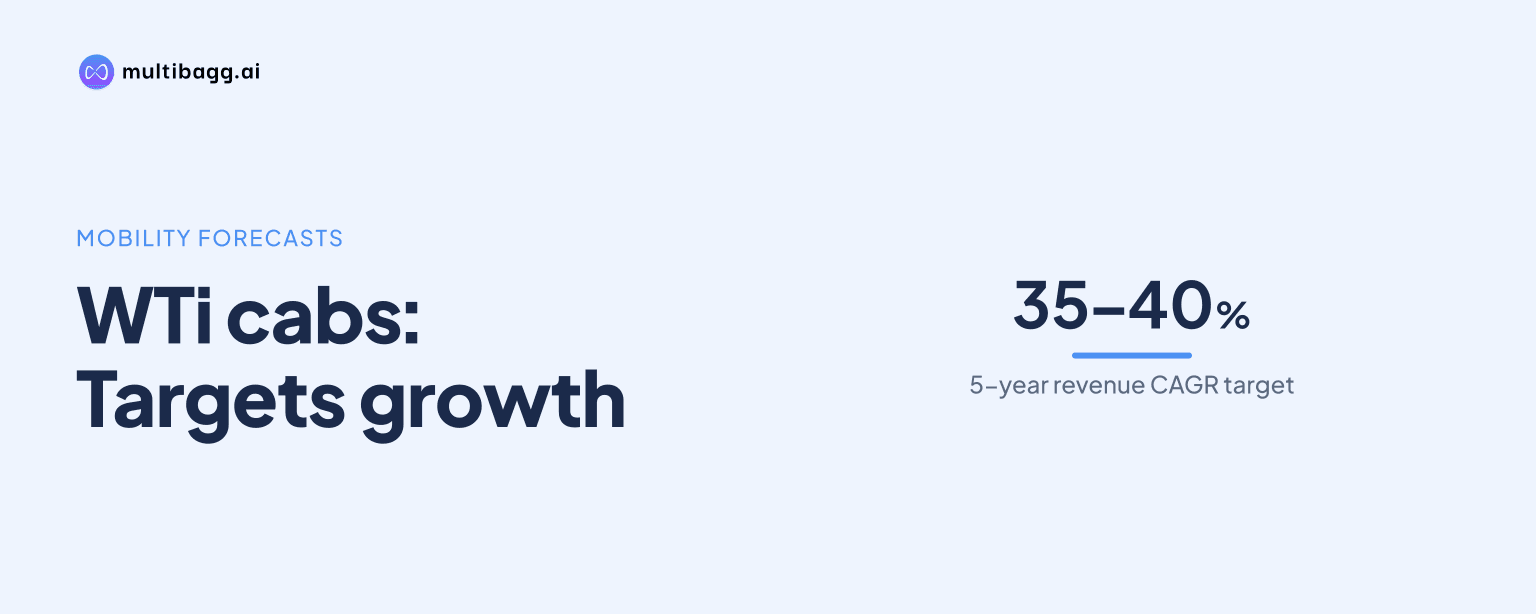
Wise Travel India Limited, referred to as WTi cabs, targets a 35–40% five-year revenue compound annual growth rate, compared with the presentation’s 11% corporate-car-rental and 5.34% employee-transportation forecasts through 2030. Its consolidated FY26 revenue from operations was Rs 826.50 crore, up from Rs 548.60 crore in FY25.
Know Wise Travel India inside out
Results, valuation, peers and who's buying, in one view.
Why is WTi cabs targeting 35–40% revenue CAGR?
WTi cabs says it aims to attain a 35–40% revenue CAGR through strategic investments in Employee Transportation Services, Car Rental Services and consolidation of operations across more than 250 cities. The company presents this as a five-year growth ambition rather than a forecast for a single financial year. Its stated objective is to establish a significant global presence while expanding its domestic operating network.
WTi cabs attributes its projected five-year growth outlook to customer acquisition and retention and cites relationships with more than 800 corporate clients across industries. The presentation does not disclose the revenue contribution, contract duration or retention rate of these customers. It identifies potential partnerships with global car-rental brands and market-share expansion as additional elements of the route management expects to use to pursue the 35–40% target.
Which market forecasts is WTi cabs seeking to exceed?
WTi cabs is seeking to grow faster than the two Indian mobility markets highlighted in its presentation: corporate car rental, projected to grow 11% annually, and employee transportation, projected to grow at a 5.34% CAGR through 2030. WTi cabs puts India’s corporate car-rental market at Rs 37,500 crore and forecasts Rs 70,000 crore by 2030. It estimates the employee-transportation market at Rs 3,00,000 crore, rising to Rs 3,60,000 crore by 2030.
At the low end, WTi cabs’s 35% target is 24 percentage points above the 11% corporate-car-rental forecast and 29.66 percentage points above the 5.34% employee-transportation forecast. The presentation does not provide annual revenue forecasts or a market-share target, so it does not establish how the company will achieve that difference. It does indicate that management expects growth to come from more than the underlying expansion of the two markets.
WTi cabs links the market opportunity to growth in corporate, commercial, hospitality and tourism activity. The presentation does not allocate the FY26 revenue of Rs 826.50 crore among corporate car rental, employee transportation or these demand categories. It therefore supports comparison of the 35–40% ambition with market forecasts, but not calculation of WTi cabs’s current share of either market.
Got a follow-up? Ask IRIS
Which services and operating tools support WTi cabs’s plan?
WTi cabs identifies Employee Transportation Services and Car Rental Services as its main strategic investment priorities. Its wider service-portfolio plan includes corporate leasing, premium mobility, electric-vehicle fleet solutions and international operations. The presentation describes these as high-margin verticals, although it does not disclose revenue, vehicle numbers or margins by service line.
WTi cabs also identifies technology as a mechanism for scaling its more than 250-city operation. The listed tools include Global Positioning System, or GPS, tracking; Internet of Things, or IoT, fleet tracking; app-based booking; automated billing and payments; route optimisation; and predictive maintenance. The presentation says route optimisation can produce 10–20% fuel-efficiency gains and that predictive maintenance is intended to reduce vehicle downtime, without quantifying WTi cabs’s current savings or deployment levels.
The company’s operating plan further includes electric-vehicle adoption, emission transparency and driver-welfare initiatives aligned with enterprise environmental, social and governance, or ESG, mandates. WTi cabs also plans to improve fleet mix, utilisation rates and capital efficiency across owned and partner networks. Its presentation cites a policy-driven 30% electric-vehicle penetration target by 2030, but does not set a company-specific electric-vehicle fleet target, capital-spending amount or electrification date.
How do WTi cabs’s financials frame the growth ambition?
WTi cabs reported higher revenue and earnings in FY26, which provides the latest annual base for its five-year target. Revenue from operations increased to Rs 826.50 crore in FY26 from Rs 548.60 crore in FY25 and Rs 410.60 crore in FY24. Earnings before interest, tax, depreciation and amortisation, or EBITDA, rose to Rs 93.60 crore in FY26 from Rs 53.60 crore a year earlier.
FY25-to-FY26 revenue increased by Rs 277.90 crore, while EBITDA increased by Rs 40 crore and profit after tax increased by Rs 6.10 crore. Return on equity rose from 14.0% in FY25 to 15.0% in FY26, and return on capital employed rose from 15.0% to 16.0%. The presentation does not reconcile the difference between the growth in EBITDA and profit after tax.
WTi cabs’s balance sheet was larger at H1FY27 than at FY26. Total assets increased to Rs 549.86 crore at H1FY27 from Rs 498.84 crore at FY26, while total equity rose to Rs 220.20 crore from Rs 201.44 crore. Cash and cash equivalents increased from Rs 68.20 crore to Rs 95.34 crore, and long-term borrowings rose from Rs 106.81 crore to Rs 117.32 crore; the presentation does not specify how these movements relate to the strategic investments behind the revenue target.
Conclusion
WTi cabs’s 35–40% five-year revenue CAGR objective is above the 11% corporate-car-rental and 5.34% employee-transportation growth rates it cites through 2030. Management’s stated path combines Employee Transportation Services, Car Rental Services, portfolio expansion, technology deployment and consolidation across more than 250 cities, using FY26 revenue of Rs 826.50 crore as the reported annual base.
The next disclosed execution points are the expansion of the 250-plus-city network and investments in corporate leasing, premium mobility, electric-vehicle fleet solutions, artificial-intelligence-led dispatch, predictive maintenance and smart pooling. WTi cabs has not disclosed annual revenue milestones, service-line targets or a company-specific electric-vehicle fleet objective, while the industry backdrop in its presentation includes a 30% electric-vehicle penetration target by 2030.

