








Supreme Engineering Limited targets higher Khopoli utilisation
MAX Plan at ₹4,999/yr

Find your next multibaggerBe a Pro Investor
Research stocks and track your picks on the go. Download the app.
Key highlights
- Supreme Engineering Limited’s Khopoli plant has 3,000 tonnes-per-annum capacity and reported utilisation of 10–15%.
- Management estimates Rs 500 crore of potential revenue at optimal utilisation of the Khopoli facility.
- Superalloys represented 67.8% of Q2FY27 value, up from 30.6% in Q1FY27.
- Defence accounted for 67.4% of Q2FY27 value, compared with 27.4% in Q1FY27.
powered by IRIS
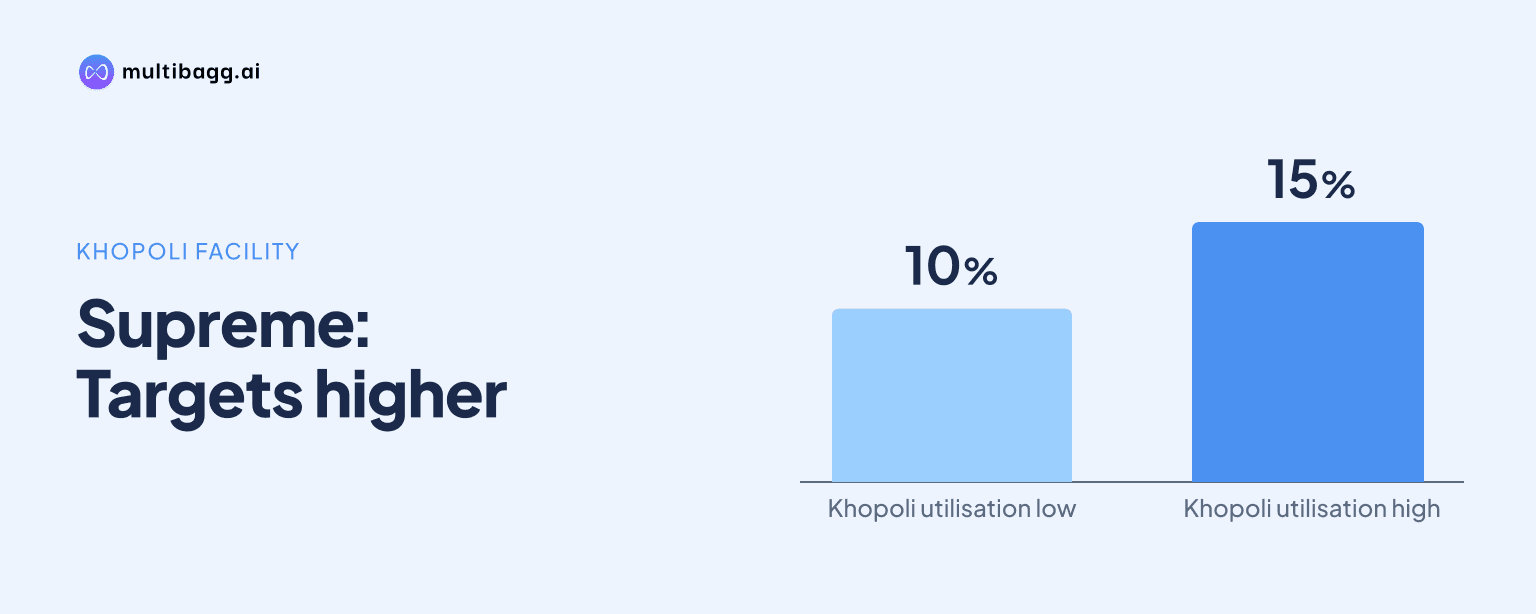
Supreme Engineering Limited is targeting higher utilisation from the Khopoli specialty-steel plant’s current 10–15% in FY27, with management estimating Rs 500 crore of potential revenue at optimal utilisation of its 3,000-tonnes-per-annum facility. The plan depends on repeat orders from existing approvals in defence, aerospace, nuclear and energy applications.
Know Supreme Engineering inside out
Results, valuation, peers and who's buying, in one view.
Why is Supreme Engineering Limited’s Khopoli plant the focus of the ramp-up?
Supreme Engineering Limited’s Khopoli Special Steels Division is the focus because the 3,000-tonnes-per-annum plant was operating at only 10–15% utilisation in the H1FY27 presentation. Established in 2008, the facility makes five product categories: superalloys, specialty steels, precipitation-hardening, or PH, and maraging steels, high-speed steels, and tool steels. Management estimates Rs 500 crore of potential revenue at optimal utilisation.
The Khopoli operation has a different role from Supreme Engineering Limited’s Rabale Wire Division, which has 4,000 tonnes per annum of installed capacity and primarily serves automotive and engineering applications. Khopoli’s stated product-realisation range is Rs 500 to Rs 35,000 per kilogram, showing that revenue depends on the grade and product mix as well as output volume. The presentation identifies more than 253 specialty-steel and superalloy grades across the business.
Supreme Engineering Limited’s stated FY27 priorities are to lift Khopoli utilisation, convert existing customer approvals into repeat orders and put fresh capital into working capital. This follows a restructuring period in which Bank of India approved a Rs 60.32 crore one-time settlement, which the company says it paid in full and for which it received a no-due certificate. The company also says shareholders approved a preferential issue of up to Rs 110.75 crore at Rs 2.60 a share.
How do approvals affect Supreme Engineering Limited’s capacity plan?
Supreme Engineering Limited says approvals govern the capacity ramp because aerospace, defence and other critical-sector qualification cycles take three to seven years. The process includes product-specific approvals, rigorous audits, technical capability and sustained investment, according to the presentation. Consequently, installing melting, remelting or finishing equipment does not by itself give a producer access to qualified customer programmes.
Supreme Engineering Limited reports AS9100D, an aerospace quality-management certification, and ISO 9001:2015 quality-management certification as already in place. It also cites more than 840 approved original equipment manufacturer, or OEM, and customer relationships. Named government and sovereign organisations include the Defence Research and Development Organisation, Hindustan Aeronautics Limited, Bharat Dynamics Limited, Nuclear Power Corporation of India Limited, Bhabha Atomic Research Centre and Bharat Heavy Electricals Limited.
The next qualification steps are plans, rather than completed milestones. Supreme Engineering Limited plans to pursue CEMILAC grade-specific qualification for Indian aerospace and defence programmes, and NADCAP approval for furnace operations and non-destructive testing. It also plans qualifications with global OEMs in aerospace and energy, while longer-term aerospace supply-chain opportunities are subject to facility upgrades; the presentation gives no completion dates for these actions.
Got a follow-up? Ask IRIS
Which products and sectors changed in Supreme Engineering Limited’s Q2FY27 mix?
Supreme Engineering Limited’s Q2FY27 value mix shifted substantially toward superalloys and defence compared with Q1FY27. Superalloys accounted for 67.8% of Q2FY27 value, up from 30.6% in Q1FY27. PH and maraging steels declined to 26.2% from 37.8%, while ultra-high-strength steels fell to 5.5% from 25.8%; these are value-mix data rather than disclosed production volumes.
Defence represented 67.4% of Q2FY27 value, compared with 27.4% in Q1FY27, while aerospace declined to 26.4% from 62.4%. Engineering and industrial applications increased to 5.0% from 3.2%, and oil and gas was 1.1% compared with 1.9%. The movement indicates a different quarterly sector concentration, with defence replacing aerospace as the largest disclosed end market.
Supreme Engineering Limited links its Khopoli products to specialised applications. Nickel superalloys, including Alloy 718, 625 and X-750, are listed for missile propulsion, aero-engine hot sections, gas turbines and nuclear use. PH and maraging grades such as 17-4PH, 15-5PH and Maraging 250/350 are listed for missile casings, gun barrels and space-launch structures, while 300M and AMS 6414 ultra-high-strength steels are listed for battle-tank parts and landing gear.
What financial evidence accompanied Supreme Engineering Limited’s Q2FY27 mix shift?
Supreme Engineering Limited reported Q2FY27 revenue from operations of Rs 5.79 crore, 42.21% above Rs 4.07 crore in Q1FY27. Earnings before interest, tax, depreciation and amortisation, or EBITDA, including other income, rose to Rs 1.11 crore from Rs 2.77 lakh. The EBITDA margin increased to 19.20% from 0.68%, with margins calculated on revenue from operations.
Profit before tax before exceptional items was Rs 37.77 lakh in Q2FY27, compared with a loss of Rs 70.64 lakh in Q1FY27. The presentation does not attribute the revenue increase specifically to a disclosed increase in Khopoli utilisation. However, the Q2 mix had superalloys at 67.8% and defence at 67.4% of value, compared with 30.6% and 27.4% respectively in Q1FY27.
For H1FY27, Supreme Engineering Limited reported revenue from operations of Rs 9.86 crore, down 27.18% from Rs 13.54 crore in H1FY26. H1FY27 EBITDA, including other income, was Rs 1.14 crore, up 84.76% from Rs 61.63 lakh, while the EBITDA margin rose to 11.55% from 4.55%. H1FY27 profit after tax was Rs 1.78 crore versus a Rs 57.58 lakh loss, although the first quarter included an exceptional item of Rs 2.46 crore.
Supreme Engineering Limited’s manufacturing process includes vacuum induction melting, electroslag remelting, radial forging and rolling, heat treatment and bright-bar finishing. Its stated dispatch controls cover chemical analysis, tensile, hardness and impact testing, ultrasonic and magnetic-particle inspection, metallurgical checks and heat-number traceability. The presentation does not disclose plant-level yield, rejection rates, capacity use by product family or an order book for Khopoli.
Conclusion
Supreme Engineering Limited has a 3,000-tonnes-per-annum Khopoli specialty-steel plant operating at 10–15% utilisation, making the conversion of customer qualifications into recurring demand central to its FY27 plan. Q2FY27 revenue rose 42.21% sequentially to Rs 5.79 crore, while superalloys reached 67.8% of value and defence reached 67.4%, changing the mix from the aerospace-led Q1FY27 quarter.
What to watch next is the company’s planned working-capital deployment, repeat-order conversion and progress toward CEMILAC, NADCAP and global OEM qualifications. Management’s Rs 500 crore potential-revenue estimate is explicitly linked to optimal Khopoli utilisation, but the presentation does not disclose a target date for that utilisation level, planned approvals or facility upgrades.

