










Supreme Engineering review flags unpaid dues and audit gaps
Key highlights
- Supreme Engineering's reviewer said TDS, provident fund, ESIC and professional-tax dues were overdue or short-paid at 30 September 2026.
- Supreme Engineering had not filed its income-tax audit report or income-tax return for FY 2020-21.
- Supreme Engineering had not conducted required cost audits from FY 2020-21 onward.
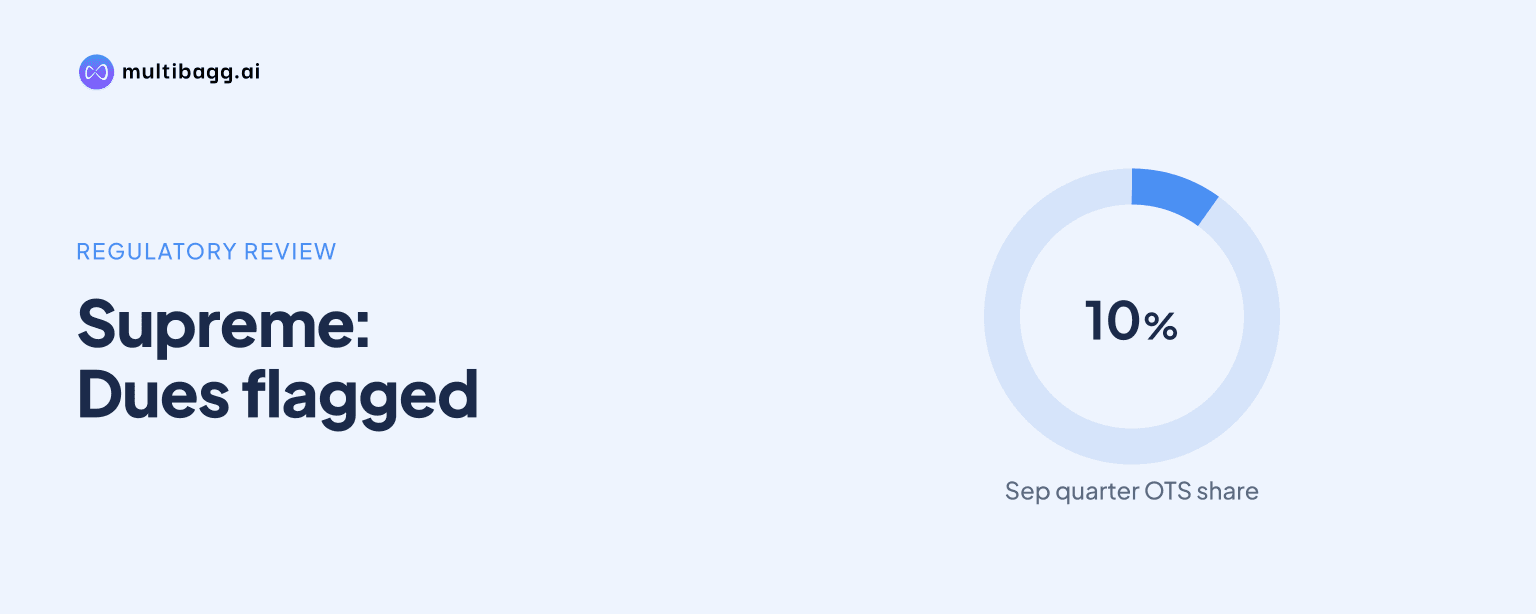
- Supreme Engineering completed its OTS payment on 11 November 2026 after depositing 10% of the proposed settlement amount during the September quarter.
powered by IRIS
Supreme Engineering Limited's limited review for the quarter ended 30 September 2026 flagged overdue statutory dues, an unfiled FY 2020-21 income-tax return and missing cost and internal audits, while its lender issued a no-due certificate after the company completed its One-Time Settlement on 11 November 2026.
Know Supreme Engineering inside out
Results, valuation, peers and who's buying, in one view.
Why did Supreme Engineering receive a qualified review?
Supreme Engineering received a qualified review because the reviewer identified unpaid statutory dues, incomplete income-tax compliance and missing statutory audit processes. Rushabh Davda & Associates issued its report on 14 November 2026 on the standalone unaudited results for the quarter ended 30 September 2026 under Regulation 33 of the Securities and Exchange Board of India, or SEBI, listing regulations.
The reviewer said that, other than the listed matters, nothing had come to its attention indicating that the statement was not prepared in all material respects under applicable Indian Accounting Standards. It conducted the work under Standard on Review Engagements 2410, which the report says is substantially narrower than an audit and therefore does not provide assurance that every significant matter would be identified.
Supreme Engineering told the National Stock Exchange on 14 November 2026 that its statutory auditor had issued reports with a qualified opinion on its unaudited financial results for the half year ended 30 September 2026. That exchange filing places the matters within the formal interim-results review rather than solely in management's disclosures.
What statutory dues remain unpaid at Supreme Engineering?
Supreme Engineering had not paid, or had short-paid, overdue statutory dues including tax deducted at source, provident fund, Employees' State Insurance Corporation contributions and professional tax as at 30 September 2026. The reviewer said related interest and penalties had remained unascertained and unaccounted for, without providing a rupee amount for either item.
The review also said Supreme Engineering had not filed its income-tax audit report and income-tax return for FY 2020-21. The supplied filing does not quantify the tax, interest or penalty exposure arising from that non-filing, so the financial effect cannot be calculated from the September 2026 results.
An independent company secretary's secretarial report had identified delays and non-compliances, whose effect Supreme Engineering presented as contingent liabilities. The review report does not state a rupee value for those contingent liabilities, and it also says the outcome of the company's income-tax and goods and services tax, or GST, litigation remains dependent on proceedings before various forums.
Which audit and accounting gaps did Supreme Engineering disclose?
Supreme Engineering had not conducted the cost audit required under Section 148 of the Companies Act, 2013 from FY 2020-21 onward, according to the review report. The report identifies this as a continuing compliance gap through the quarter ended 30 September 2026, rather than a matter confined to the current reporting period.
Supreme Engineering also had not carried out an internal audit for the previous financial year. The reviewer further said no records or evidence had been supplied to substantiate whether internal audits were conducted in years before the previous year, leaving the history of that control process unverified in the 14 November 2026 review.
The report separately identified long-outstanding trade receivables, trade payables, recoverable advances and borrowings, including cash-credit accounts, that had remained unsettled for a substantial period. Supreme Engineering's management said it had provided for expected credit losses on relevant assets under Indian Accounting Standards, but the reviewer also said interest on delayed payments to micro, small and medium enterprise, or MSME, vendors had not been provided.
Got a follow-up? Ask IRIS
Does Supreme Engineering's OTS settlement resolve these findings?
Supreme Engineering's One-Time Settlement, or OTS, resolved the specified lender borrowing after 30 September 2026, but the filing does not say it resolved the tax, statutory-dues, audit or MSME-interest matters. The lender approved the OTS proposal on 13 August 2026, and Supreme Engineering deposited an initial amount equal to 10% of the proposed settlement amount during the September 2026 quarter.
Supreme Engineering completed payment of the entire OTS amount on 11 November 2026, after the reporting date, and the lender issued a no-due certificate confirming settlement of the outstanding loan dues and discharge of the related liability. The secured loan account had been classified as a non-performing asset, or NPA, on 19 August 2021, after which the company discontinued repayment of principal and interest, according to the filing.
No gain from the OTS was recognised in the results for the quarter and half year ended 30 September 2026 because the financial liability was extinguished only after that date. Supreme Engineering said any gain, being the difference between the liability's carrying amount and settlement consideration, would be recognised in the quarter ending 31 December 2026 under Indian Accounting Standard 109 on financial instruments.
What does the going-concern warning mean for Supreme Engineering?
Supreme Engineering's reviewer said the company had incurred losses in prior years and that current liabilities exceeded total assets, resulting in negative net worth. Together with the NPA classification on 19 August 2021, those conditions created a material uncertainty that could cast significant doubt on Supreme Engineering's ability to continue as a going concern.
Management nevertheless prepared the 30 September 2026 results on a going-concern basis, citing reported profit and positive earnings before interest, depreciation and tax, or EBITDA, in the quarter. It also cited approval and subsequent completion of the OTS, while saying it had explored fund infusion, preferential allotment and asset monetisation to arrange funds needed to meet the settlement terms.
The reviewer said Supreme Engineering's continued operation remains dependent on generating sufficient cash flows from operations, improving its financial position and sustaining business operations. It said the ultimate outcome could not be determined with certainty when the September 2026 financial results were approved, despite the 11 November 2026 settlement and lender no-due certificate.
Conclusion
Supreme Engineering's September 2026 review combines a completed post-period bank settlement with unresolved compliance matters. The OTS discharged the disclosed lender liability on 11 November 2026, but overdue statutory payments, the FY 2020-21 tax-return issue, missing cost audits, absent internal-audit evidence, unprovided MSME interest and tax and GST litigation remained matters identified by the reviewer.
The next stated accounting event is the quarter ending 31 December 2026, when Supreme Engineering said it would recognise any OTS gain under Indian Accounting Standard 109. The filing leaves unresolved whether statutory dues will be paid, the FY 2020-21 return will be filed, required audits will be completed, and contingent tax and GST proceedings will be resolved.