










Xpro India doubles dielectric-film capacity to 8,000 MT annually
Key highlights
- Xpro India commissioned its Barjora dielectric-film line on March 27, 2026, doubling Indian nameplate capacity to 8,000 MT annually.
- Xpro India reported Q2 FY27 revenue of Rs 176.7 crore, up 47.4% year on year.
- Xpro India’s coextruded sheets and formed-products volumes increased 18% in H1 FY27.
- Xpro India said UAE equipment installation was nearly complete, with trials and utilities start-up in progress.
powered by IRIS
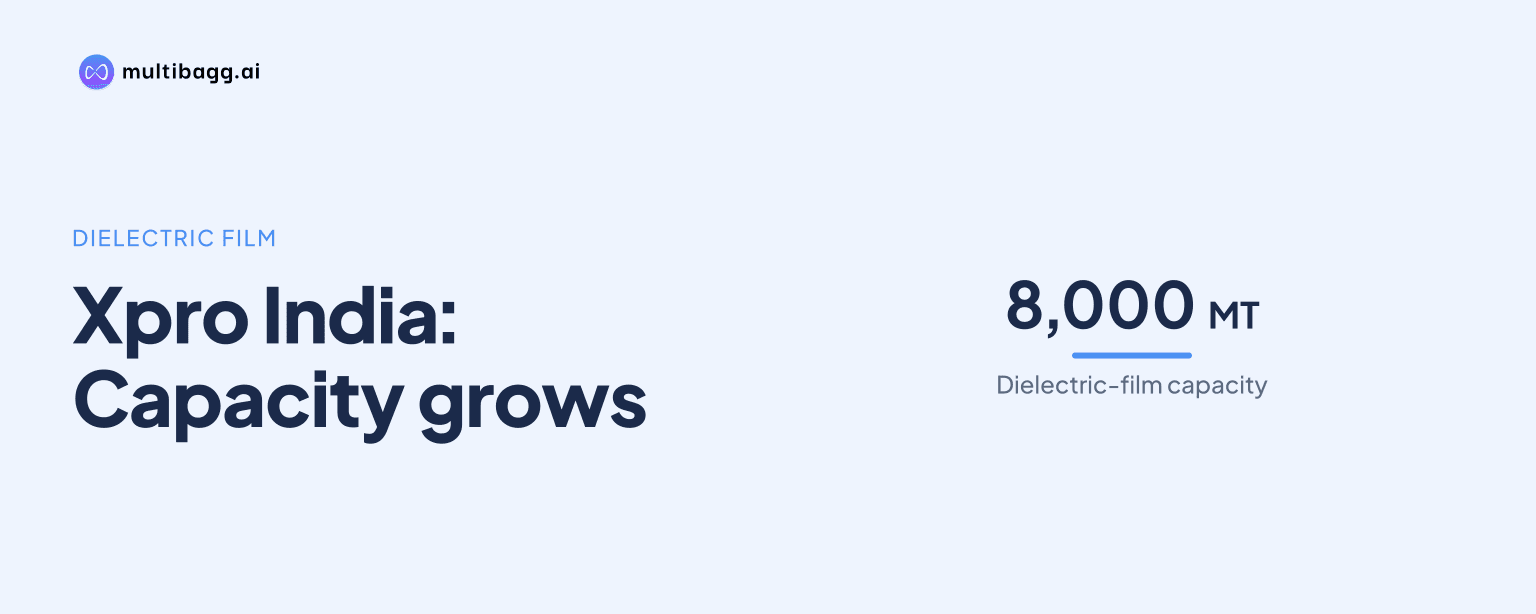
Xpro India Limited doubled Indian dielectric-film nameplate capacity to 8,000 metric tonnes (MT) annually by commissioning its Barjora line on March 27, 2026; as of the November 3, 2026 release, its UAE subsidiary had nearly completed key-equipment installation and was conducting sequential trials and utilities start-up.
Know XPRO India inside out
Results, valuation, peers and who's buying, in one view.
How did Xpro India reach 8,000 MT of dielectric-film capacity?
Xpro India reached 8,000 MT of annual Indian dielectric-film nameplate capacity by commissioning a new Barjora line on March 27, 2026. The company said this addition doubled capacity, indicating a pre-expansion Indian nameplate capacity of 4,000 MT annually when calculated from the disclosed doubling. Management described the investment as a step towards a globally scaled dielectric-films platform.
The Barjora line was operating in the quarter ended September 30, 2026, but its output was still being built up. Xpro India said recurring external power disruptions slowed the ramp-up during the quarter. The 8,000-MT figure is therefore installed nameplate capacity, rather than a disclosed production or utilisation level.
Customers in India and overseas responded well to initial Barjora supplies and moved on to commercial orders, according to Xpro India. The company also said it was advancing work on the full and enhanced product range for the new line. Ultra-thin and higher-end dielectric grades remained under customer validation in Q2 FY27, a process Xpro India identified as important for a richer product mix.
What is the status of Xpro India’s UAE plant?
Xpro India’s UAE dielectric-film operation had nearly completed mechanical installation of key production equipment as of November 3, 2026. Sequential equipment trials and utilities start-up were in progress at Xpro Dielectric Films FZ-LLC, the company’s UAE subsidiary.
Xpro India did not disclose a commissioning date, annual capacity, capital expenditure or revenue target for the UAE project. This contrasts with the Barjora expansion, for which it disclosed both the March 27, 2026 commissioning date and the resulting 8,000-MT annual Indian nameplate capacity.
Management said the UAE subsidiary was set to begin production shortly, but this is a forward-looking statement rather than a reported production start. The company also said the West Asia conflict situation remained fluid and was being closely monitored while installation work continued, leaving the timing of the remaining start-up steps unresolved.
How did Xpro India’s Q2 FY27 financial performance change?
Xpro India reported revenue from operations of Rs 176.7 crore in Q2 FY27, up 47.4% from Rs 119.9 crore in Q2 FY26. Operating earnings before interest, tax, depreciation and amortisation (EBITDA) rose 53.5% to Rs 16.4 crore in the quarter ended September 30, 2026.
Revenue increased 1.3% from Rs 174.4 crore in Q1 FY27, while operating EBITDA increased 7.1% from Rs 15.3 crore. Operating EBITDA margin rose to 9.3% from 8.9% a year earlier and 8.8% in Q1 FY27. Xpro India attributed higher average selling prices to cost pass-through and a favourable product mix, while noting higher input costs and supply-chain constraints in the first half.
For H1 FY27, the first half of fiscal 2027, revenue grew 32.6% to Rs 351.1 crore from Rs 264.8 crore in H1 FY26. Operating EBITDA rose 26.7% to Rs 31.7 crore, but its margin declined to 9.0% from 9.5%. Profit after tax increased 89.2% to Rs 19.3 crore from Rs 10.2 crore, and the profit-after-tax margin rose to 5.5% from 3.8%.
Got a follow-up? Ask IRIS
Which Xpro India businesses changed most in H1 FY27?
Xpro India said coextruded sheets and formed-products volumes increased 18% in H1 FY27, alongside what it described as a clear market-share gain. The company attributed the movement to execution, customer satisfaction and customer relationships, but did not provide separate revenue, capacity or profit data for this business.
Coextruded cast-films volumes were lower in H1 FY27 because of weak market conditions and competitive pressure. Xpro India said this business saw a strong revival in Q2 FY27 and remained focused on new-product development on its revamped manufacturing line. It did not quantify either the H1 volume decline or the Q2 recovery.
Dielectric films combined the March 2026 capacity addition with a market-development update. Xpro India said its domestic and export position strengthened, new customers continued to come on board, and new applications were in qualification. Commercial orders after initial Barjora supplies indicate customer progression, although the release gives no order values or line-utilisation figures.
What could affect Xpro India’s expansion plans?
Xpro India identified recurring external power disruptions as a constraint on the Barjora ramp-up in Q2 FY27. It also said the West Asia conflict pushed polymer prices up, while higher input costs and supply-chain constraints weighed on H1 FY27 operating EBITDA margin, which was 9.0% compared with 9.5% in H1 FY26.
The company said the West Asia conflict remained fluid while the UAE facility progressed through equipment trials and utilities start-up. This matters because the UAE project has no disclosed commissioning date or capacity figure, and because polymer-price and supply-chain conditions were already affecting the operating environment in the six months ended September 30, 2026.
Customer validation remains an unresolved step for ultra-thin and higher-end dielectric grades. Xpro India said these grades were under validation but did not disclose expected approval dates, volumes or revenue effects. Its safe-harbour statement also identified industry conditions, political and economic developments, exchange rates, technological change, investment, cash flow and interest costs as factors that could affect forward-looking outcomes.
Conclusion
Xpro India’s Barjora commissioning doubled Indian dielectric-film nameplate capacity to 8,000 MT annually while Q2 FY27 revenue rose 47.4% year on year to Rs 176.7 crore. The expansion is supported by commercial orders following initial supplies and by stronger stated dielectric-film market positioning, but installed capacity has not yet translated into disclosed production volumes or utilisation.
The next disclosed operating milestones are continued Barjora output build-up, customer validation of ultra-thin and higher-end grades, and sequential equipment trials and utilities start-up at the UAE subsidiary. Management’s progress on these steps, together with power reliability, the West Asia conflict, polymer prices and supply-chain conditions, will determine how quickly the expansion moves toward production.