










Arisinfra’s exclusive capacity reaches 11.7 million tonnes
Key highlights
- ARIS had 11.7 million tonnes a year of exclusive reserved capacity at 30 September 2026.
- Chennai accounted for 4.72 million tonnes of ARIS capacity, ahead of Mumbai’s 3.67 million tonnes.
- Aggregates represented 7.33 million tonnes, or 63%, of capacity across 23 partner plants.
- Reserved capacity increased by 2.6 million tonnes from 9.1 million tonnes on 30 June 2026.
powered by IRIS
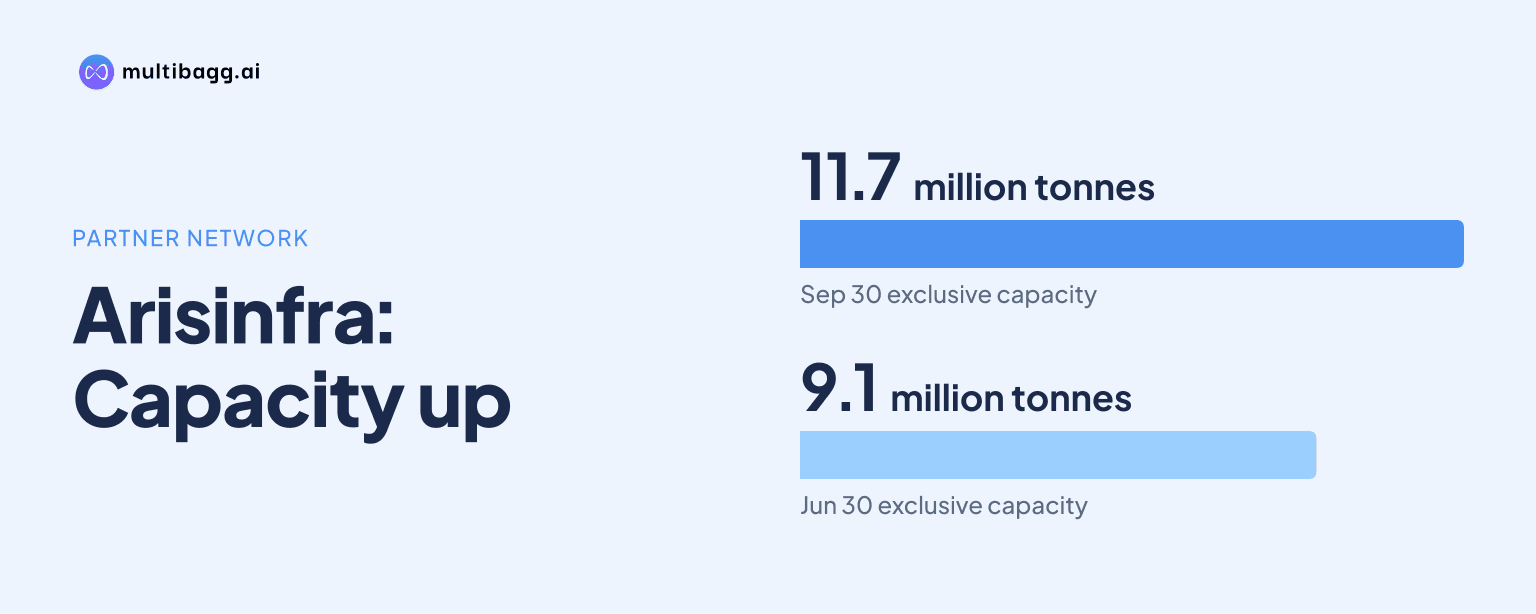
Arisinfra (ARIS) had 11.7 million tonnes a year of exclusive contract-manufacturing capacity at 30 September 2026, up from 9.1 million tonnes on 30 June 2026. Chennai accounted for the largest 4.72 million tonnes, while the 23-partner-plant network supplied aggregates, ready-mix concrete and asphalt/bitumen across four end markets.
Know Arisinfra Solutions inside out
Results, valuation, peers and who's buying, in one view.
How is ARIS’s 11.7 million-tonne capacity distributed across markets?
ARIS’s 11.7 million tonnes of annual reserved capacity was led by Chennai at 4.72 million tonnes and Mumbai at 3.67 million tonnes as of 30 September 2026. Together, these two markets represented about 72% of the stated network, compared with 2.17 million tonnes in Bengaluru and 1.15 million tonnes in Jharkhand. The presentation defines a market as the end market served.
Chennai’s capacity exceeded Mumbai’s by 1.05 million tonnes, establishing it as ARIS’s largest disclosed market. Bengaluru had less than half of Chennai’s capacity, while Jharkhand’s 1.15 million tonnes matched the network-wide capacity assigned to asphalt/bitumen. The figures show that capacity was concentrated in Chennai and Mumbai, with smaller allocations in Bengaluru and Jharkhand.
What products and plants make up ARIS’s contract-manufacturing network?
ARIS’s 23 exclusive partner plants were split between nine aggregates plants, 11 ready-mix concrete plants and three asphalt/bitumen plants at 30 September 2026. Aggregates represented 7.33 million tonnes a year, or 63% of total capacity, making it the largest category by capacity despite having two fewer plants than ready-mix concrete.
Ready-mix concrete accounted for 3.22 million tonnes, or 27%, from 11 plants, the highest plant count among the three products. Asphalt/bitumen accounted for 1.15 million tonnes, or 10%, from three plants. The disclosed mix indicates that plants were not uniform in capacity, as aggregates had more than twice the capacity of ready-mix concrete from fewer sites.
The three contract-manufacturing products sit within ARIS’s wider business-to-business materials range. Its structural offering includes steel, cement, blocks and shuttering ply; its services category includes electricals, plumbing and heating, ventilation and air conditioning; and its finishes range includes tiles, sanitaryware, paints and laminates.
Got a follow-up? Ask IRIS
How quickly did ARIS expand reserved capacity and contract-manufacturing revenue?
ARIS added 2.6 million tonnes of reserved capacity between 30 June and 30 September 2026, taking the network from 9.1 million tonnes to 11.7 million tonnes. The company states that 100% of the September capacity was exclusive to ARIS, meaning the figure refers to output reserved at partner plants rather than general access to third-party production.
Management reported 309% contract-manufacturing revenue growth from financial year 2024 to financial year 2026. The presentation does not provide revenue in rupees for either period, so the disclosed growth rate cannot be converted into revenue per tonne or used to measure capacity utilisation. The capacity comparison covers three months in 2026, whereas the revenue comparison covers FY24 to FY26.
ARIS does not disclose production volumes, utilisation, product-level prices or product-level revenue for the 11.7 million-tonne network on these pages. The available data therefore show an increase in reserved annual capacity and a separate multi-year revenue-growth measure, but not the level of output produced from each product category.
How does contract manufacturing fit ARIS’s wider supply model?
ARIS presents contract manufacturing as an asset-light model in which exclusive capacity is secured through partner plants rather than owned plants. Its illustrative industry-model comparison says ARIS combines multi-category materials supply, exclusive manufacturing capacity, Developer as a Service (DaaS) and proprietary technology. The company reported more than 2,300 vendors, 23 partner plants and more than 3,560 customers as of 30 September 2026.
ARIS’s in-house system links pricing, deliveries, credit and ecosystem management for the supply model. The company reported 3.6 lakh deliveries on the system, more than 14 lakh digitised documents and 64% of delivery documents auto-created as of 30 September 2026. It also reported that the system managed more than 5,860 customers and vendors.
DaaS can create a route for materials demand because ARIS states that every project under this model buys materials from ARIS. At 31 October 2026, its live DaaS order book was Rs 2,817 crore of gross development value across 15 projects, compared with 10 projects at 30 June. Gross development value is the expected sale value of projects under mandate, not ARIS revenue.
Conclusion
ARIS expanded exclusive contract-manufacturing capacity to 11.7 million tonnes a year by 30 September 2026, adding 2.6 million tonnes in three months. Aggregates supplied 7.33 million tonnes of the total, while Chennai supplied 4.72 million tonnes, showing that both product capacity and market capacity were concentrated in specific parts of the 23-plant partner network.
The next data point to watch is whether ARIS discloses utilisation, output or product-level revenue for the added 2.6 million tonnes, which are not provided in the presentation. Execution of the 15 DaaS projects, with Rs 2,817 crore of gross development value at 31 October 2026, is also relevant because ARIS says those projects purchase their materials from the company.