










Zelio H1 revenue more than doubles; profit outpaces sales
Key highlights
- Zelio reported Rs 296.66 crore of consolidated H1 FY27 revenue, about 95% of FY26 revenue of Rs 314 crore.
- Zelio's H1 FY27 profit after tax was Rs 31.39 crore, while EBITDA margin increased to 13.6% from 12%.
- Zelio's borrowings were Rs 44.82 crore and debt-to-equity rose to 0.31 times from 0.18 times in March.
- Zelio had four plants with annual installed capacity of 3.12 lakh units after Patan began production on October 28, 2026.
powered by IRIS
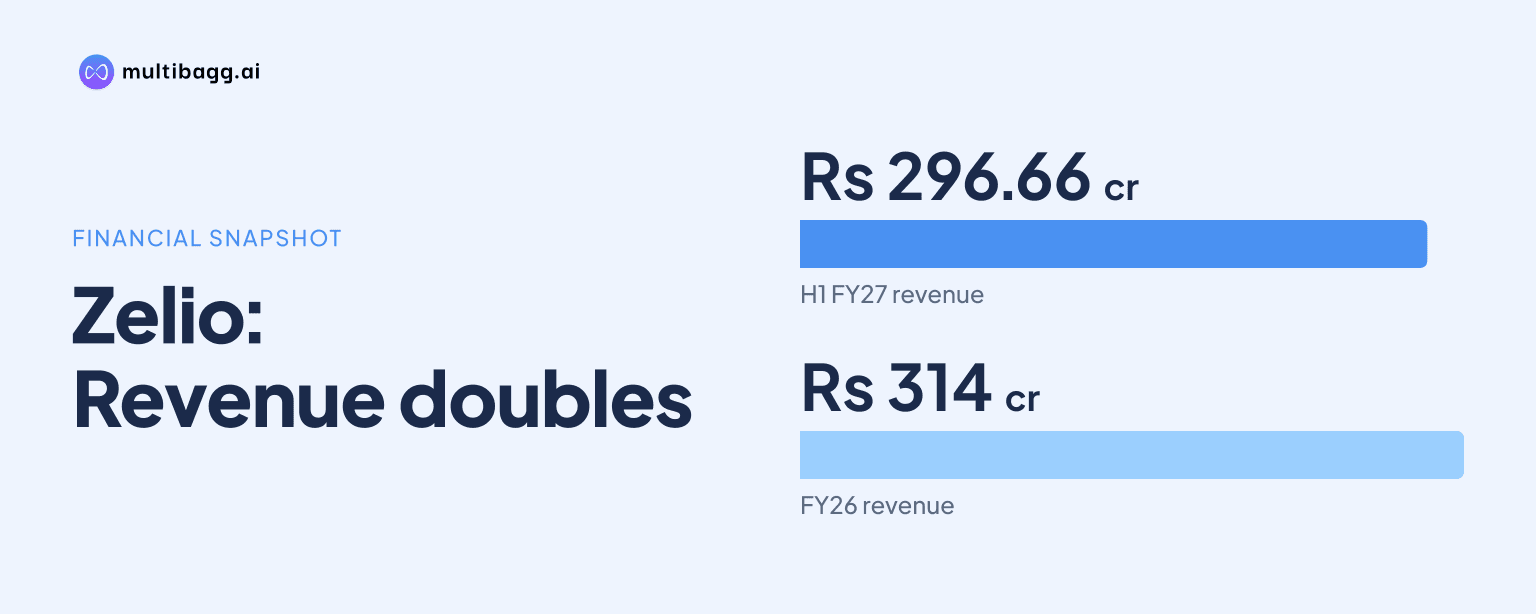
Zelio E-Mobility Limited reported Rs 296.66 crore of consolidated revenue for the six months ended September 30, 2026, more than double the prior-year period, while profit after tax of Rs 31.39 crore rose faster than sales and borrowings reached Rs 44.82 crore after inventory and supplier advances increased working-capital needs.
Know Zelio E-Mobility inside out
Results, valuation, peers and who's buying, in one view.
How fast did Zelio grow in H1 FY27?
Zelio grew consolidated revenue to Rs 296.66 crore in H1 FY27, which management said was more than twice the corresponding prior-year period and about 95% of FY26 revenue of Rs 314 crore. The six-month result therefore approached the sales recorded across the preceding full financial year.
Profit increased faster than revenue. Earnings before interest, taxes, depreciation and amortisation, or EBITDA, were Rs 40.49 crore, and EBITDA margin rose to 13.6% from 12% in the prior-year first half. Profit after tax was Rs 31.39 crore, more than 2.5 times the prior-year first-half figure, while earnings per share of Rs 14.84 equalled 98% of FY26 earnings per share, according to management.
Which products and businesses drove Zelio's sales?
Zelio's low-speed scooters remained its largest sales contributor in H1 FY27. Management said the company sold more than 62,000 two-wheelers in the six months, compared with more than 70,000 two-wheelers during all of FY26, while around 600 e-rickshaws were sold versus 650 in FY26.
Zelio reported standalone revenue of Rs 289.10 crore and standalone profit after tax of Rs 30.53 crore for H1 FY27. Its subsidiary, Zelio Auto Components, added Rs 7.56 crore of revenue and remained profitable. Management did not provide a product-level revenue split or quantify how much growth came from volume rather than pricing.
Management said the average scooter stock-keeping-unit price had increased from about Rs 45,000 to about Rs 48,000 to Rs 50,000 because of higher raw-material and metal prices. High-speed scooters are currently a smaller portion of sales than low-speed scooters, although Zelio plans to launch high-speed models during the financial year.
Why did Zelio's borrowings and working-capital needs rise?
Zelio's borrowings rose to Rs 44.82 crore because it built inventory and paid advances to suppliers before the festive season and to supply newer plants. Management said these actions made operating cash flow negative during H1 FY27, separating the cash-flow outcome from the period's Rs 31.39 crore reported profit after tax.
Debt-to-equity increased to 0.31 times at September 30, 2026, from 0.18 times in March, while net worth rose from Rs 111.5 crore to Rs 142.9 crore. Finance cost was about Rs 1 crore for the half. The increase in the ratio shows borrowings rose relative to equity despite the higher net-worth base.
Management said receivables were below six days of sales because dealers pay in advance. It expects working capital to ease as seasonal inventory converts into second-half sales and said it would report on the position in the next earnings call; that expectation is management's outlook rather than a reported cash-flow result.
Got a follow-up? Ask IRIS
How is Zelio expanding production capacity and dealer reach?
Zelio had four plants with installed annual capacity of 3.12 lakh units after the Patan facility began commercial production on October 28, 2026. Management said the company had one plant and annual capacity of 72,000 units 18 months earlier, marking a substantial expansion of its manufacturing footprint.
The Patan plant adds 72,000 units of annual capacity, comprising 48,000 two-wheelers and 24,000 three-wheelers, with investment of more than Rs 20 crore. Management said it was funded partly with initial public offering proceeds in line with the issue objects and partly through internal accruals, and that future three-wheelers would be made in-house there.
Utilisation varied across older and newer facilities. Management put Hisar at about 70% to 80%, Odisha at about 50%, and Coimbatore at about 30% because dealer development was continuing in that region. Zelio had more than 400 dealers in more than 25 states and is targeting more than 550 dealers; management expects Patan utilisation to reach about 80% within two years.
What is Zelio targeting for the full year?
Zelio is targeting more than 1.25 lakh units, more than 550 dealers, new high-speed models and revenue growth of 75% to 80% for the full year. These are management targets and plans, not reported outcomes. Management also said it would not pursue volumes at the cost of profitability.
The targets follow FY26 revenue of Rs 314 crore, above management's earlier range of Rs 260 crore to Rs 280 crore. Management said the Cuttack plant started production in February 2026 and Coimbatore followed in July 2026. It also said a monitoring-agency report filed for the September quarter showed no deviation in the use of initial public offering proceeds.
Shareholders approved a preferential issue of about Rs 168 crore in the month before the November 14, 2026 call. Management said the funds are intended mainly for research and development, backward integration, added capacity and production lines, with a meaningful part involving promoter warrants. The call did not provide a timetable or project-by-project allocation for the capital.
Conclusion
Zelio's H1 FY27 performance combined more-than-doubled revenue, a 1.6-percentage-point increase in EBITDA margin and profit growth that exceeded sales growth. At the same time, the build-up of inventory and supplier advances turned operating cash flow negative, lifted borrowings to Rs 44.82 crore and raised debt-to-equity to 0.31 times from 0.18 times in March.
The next results will indicate whether seasonal stock converts into sales and whether working capital eases as management expects. Investors can also watch progress toward more than 1.25 lakh units, more than 550 dealers, the high-speed model launches, Patan's two-year utilisation target and the stated 75% to 80% full-year revenue-growth target.